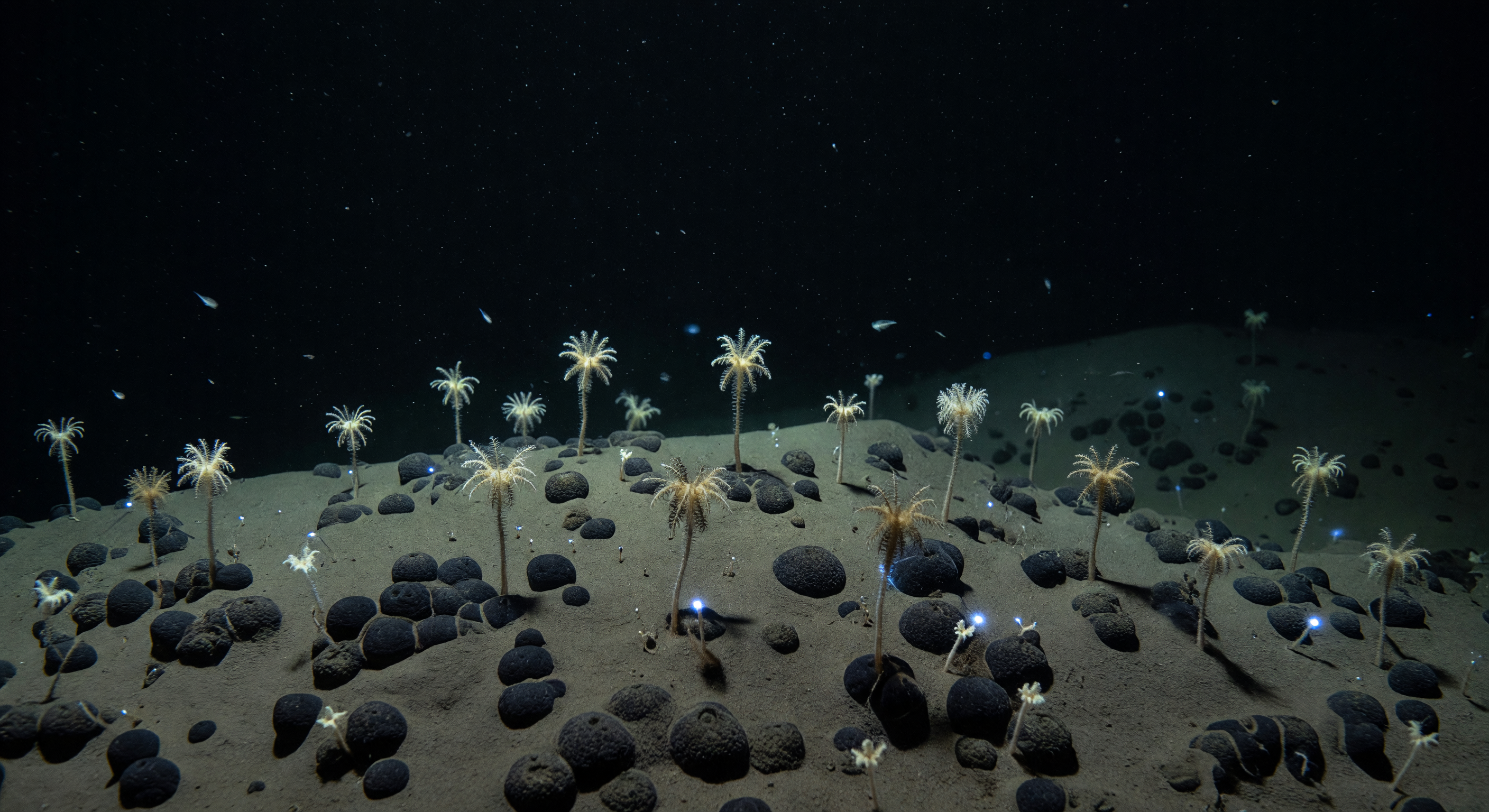
At roughly five kilometers beneath the surface of the equatorial Pacific, the abyssal plain of the Clarion–Clipperton Zone stretches away in every direction as a near-featureless expanse of pale grey-brown siliceous mud, broken only by the black, rough-surfaced manganese nodules that have been accreting, grain by imperceptible grain, for millions of years — growing at rates measured in millimeters per million years under pressures exceeding 500 atmospheres. From the surfaces of several of these nodules, stalked crinoids — living relatives of forms preserved in Paleozoic rock — rise on slender calcite stems, holding their pinnule-fringed arms in a delicate radial crown that filters passing organic particles from water barely above freezing, water that has not seen sunlight since it sank in polar seas centuries ago. Faint bioluminescent pulses — blue-cyan flickers from drifting plankton invisible except in that cold instant of self-illumination — briefly trace the curvature of a nodule, rim the translucent edges of a crinoid arm, and then vanish, leaving the sediment to its velvet silence and the slow, continuous drift of marine snow settling down from the sunlit world impossibly far above. This is one of the most extensive and least disturbed benthic ecosystems on Earth, where biomass is extraordinarily sparse but biological diversity is surprisingly high, each organism an evolutionary solution to perpetual darkness, crushing pressure, oligotrophic scarcity, and the cold patience of geological time.
Polymetallic nodule fields