Scientific confidence: High
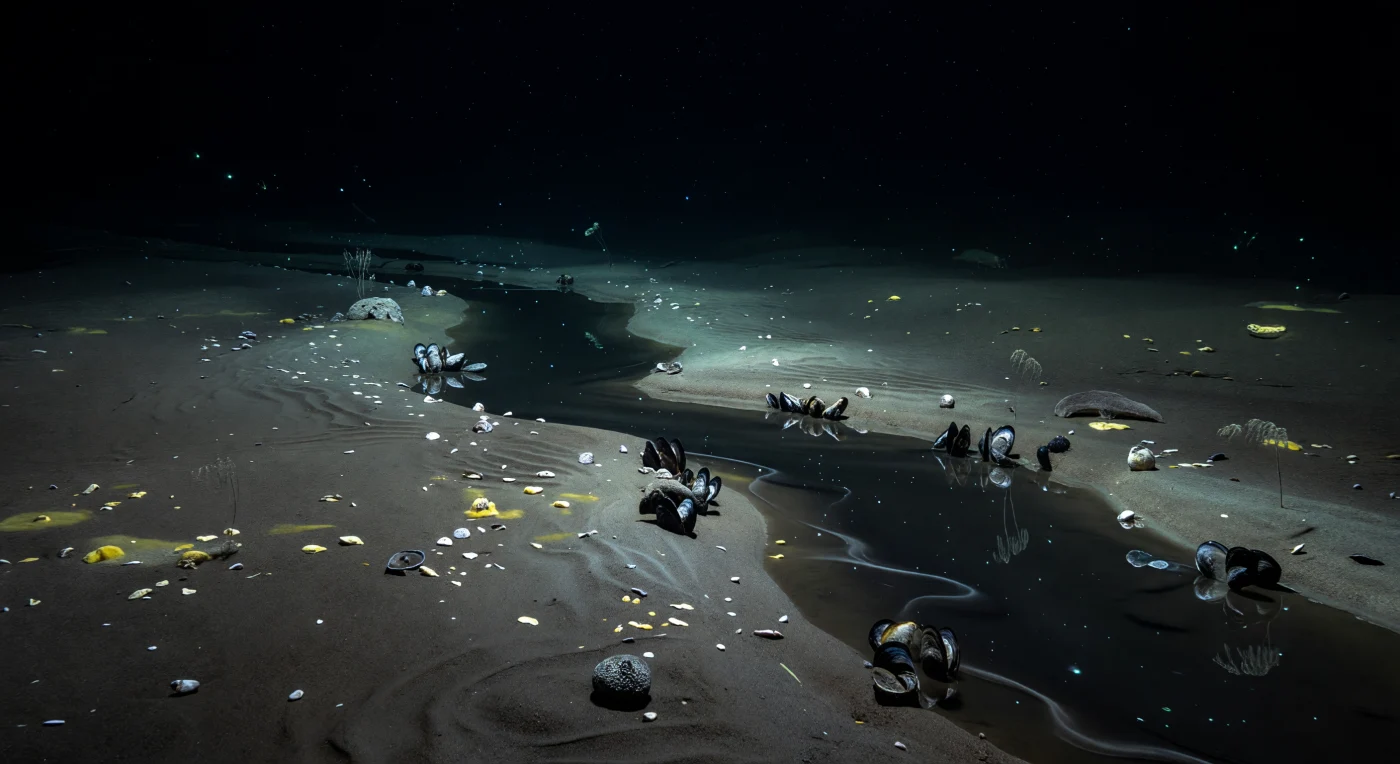
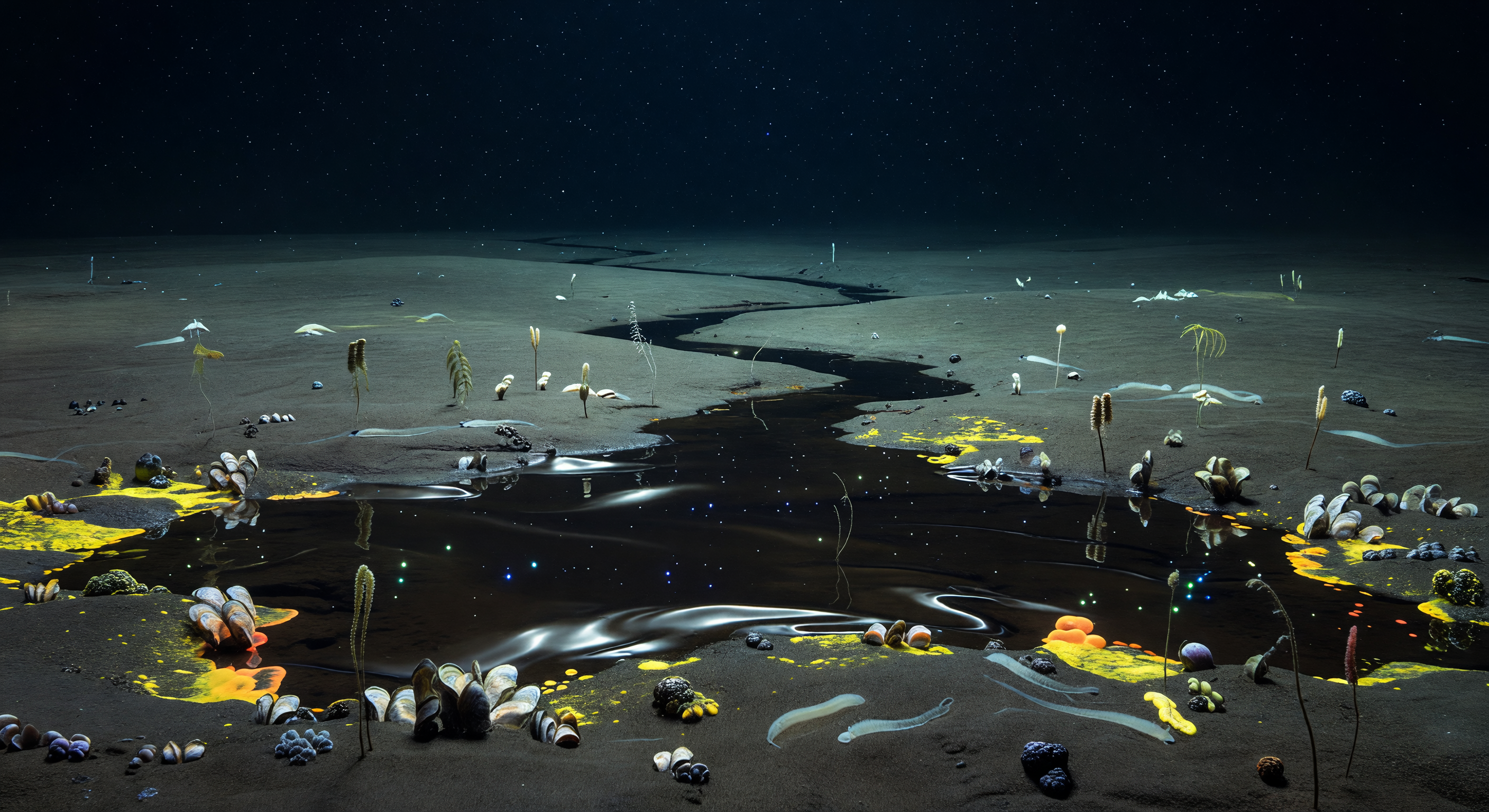
At roughly 5,000 metres below the surface, where pressures exceed 500 atmospheres and ambient temperatures hover near 2 °C, a narrow river of hypersaline brine traces a slow, sinuous course across the abyssal plain — a liquid anomaly resting inside the ocean like a buried sea within a sea. Its upper boundary is unnervingly sharp, a mirror-like halocline where the brine's density, two to five times that of the surrounding water, causes it to pool and flow as a coherent body, folding perfect inverted reflections of pale silt levees, scattered shell hash, and sulfur-yellow bacterial mats into its dark, glassy surface. Along the chemical boundary, clusters of mytilid mussels harbour chemosynthetic symbionts that fix energy not from sunlight — which vanished kilometres above — but from the methane and sulfide exhaled by the seeping seafloor, while faint cold luminescence pulses in near-invisible pinpricks from drifting microorganisms and microbial films edge the brine's margins in a dim, ghostly cyan. A holothurian moves with glacial patience across the adjacent sediment plain, and fragile sea pens stand motionless in the near-stillness, surrounded by the slow vertical drift of marine snow — particulate organic matter descending from the sunlit world above, a faint and distant snowfall settling through crushing darkness. Here the ocean exists entirely on its own terms: anoxic, lethal, chemically alien, and indifferent — a landscape governed by density gradients, mineral dissolution, and the quiet metabolisms of organisms that have never required the sun.
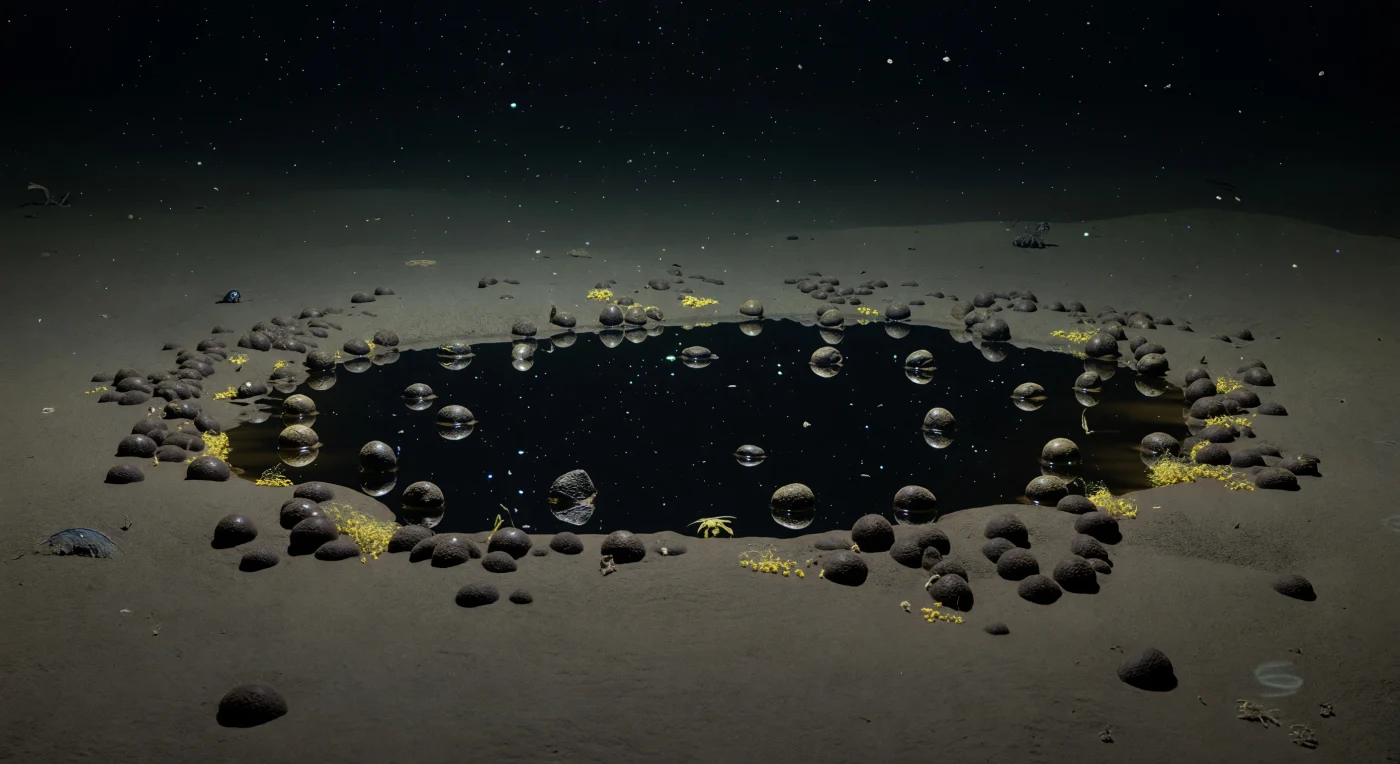
At roughly 4,500 to 5,500 metres beneath the surface, where pressure exceeds 400 atmospheres and temperatures hover near 2 °C, the abyssal plain stretches in near-total darkness as a featureless expanse of taupe-grey sediment — except where a shallow depression cradles a body of hypersaline brine so dense it refuses to mix with the overlying water, resting instead like a submarine lake with a razor-sharp, mirror-like interface that reflects the scattered manganese nodules at its margin as perfect, faintly stretched inversions. These nodules — polymetallic concretions of manganese, iron, nickel, and cobalt — have grown grain by grain over millions of years, accreting around microscopic nuclei at rates measured in millimetres per million years, each one half-swallowed by the soft ooze that accumulates from the perpetual slow rain of marine snow drifting down from the sunlit world far above. At the brine's edge, where lethal hypersalinity gives way to ambient seawater, chemosynthetic bacterial mats glow in faint sulphurous yellow and sparse symbiont-bearing mussels anchor themselves at the only chemically viable margin, deriving energy not from sunlight but from the methane and hydrogen sulphide seeping upward through ancient evaporite strata below. Tiny blue-green bioluminescent pulses wink among the falling particles — fleeting signals from drifting zooplankton and small benthic organisms — and their cold light trembles in miniature across the glossy brine surface, the only illumination in a world that has never known the sun, immense and pressurized and profoundly silent, existing entirely on its own terms.
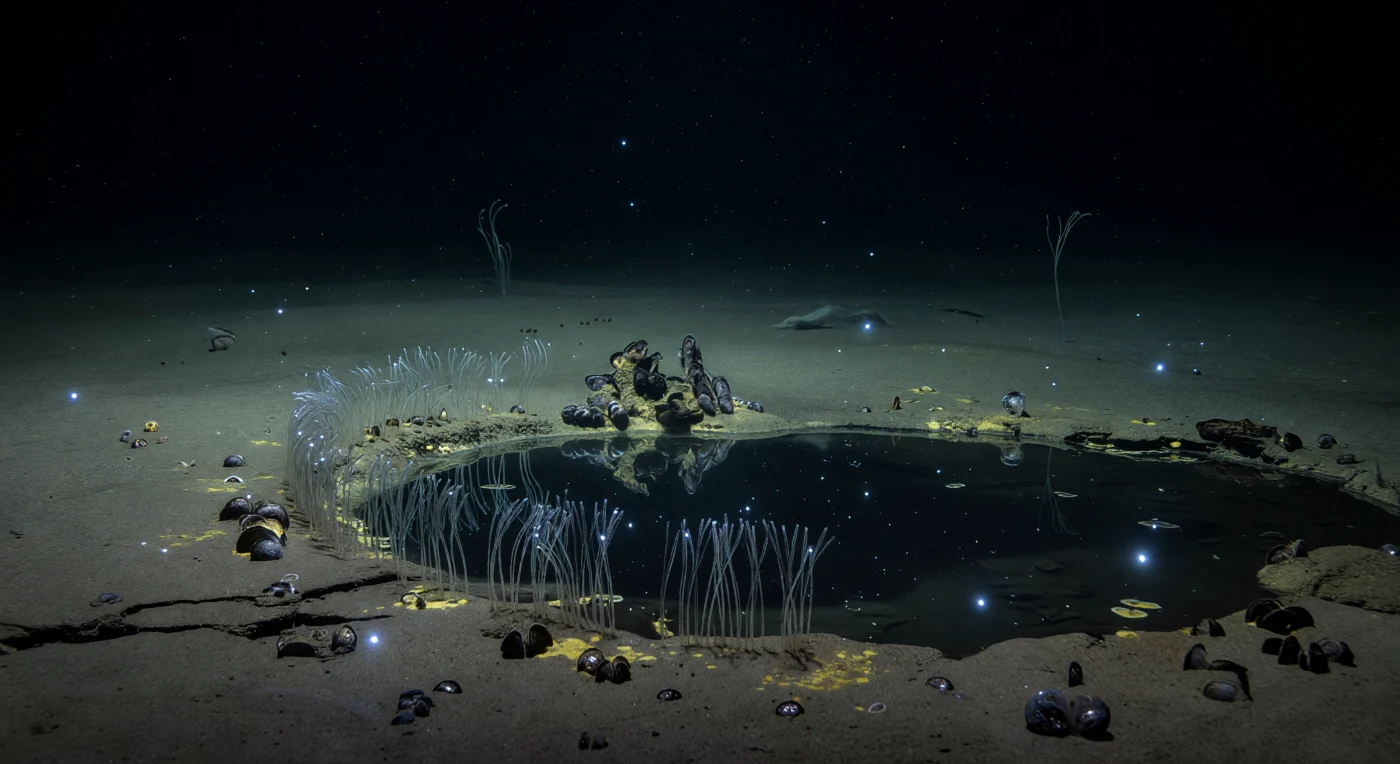
At depths where pressure crushes the water column to roughly 400–600 atmospheres and ambient temperatures hover just above freezing, a crescent of translucent sea pens (*Pennatulacea*) rises from grey-brown abyssal sediment along the lip of a brine moat — a submarine lake of hypersaline water so dense it refuses to mix with the ocean above it, its surface resolving into an eerily sharp mirror that returns perfect inverted images of each feathered axial plume. This brine, likely sourced from the dissolution of ancient evaporite deposits or fault-guided seepage, may carry two to eight times the salinity of normal deep seawater, rendering it anoxic and largely lethal to metazoans yet sustaining sulfur-oxidizing bacterial mats whose faint yellowish films spread across seep-rich cracks nearby, while chemosynthetic mussels cluster at the chemocline margin where toxic and oxygenated waters briefly negotiate. Scattered manganese nodules lie half-embedded in the sediment — products of millions of years of slow accretion from dissolved metals settling through the water column — and a soft-bodied holothurian moves almost imperceptibly across the plain beyond, its presence a reminder that, at these depths, life has reorganized itself entirely around pressure, cold, and chemical energy rather than sunlight. The only illumination here is intrinsic to life itself: cold-blue pulses from bioluminescent plankton drifting in slow suspension, a ghostly microbial glow barely tracing the glassy brine interface, and the constant quiet fall of marine snow — particulate organic matter descending from the sunlit world thousands of meters above — dusting every surface with the faint, continuous record of a biosphere that this place will never directly see.
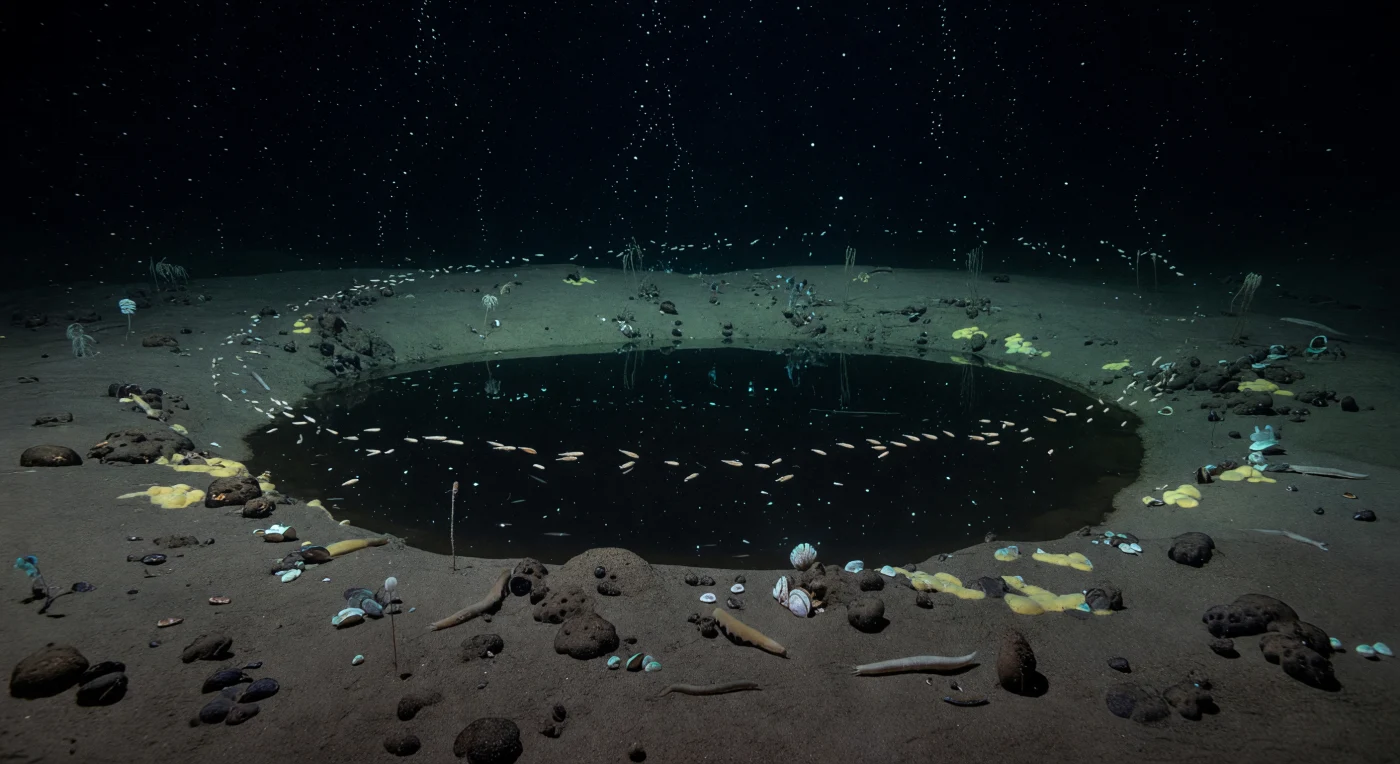
At depths where pressure exceeds four hundred atmospheres and the water temperature hovers near freezing, a shallow depression in the grey-brown sediment holds one of the ocean's most alien phenomena: a brine pool, its hypersaline body so dense — two to eight times the salinity of the surrounding seawater — that it rests as a discrete liquid mass with a razor-defined halocline marking the boundary between worlds. Above this mirror-like interface, an unbroken rain of marine snow descends from the sunless water column above, each particle a fragment of dead plankton, fecal pellets, and organic detritus that has fallen for weeks through kilometers of darkness, only to stall abruptly at the density boundary and drift laterally, accumulating into a suspended horizontal veil that catches vanishingly faint bioluminescent glimmers from drifting microorganisms. Along the pool's margins, sulfur-yellow bacterial mats and pale Bathymodiolus mussels — their tissues threaded with chemosynthetic symbionts that fix energy from methane and hydrogen sulfide rather than sunlight — form a chemosynthetic oasis, while holothurians move at imperceptible pace across the surrounding sediment and sea pens rise like pale antennae from the silt, filtering what little organic matter the current carries. Scattered across the abyssal plain, manganese nodules accreted over millions of years sit undisturbed in the mud, their slow geological time entirely indifferent to the chemical theater of the brine below — a world of extreme salinity, anoxia, and primordial chemistry that has operated in complete darkness and utter silence long before and entirely without witness.
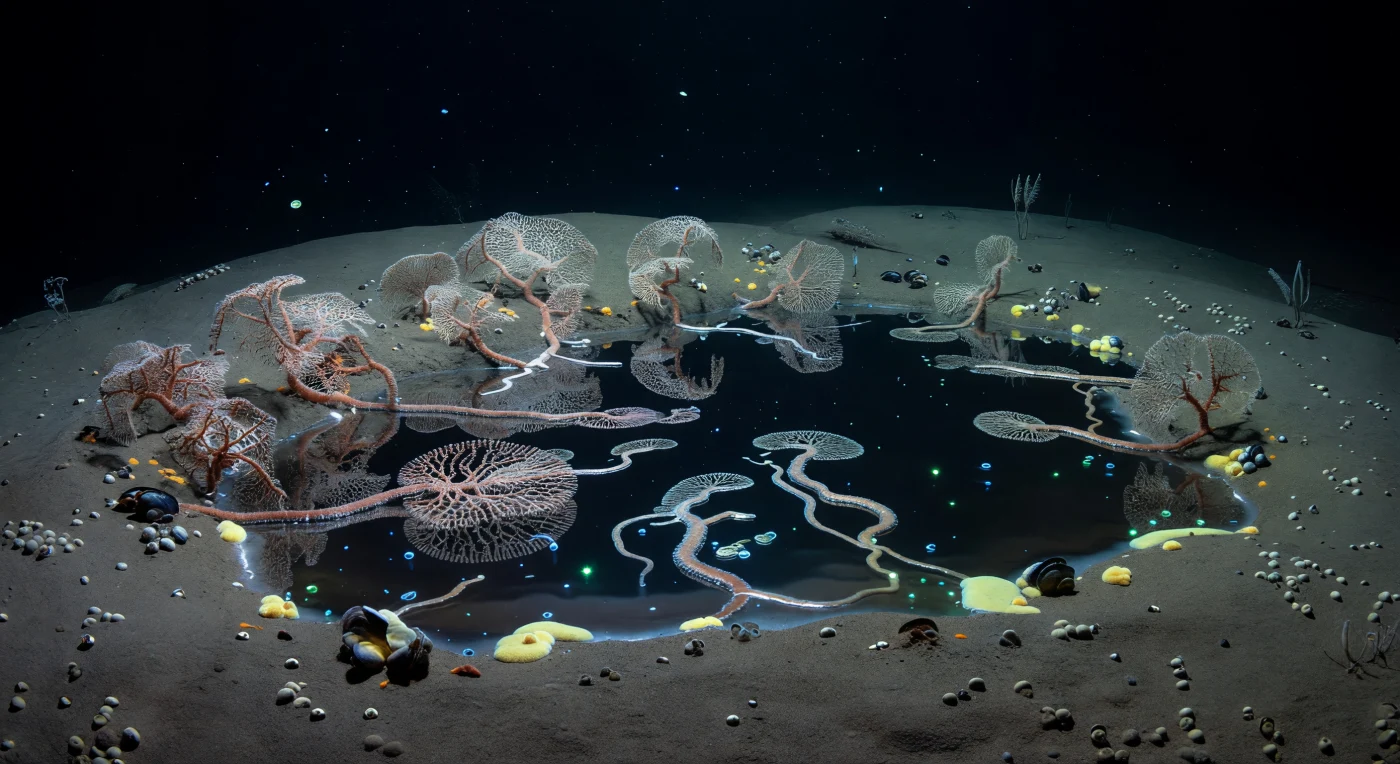
At 4,800 metres beneath the surface, where pressure exceeds 480 atmospheres and ambient water hovers near 2 °C, a shallow depression in the abyssal plain holds one of the ocean's most extraordinary phenomena: a submarine lake of hypersaline brine, its upper boundary a perfectly defined mirror of dark polished stillness, refracting the surrounding water with the uncanny shimmer of a submerged mirage. The brine itself — two to five times the salinity of the overlying seawater — is too dense to mix, pooling in geological silence as tongues of it seep between the sprawling forms of giant xenophyophores, the largest known single-celled organisms on Earth, whose agglutinated, lacework ridges of sediment and organic matter pattern the basin flank in fragile pale labyrinths. Along the brine margin, sulphur-oxidising bacterial mats spread in velvety yellow films, sustained entirely by chemosynthesis, and clusters of deep-sea mussels harbouring symbiotic bacteria occupy the chemically enriched edge where lethal brine and cold seawater meet in an invisible gradient of dissolved methane and hydrogen sulphide. Rare cyan and green bioluminescent pinpricks drift through the absolute darkness — microscopic organisms advertising their presence in a world where light has not reached since the Hadean — while marine snow descends with imperceptible slowness through water so still and cold that a holothurian grazing the silted plain and distant sea pens barely disturb the primordial quiet of a landscape that has existed, unseen, on its own terms for millions of years.
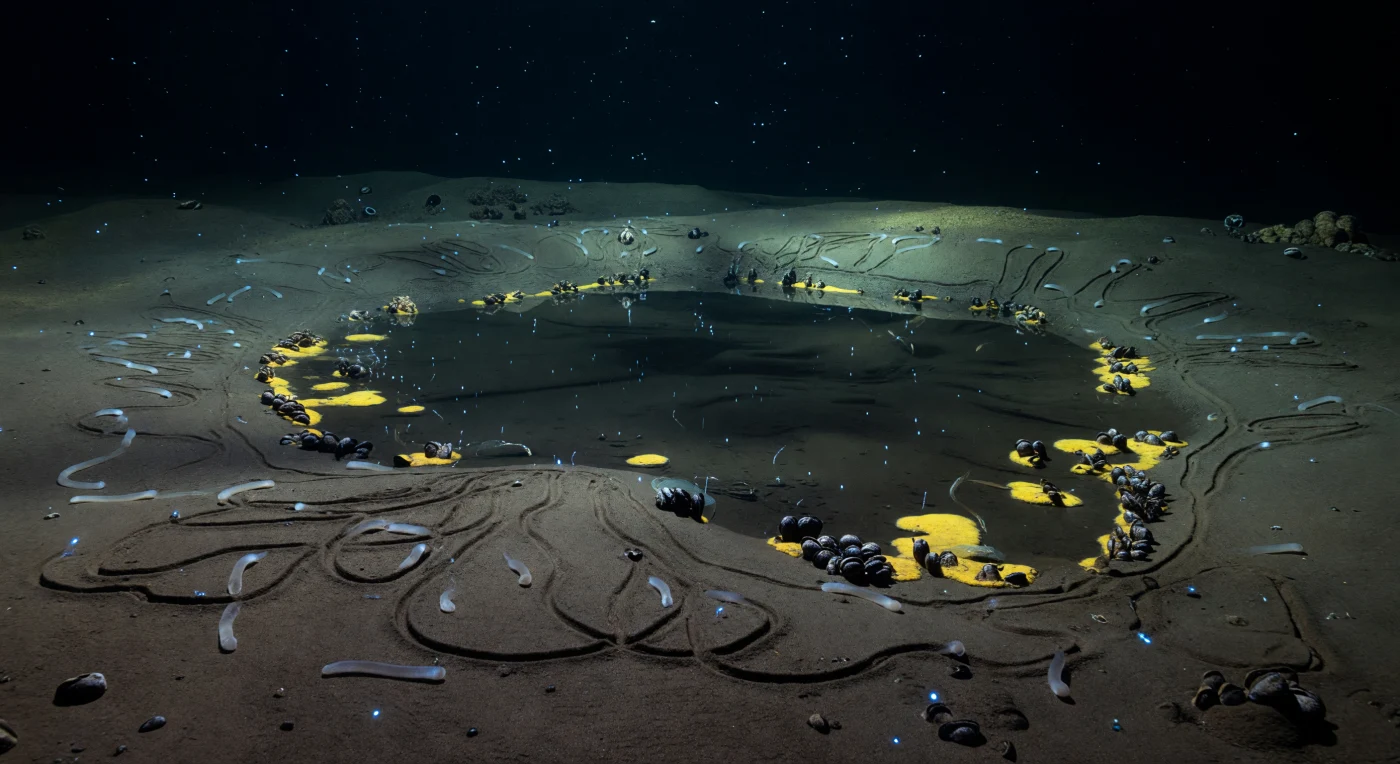
At roughly 4,500 to 5,000 metres below the surface, where pressures exceed 450 atmospheres and ambient temperatures hover near 2 °C, an abyssal brine pool rests in a shallow depression of the flat sediment plain like a dark inland sea submerged within the ocean itself — its hypersaline body, perhaps five to eight times saltier than the surrounding water, so dense that cold seawater simply floats above it, forming a mirror-like halocline that shimmers with refractive wavering and silvery mirage-like distortions. Along the outer terrace, pale holothurians — sea cucumbers of the family Holothuriidae — graze in loose, unhurried ranks, drawing looping feeding furrows through chocolate-brown abyssal mud as they ingest sediment and extract organic matter, their tracks converging toward sulfur-yellow bacterial mats that mark where methane and sulfide seep upward to sustain entire chemosynthetic communities in the absence of any photosynthetic energy. Compact clusters of symbiont-bearing mussels cling near these bacterial carpets, their tissues harboring chemoautotrophic bacteria that fix carbon from reduced sulfur compounds, while half-buried manganese nodules — accreted over millions of years at rates of mere millimetres per million years — punctuate the sediment like scattered monuments to geological time. The brine edge itself is lethal to most metazoans, its anoxic, hypersaline chemistry dissolving the biochemical tolerances of any organism that crosses it, and so life arranges itself in concentric tolerance rings around the pool, the entire community existing in crushing, primordial silence broken only by the intermittent cold blue and cyan flicker of bioluminescent plankton drifting freely through the blackness above.
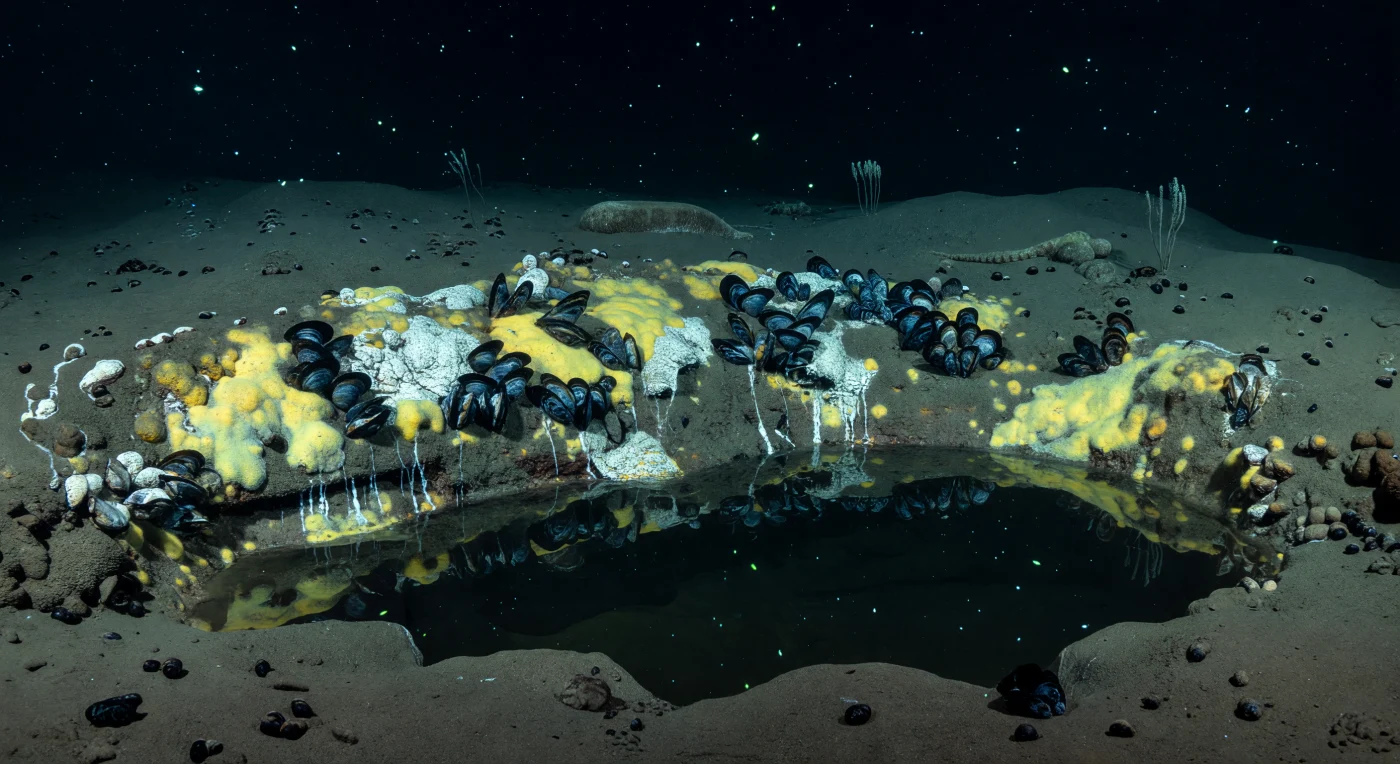
At the margin of an abyssal brine pool lying somewhere between four and six kilometers beneath the surface, a low escarpment descends through pressures exceeding four hundred atmospheres into one of the ocean's most chemically alien environments. The slope is blanketed in sulfur-yellow bacterial mats — vast colonies of sulfur-oxidizing microorganisms drawing energy not from sunlight but from the hydrogen sulfide seeping upward through fractured sediment — and across this microbial carpet, dense aggregations of symbiont-bearing mussels press together in interlocking mosaics of blue-black shell, their tissues harboring chemosynthetic bacteria that fix carbon in permanent darkness. Where fresh hypersaline brine trickles downslope in thin rivulets, chalky precipitate crusts of barite and carbonate crust over the mussel bed, marking the chemical frontier where normal seawater chemistry collapses into something far denser and far more hostile. At the foot of the escarpment, the brine pool itself lies perfectly still, its upper surface a mirror-dark interface — sharp as glass, shimmering with subtle refraction — where seawater meeting brine five to eight times saltier creates an optical boundary like black liquid mercury, swallowing detail into lightless depth below. Beyond the seep margin, scattered manganese nodules mottle the abyssal plain, a distant holothurian moves imperceptibly through the cold, and a few delicate sea pens stand unmoving in the immense, silent pressure, their existence entirely indifferent to any witness.
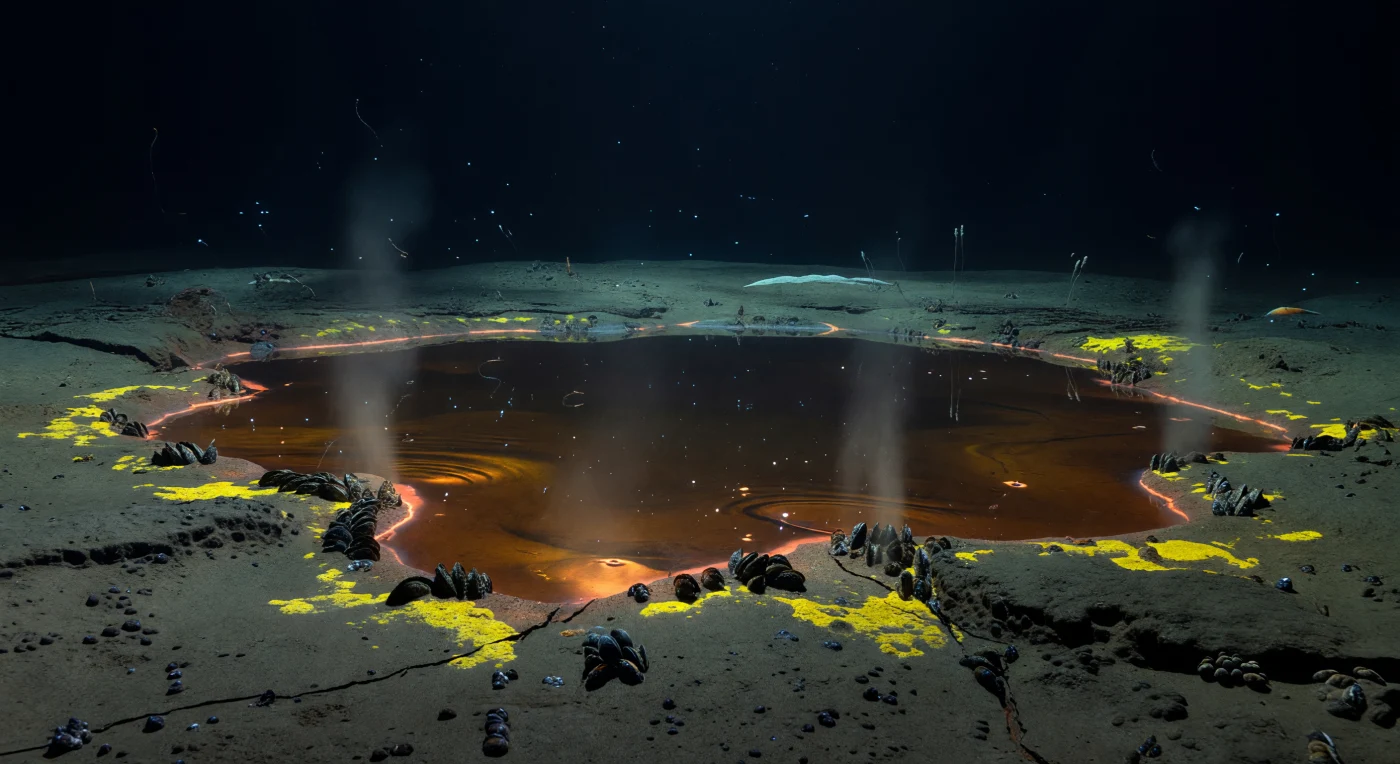
At depths where pressure crushes the water column to something approaching solidity, a fault-bounded basin cradles one of the ocean's most alien phenomena: a lake within the ocean, its amber brine so dense with dissolved salts and metals that it refuses to mix with the near-freezing abyssal seawater resting above it, the boundary between them shimmering like a liquid mirror distorted by competing densities. Along the fractured rim, chemosynthetic bacterial mats spread in sulfurous yellow-orange sheets, and dense clusters of symbiont-bearing mussels colonize the thin cracks where reduced fluids seep upward, entire communities sustaining themselves not on sunlight but on the chemical energy of hydrogen sulfide and methane welling from below. Where the hottest fractures trace the muddy scarp, a faint orange-red chemiluminescent shimmer betrays oxidation reactions occurring spontaneously in the sediment, while ghostly microbial films cast a dim diffuse glow across the basin's edge, and scattered cyan-blue bioluminescent points drift cold and sparse through the surrounding black water. At four to six thousand meters, under four hundred to six hundred atmospheres, the copper-amber brine lies oily and opaque, anoxic and hypersaline, lethal to most metazoan life yet ringed by organisms that have evolved to exploit the precise gradient where poison becomes fuel. Beyond the basin, a pale holothurian moves in slow muscular waves across the pockmarked mud, and distant sea pens stand motionless in the absolute stillness of a plain that has never known sunlight, existing entirely on its own terms.
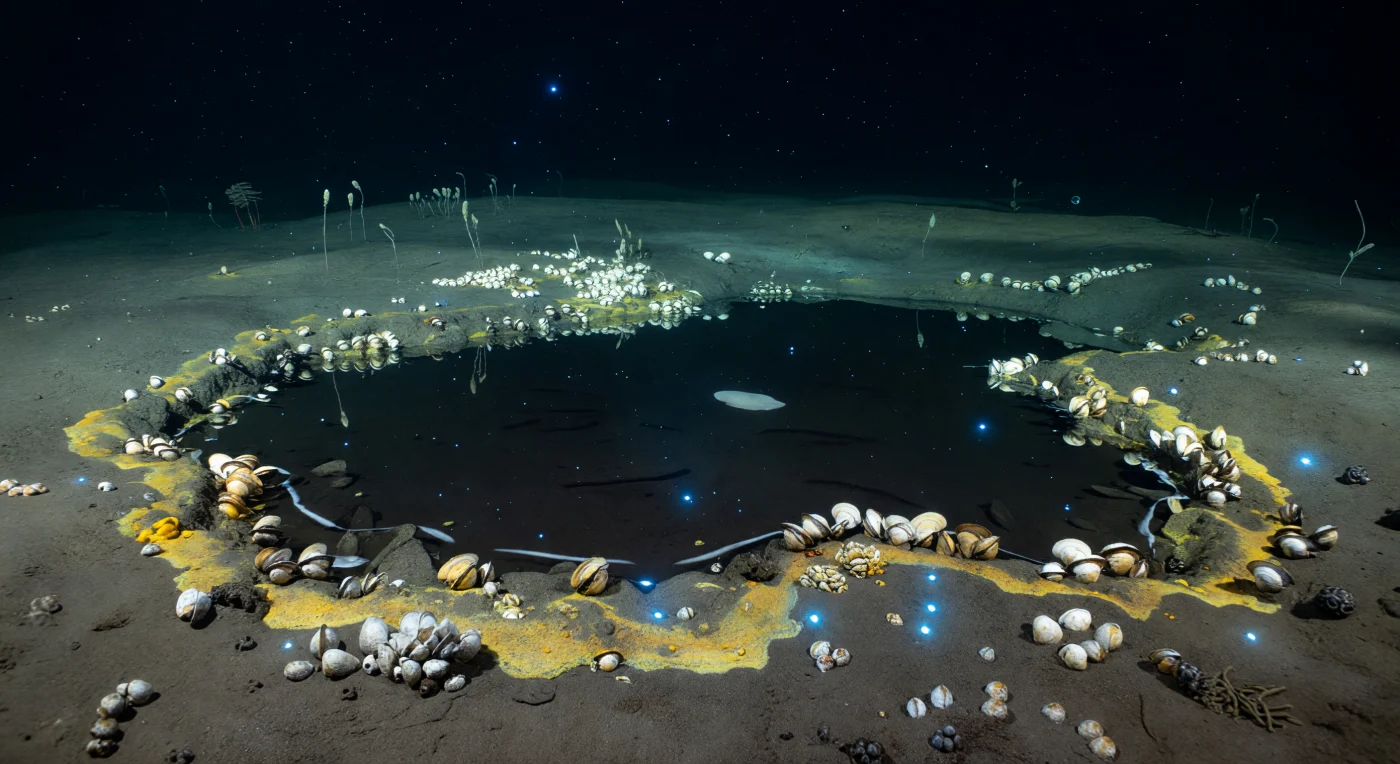
At roughly 4,800 to 5,500 metres below the surface, where pressure exceeds 500 atmospheres and ambient temperatures hover near 2 °C, a shallow hollow in the abyssal plain cradles one of the ocean's most improbable phenomena: a lake within the ocean, its surface held razor-sharp by density alone. The brine filling this depression is two to five times saltier than the surrounding seawater, enriched through the dissolution of ancient evaporite deposits buried deep within the sedimentary record, and so dense that it pools like liquid mercury, its black mirror interface bending and doubling the images of nearby mussel shells and undercut mud lips into precise, silent mirages. Along its lethal shore, chemosynthetic mussels — their tissues colonised by sulfur-oxidising endosymbionts — cluster in dense ivory-and-tan beds at the precise margin where toxic brine chemistry and oxygenated water meet, sustaining an entire community on chemical energy alone, independent of any sunlight that ceased penetrating the water column kilometres above. Sulfur-yellow bacterial mats spread across the scalloped sediment in slow microbial carpets, their faint cold luminescence doubling as ghostly reflected sparks on the brine's black surface, while sparse blue-cyan bioluminescent points drift through the overlying water column like scattered stars above a still lake. Farther across the ashen plain, a pale holothurian moves with glacial patience through soft silt dusted with manganese nodules, utterly indifferent to the strange liquid shore at its margin — a world complete, pressurised, and profoundly silent in its own deep existence.
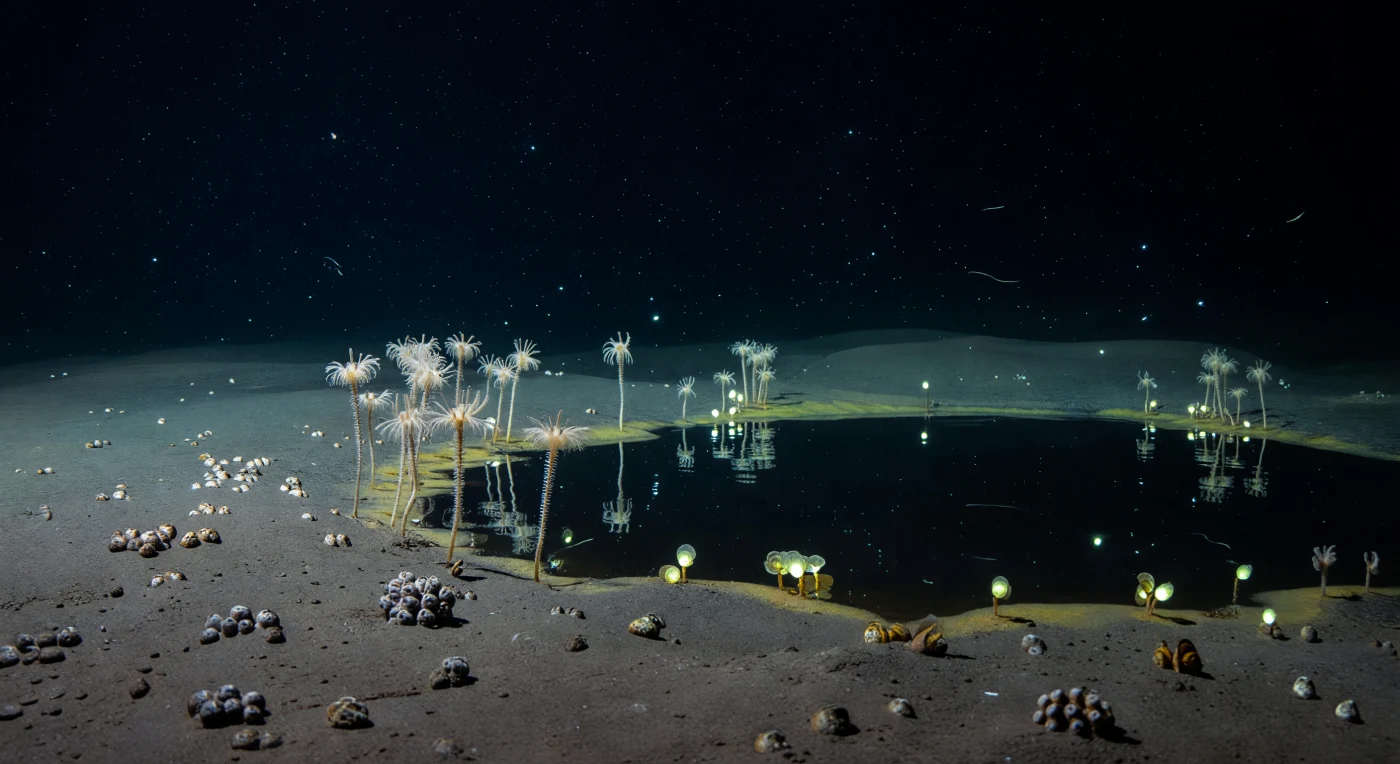
At depths where pressure crushes the water column into 400 to 600 atmospheres of cold silence, a flat sediment plain of grey-brown ooze stretches outward, peppered with half-buried manganese nodules that have been accumulating for millions of years at rates of mere millimetres per millennium. From this seafloor mud, stalked crinoids — ancient suspension feeders whose lineage predates the dinosaurs — raise pale ivory crowns into a current so faint it barely registers, each feathery arm filtering the slow rain of marine snow that descends ceaselessly from the sunlit world kilometres above. At the plain's edge lies the brine pool: a body of hypersaline water so dense, two to eight times the salinity of surrounding seawater, that it settles into depressions and holds its form like a submarine lake, its surface a black mirror with a sharply defined halocline interface that distorts and swallows the reflected geometries of the crinoids standing at its shore. Yellow bacterial mats fringe this lethal boundary, sustained by chemosynthetic metabolism rather than sunlight, while clusters of symbiont-bearing mussels colonise the transitional zone where oxygenated bottom water meets the anoxic, organism-killing brine below. Sparse blue-green bioluminescent sparks drift through the surrounding water column — organisms communicating, hunting, or simply existing in a world of perpetual darkness where all light is biological and all life has negotiated, in its own way, the terms of existence at the edge of an inland sea that the ocean quietly keeps to itself.