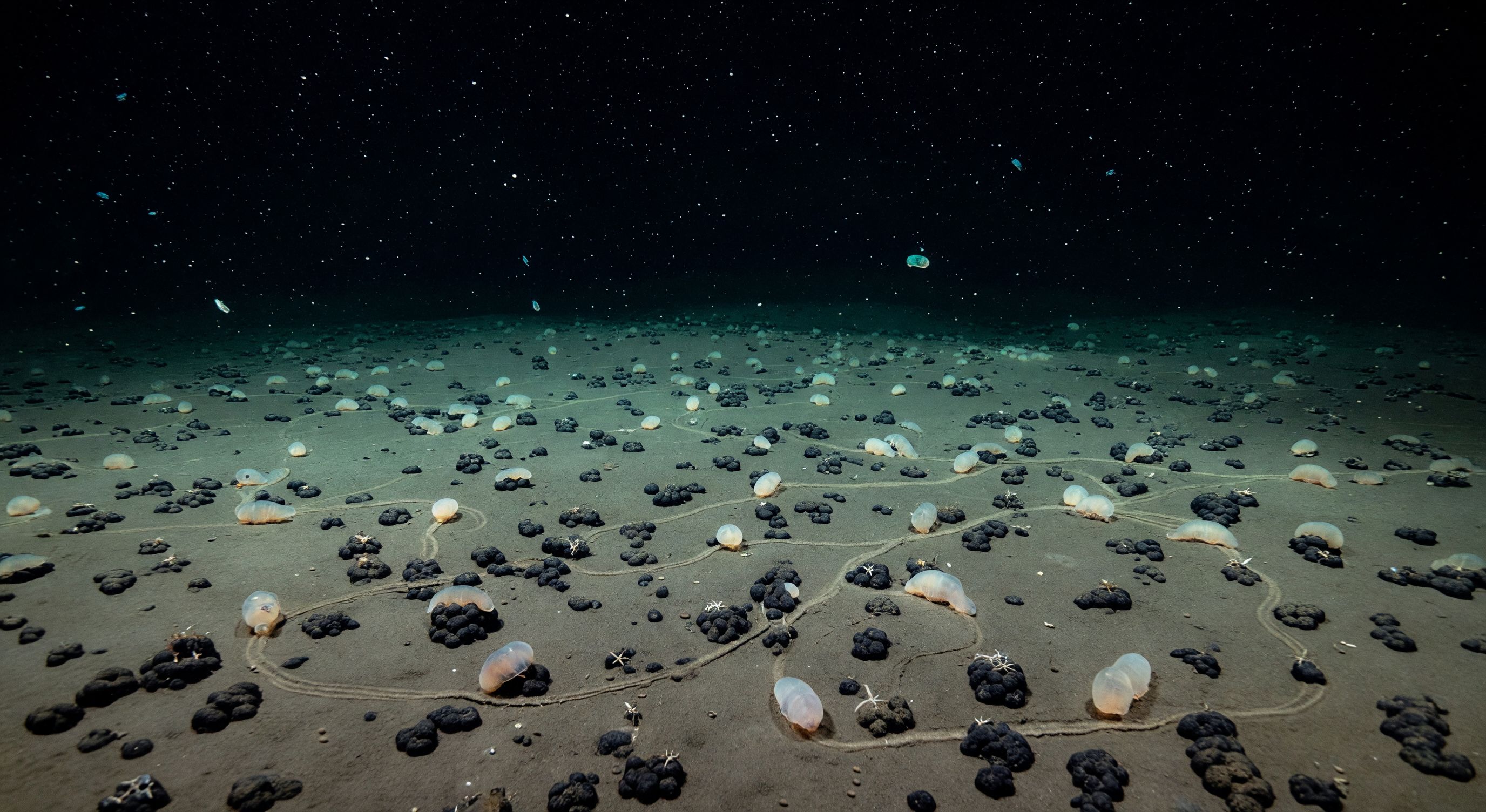
Across the abyssal plain of the Clarion–Clipperton Zone, at depths where pressure exceeds four hundred atmospheres and water temperatures hover near two degrees Celsius, a vast sediment floor lies scattered with black manganese nodules — rounded, matte, half-swallowed by pale grey-brown mud, each one the product of millions of years of slow mineral accretion. Dozens of holothurians move in near-imperceptible procession across this terrain, their gelatinous bodies translucent and ghost-pale, drawing sustenance from the organic material trapped in the sediment, leaving behind looping feeding tracks that arc and intersect between the nodules in patterns of quiet, repeated purpose. Marine snow descends continuously through the water column above — fine particles of organic detritus drifting downward from the sunlit ocean far overhead, the primary nutritional link between the surface world and this lightless plain, each mote suspended in cold, high-clarity water laden with fine particulate. Scattered pinpricks of cyan-blue bioluminescence drift among the falling particles, the only light that has ever touched this floor, produced by organisms whose chemistry generates its own faint illumination entirely independent of any distant sun. Here, beyond the reach of all but the most extreme biological adaptations, a community of fragile benthic life persists in the sediment and on the nodule surfaces — sponges, xenophyophores, soft corals, and microbes — occupying one of the largest and least disturbed ecosystems on Earth, a world that has existed in this form since long before the first human eyes could imagine it.
Polymetallic nodule fields