At nearly five kilometers below the surface, where pressure exceeds 500 atmospheres and the water hovers just above freezing, a vast abyssal plain stretches without boundary or relief, its pale taupe sediment dusted across geological time and scattered with dense clusters of polymetallic nodules — black, matte, and faintly metallic, each one a concretion built over millions of years around a shark tooth or fragment of shell, accreting manganese and iron one atomic layer at a time from the surrounding seawater. Marine snow falls through the entire water column in a slow, perpetual drift, each particle a fragment of biological material shed from the sunlit world far above, now descending through absolute darkness to settle on surfaces that have not known light since the Miocene. The only illumination here is the ocean's own: vanishingly faint cold blue-green pulses from gelatinous organisms suspended high in the water column, their bioluminescent flickers appearing as distant cyan specks against blue-black nothing, enough to reveal the powdery texture of the sediment and the sharp edges of the nodules without ever concentrating into a beam. A holothurian traces an imperceptibly slow path across the mud, its soft body navigating between nodule clusters, while a fragile stalked sponge rises from the surface of a single dark stone, and the slender arms of an ophiuroid lie motionless among the shadows — sparse, ancient, and exquisitely adapted to a world of cold, pressure, and near-total stillness. This landscape exists in a register of time and silence entirely its own, untouched and unhurried, as though the rest of the universe has simply not arrived yet.
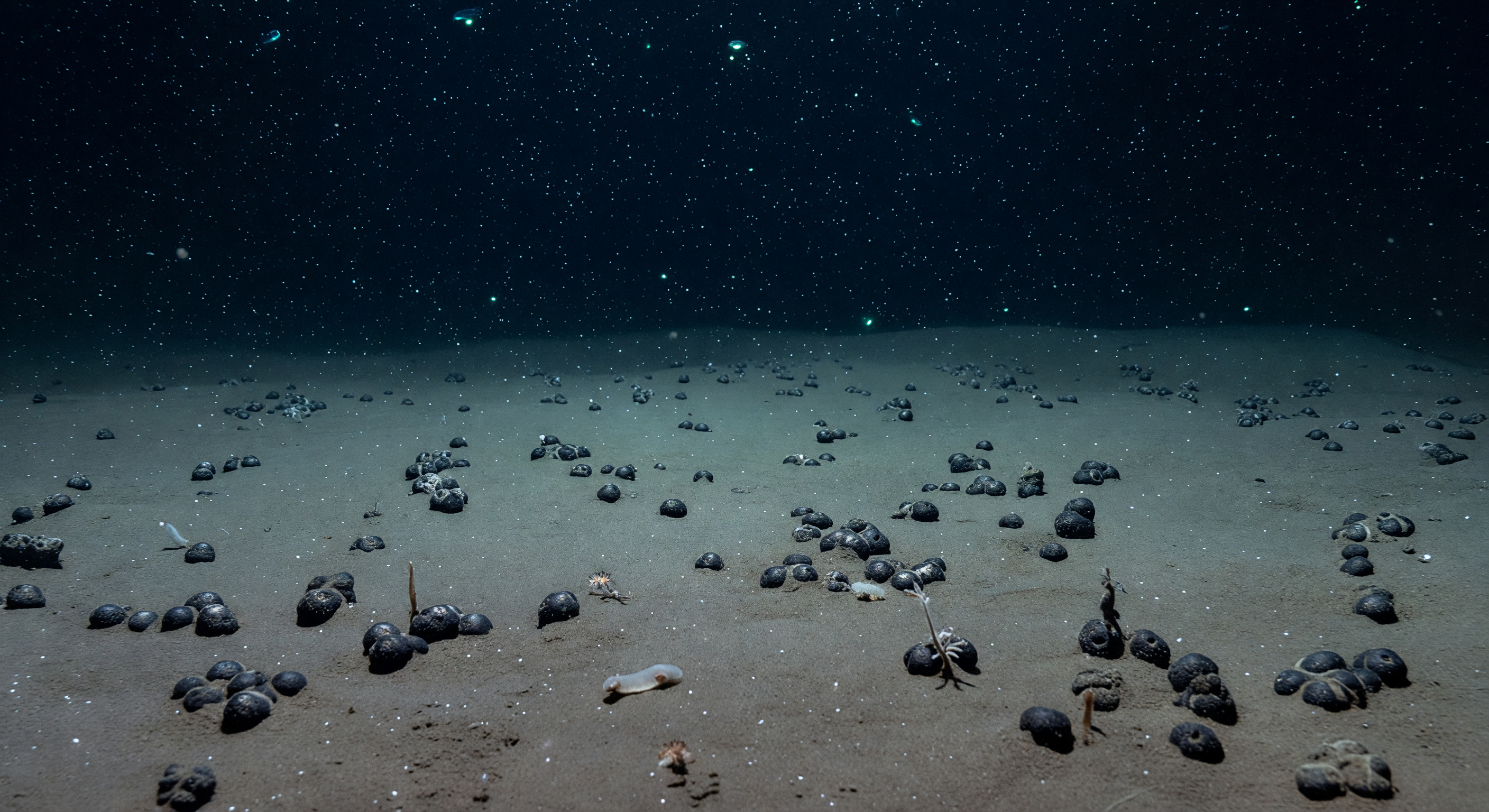
Polymetallic nodule fields