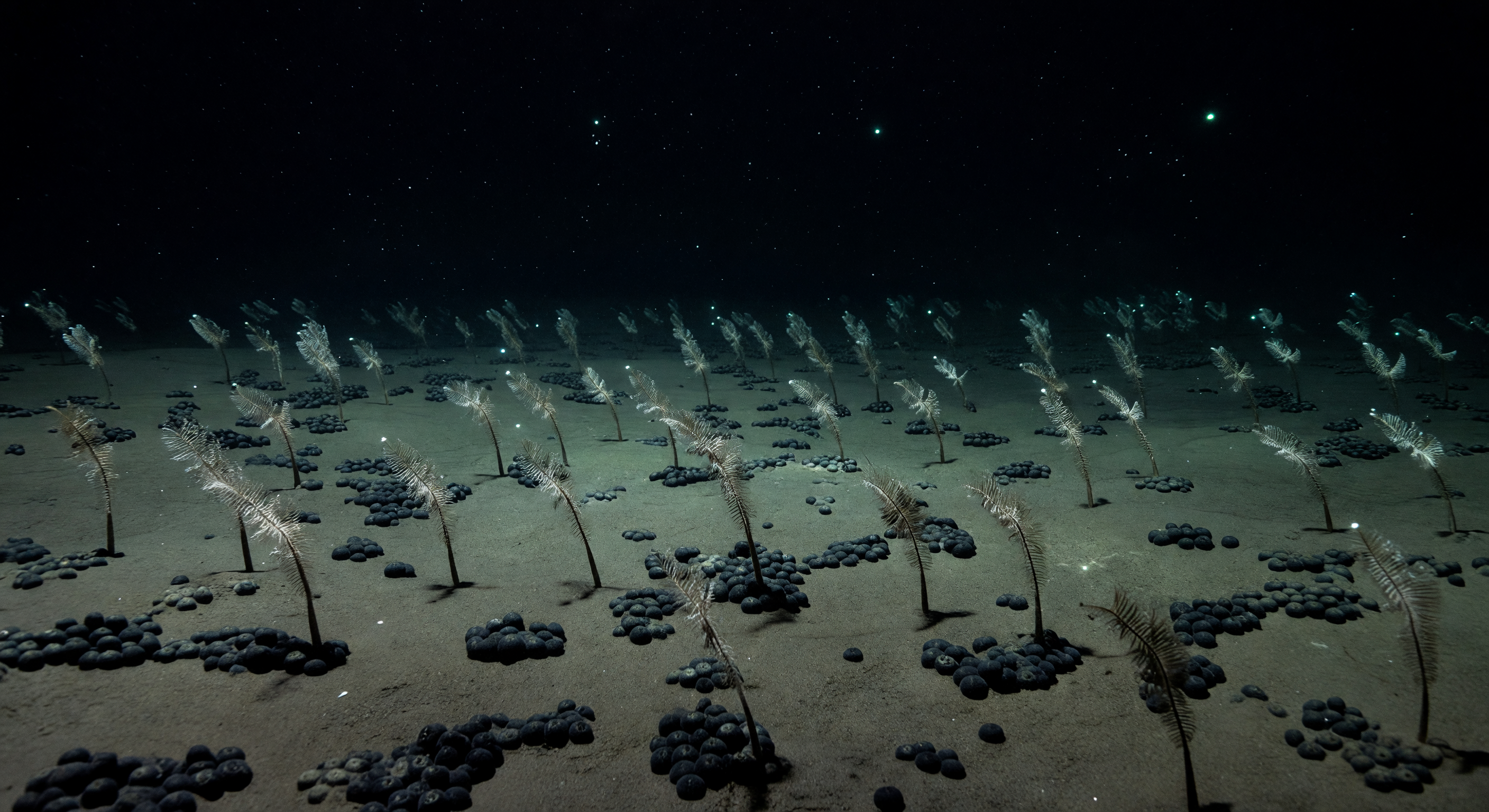
Beneath nearly five kilometres of ocean, where pressure exceeds five hundred atmospheres and the temperature hovers barely above freezing, a vast plain unfolds across the abyssal Pacific in near-total darkness. The seafloor here is a study in geological patience: black manganese nodules, each one the product of millions of years of slow accretion from seawater and sediment pore fluids, lie scattered across pale grey-brown mud like a field of ancient stones, their matte surfaces tracing the subtle topography of a landscape that has not changed in any human timescale. Among and between them, stalked crinoids rise on slender calcite stems, their feathered pinnules fanned open and tilted uniformly by a gentle bottom current — living weather vanes that betray the direction of the abyssal flow, filter-feeding on the sparse organic particles drifting down from the sunlit ocean far above. That organic rain, the marine snow, descends as faint luminous specks, while passing bioluminescent plankton cast a diffuse cyan shimmer that softly traces the rounded contours of each nodule and silvers the delicate crowns of the crinoids without ever concentrating into anything as harsh as a point of light. This is one of the largest and most fragile ecosystems on Earth, spread thinly across millions of square kilometres of abyssal plain, existing in its cold and crushing silence entirely without witness.
Other languages
- Français: Plaine de crinoïdes alignés
- Español: Llanura de crinoides alineados
- Português: Planície de crinoides alinhados
- Deutsch: Strömungsgerichtete Krinoidenebene
- العربية: سهل زنابق البحر المتجهة
- हिन्दी: धारा-संरेखित क्रिनॉइड मैदान
- 日本語: 潮流に沿う海百合の平原
- 한국어: 해류 방향 바다나리 평원
- Italiano: Pianura di crinoidi allineati
- Nederlands: Stroomgerichte crinoïdenvlakte