Scientific confidence: Very High
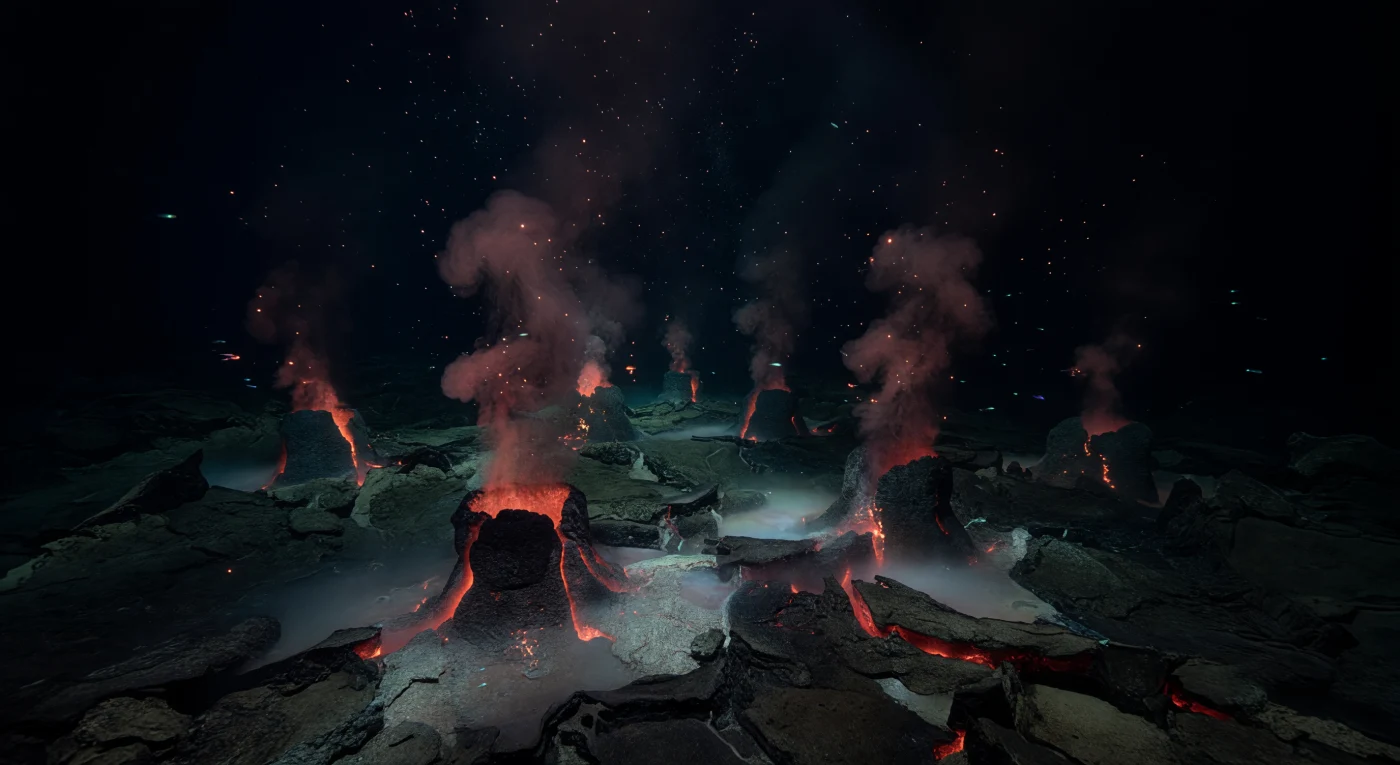
Where two tectonic plates tear slowly apart on the deep ocean floor, magma wells upward and seawater seeps into the fractured crust, emerging again as superheated, mineral-laden fluid at temperatures exceeding 400 °C — far beyond boiling, kept liquid only by pressures of 250 to 400 atmospheres bearing down at these depths between 2,500 and 3,500 meters. The sulfide chimneys that result grow in clustered formations across the axial floor, their walls precipitated from iron, copper, and zinc sulfides that crystallize the instant superheated fluid meets near-freezing ambient water, each chimney exhaling a dense dark plume edged with a faint copper-red chemiluminescent glow — a thermal radiation faint enough to be invisible to most instruments yet real, casting no illumination beyond itself, only a dim spectral warmth against the total blackness. Around the base of each structure, pale anhydrite and barite mineral crusts spread across broken pillow lavas and fresh basalt talus, slick with microbial mats of sulfur-oxidizing Archaea and Bacteria that form the true foundation of this ecosystem, replacing photosynthesis entirely with chemosynthesis. No sunlight has reached this place since the crust beneath it first cracked open; marine snow drifts down through the cold black water column above, while sparse bioluminescent flickers from small pelagic animals pulse briefly beyond the chimneys — a world of chemical fire and biological invention, wholly indifferent to the surface above it.
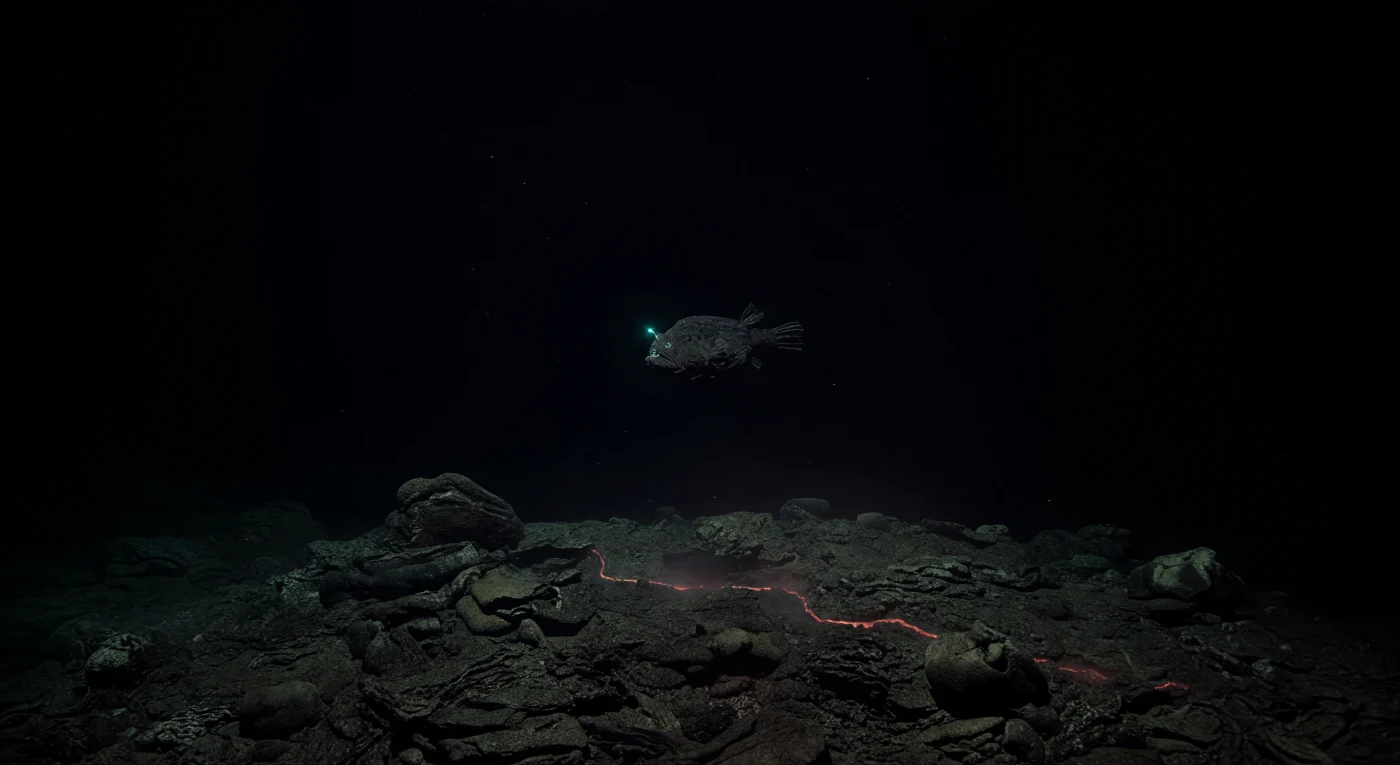
At roughly 2,500 to 3,000 meters below the surface, where the Mid-Atlantic or East Pacific Rise fractures the seafloor into a broken volcanic spine, a solitary ceratioid anglerfish drifts motionless above fresh basalt — its esca, a chemically sustained bioluminescent organ colonized by symbiotic bacteria, burning as the only resolved point of light in an otherwise absolute void. The lure belongs to a lineage perfected by millions of years of selection in perpetual darkness, where producing light costs metabolic currency and attracting prey or a mate across the crushing silence of 250 to 300 atmospheres of pressure is worth every photon. Below the animal, the ridge hummock reads as barely differentiated relief: collapsed pillow-lava lobes, glassy black crust quenched instantly against near-freezing seawater, and a narrow eruptive fissure from which diffuse hydrothermal circulation seeps a faint orange warmth — chemiluminescent oxidation reactions in mineral-laden fluid, not fire, tracing the boundary between young oceanic crust and the cold column above it. Sparse marine snow — the slow rain of organic aggregates, fecal pellets, and mineral particles descending from the productive ocean far overhead — drifts through the frame freely, each particle a long-traveled calorie in a world where sunlight has been entirely absent for hundreds of meters, and where chemical energy threading up through volcanic rock sustains the entire ecosystem below.
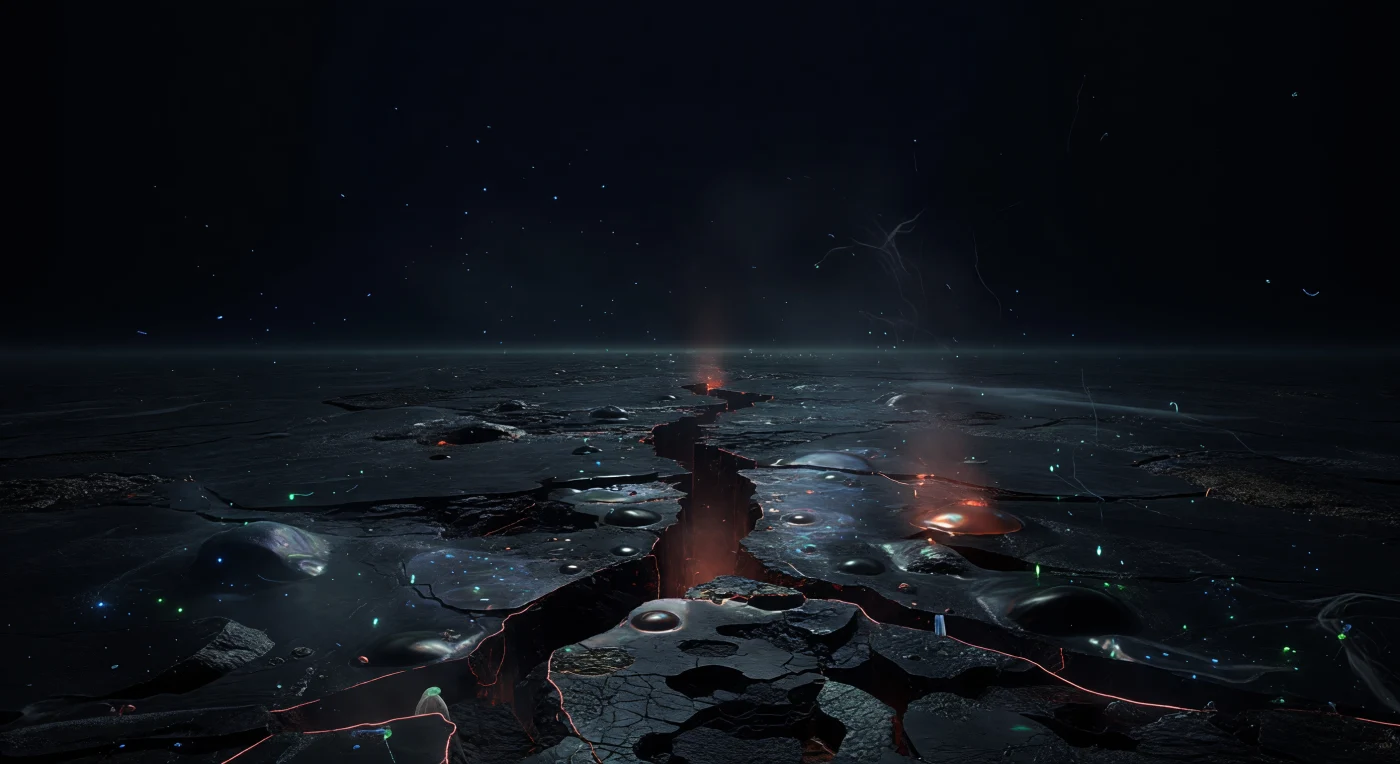
Along the axial crest of a mid-ocean spreading ridge, roughly 2,500 to 3,000 meters below the last trace of sunlight, a fresh eruptive fissure has torn open the volcanic plain, exposing the living interior of the planet's crust in near-total darkness. Molten basalt extruded along the fracture margins cools almost instantly against seawater at near-freezing temperatures and pressures exceeding 250 atmospheres, its outermost skin solidifying into jet-black volcanic glass while the still-hot interior continues to swell into the rounded forms of nascent pillow lavas — a process that has built most of Earth's oceanic crust since the planet formed. Sulfur-bearing hydrothermal fluids seep diffusely through hairline cracks in the collapsing crust, their faint chemiluminescent veil and the residual thermal glow of the freshest basalt providing the only illumination in an otherwise lightless world, while thin mineral hazes drift upward into water already carrying a slow suspension of marine snow descending from the sunlit ocean kilometers above. Sparse bioluminescent organisms — microscopic pressure-adapted plankton and vent-associated fauna — trace faint cyan sparks at the periphery of the hydrothermal shimmer, their presence a quiet testament to chemosynthetic food webs that owe nothing to the sun. Here, geology and biology exist in a state of primordial intimacy, the ridge breathing magma, the ocean absorbing it, and life persisting at the seam between them in absolute silence.
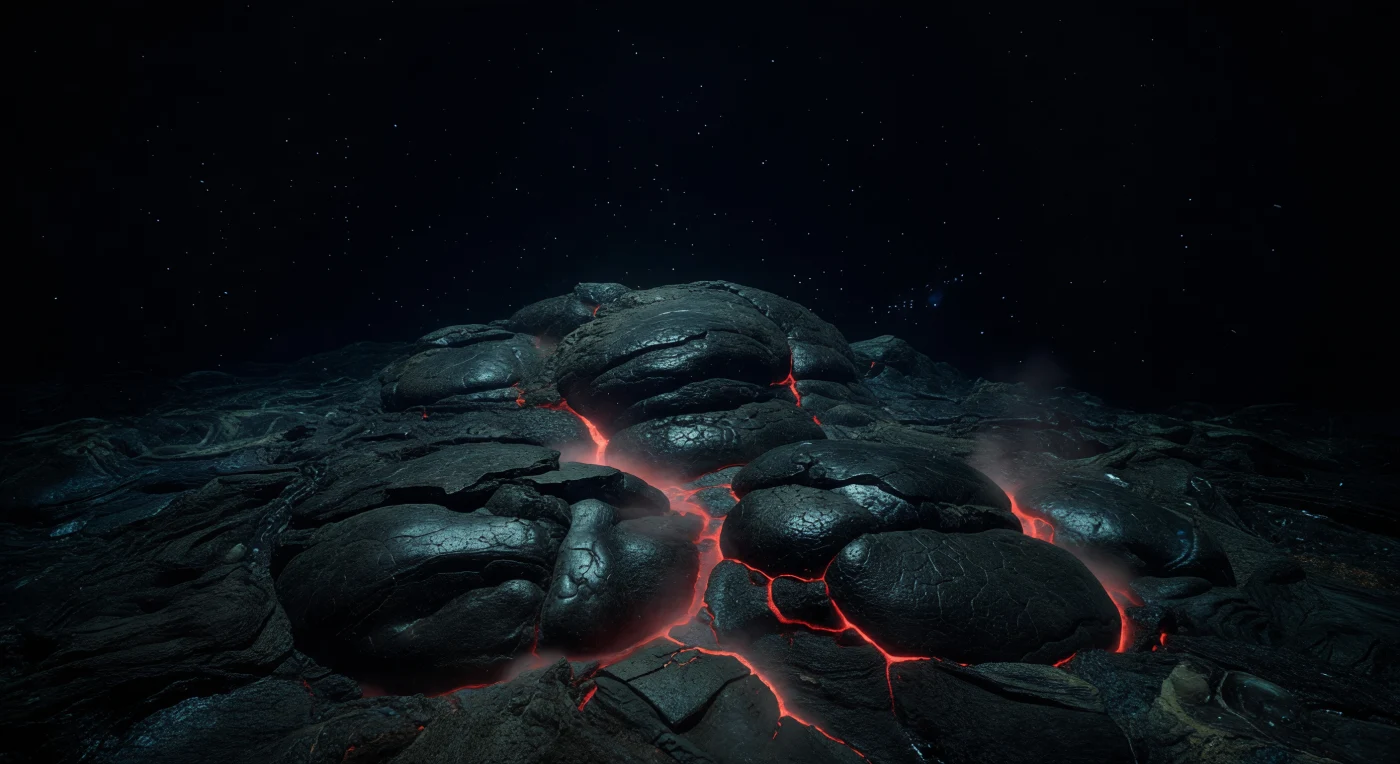
At roughly 2,500 to 3,000 meters beneath the surface, where no photon of sunlight has ever reached and hydrostatic pressure exceeds 250 atmospheres, the mid-ocean ridge crest erupts in slow volcanic breath — fresh pillow lavas heaped like swollen obsidian spheres, their quench-cracked skins still radiating a dull cherry glow where molten basalt continues to pulse through narrow eruptive seams. This is a spreading center, a place where two tectonic plates pull apart and the mantle responds by forcing magma upward, building new oceanic crust at rates of centimeters per year; the glassy, sediment-free surfaces of these pillows confirm the eruption is geologically instantaneous, the lava too newly solidified for any biological or mineral veil to have settled upon it. Along the warmest fissures, shimmering thermal distortion rises invisibly through the abyssal water column as chemically enriched hydrothermal outflow seeps between basalt contacts, carrying dissolved iron, sulfur, and silica in soft orange-red veils that betray the heat beneath without ever fully illuminating the surrounding darkness. Scattered through the black water, a few cyan-blue bioluminescent pinpricks mark the passage of deep-pelagic organisms — copepods, small medusae, or bristlemouth fish — drifting through a world powered entirely by geochemical energy rather than photosynthesis. The scene exists in absolute silence and crushing stillness, marine snow descending grain by grain through water that has never known the surface, indifferent to any witness.
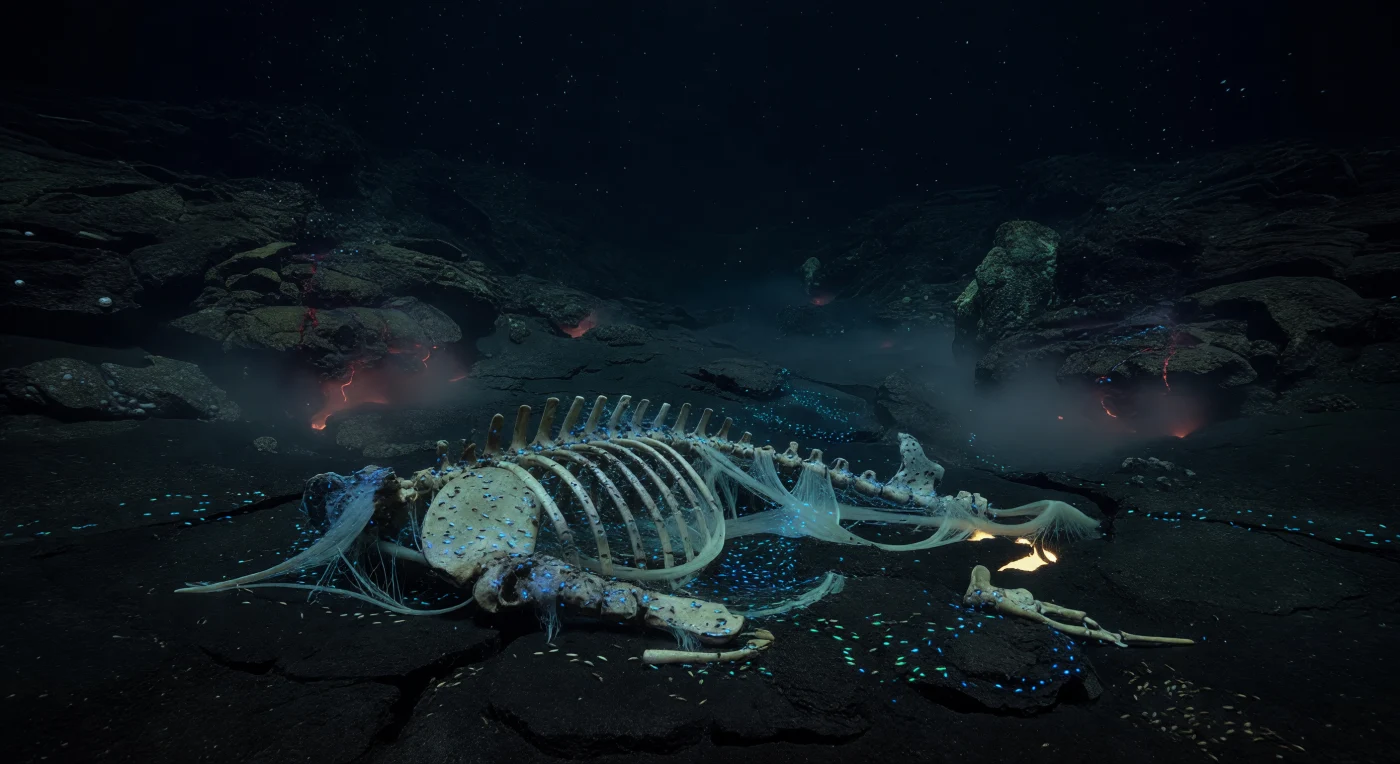
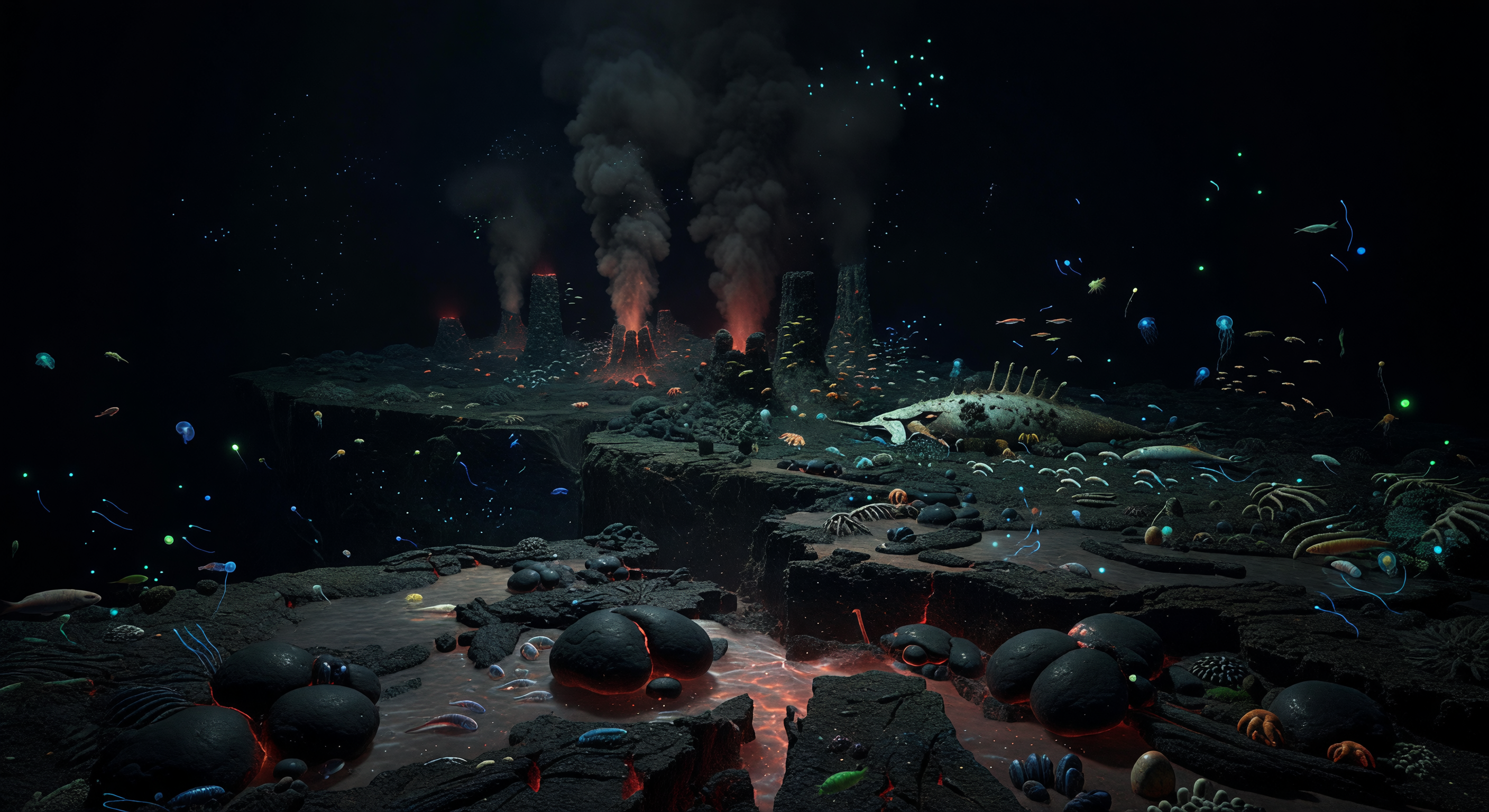
At roughly 2,500 to 3,000 metres below the surface, where tectonic plates slowly peel apart along a volcanic spine of black basalt, the crushed skeleton of a great whale has come to rest on a valley floor of pillow lavas and fractured eruptive fissures — a serendipitous collision between two of the deep ocean's most profound events. Pressure here exceeds 250 atmospheres, sunlight has been extinct for kilometres above, and yet the carcass pulses with cold blue and cyan bioluminescence as dense amphipod swarms move in coordinated feeding waves across pale tissue that still bridges the arcing ribs in translucent strands, each scavenger briefly tracing a green-blue flash before vanishing between exposed vertebrae. Farther across the basaltic sediment, diffuse hydrothermal outflow seeps silently from hairline fissures, lending a faint orange-red chemiluminescent veil to the surrounding volcanic hummocks — a reminder that this ridge already sustains chemoautotrophic life entirely independent of the sun — while mineral particles and marine snow drift freely through the absolute darkness of the water column, unhurried and unwitnessed. The whale fall transforms an otherwise austere rift valley into a sudden oasis of organic energy, a phenomenon that deep-sea ecologists recognise as a succession of ecological stages that can sustain distinct biological communities for decades, drawing mobile scavengers, enrichment-opportunist fauna, and ultimately sulfophilic bacteria that chemically mirror the hydrothermal ecosystems already colonising the basalt nearby. In the immensity of this black ridge valley, the luminous carcass reads as both catastrophe and gift — a brief, cold star settling into geological time.
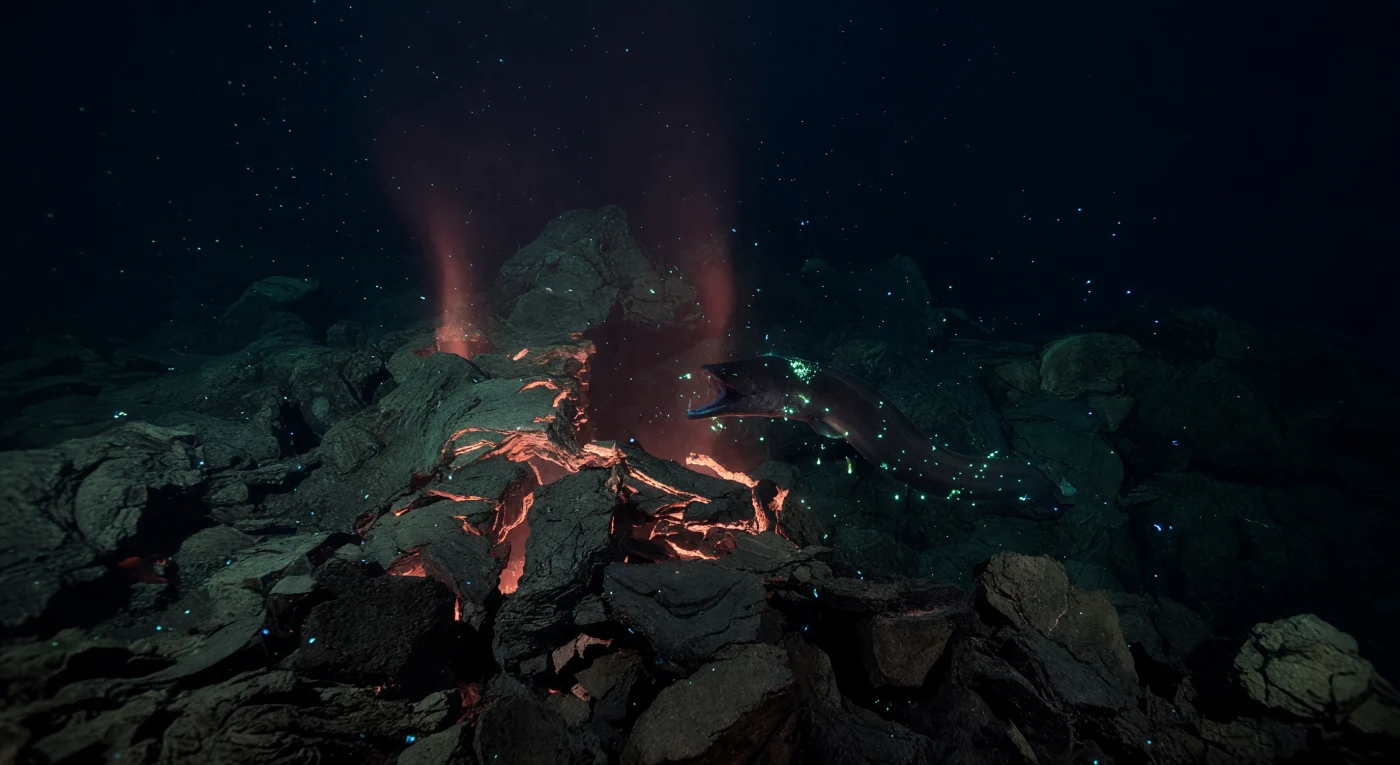
At roughly 2,500 to 3,000 metres depth along an active spreading centre, where tectonic plates pull apart and fresh basalt erupts in slow, dark violence, the water column carries the memory of heat even where no chimney rises — diffuse hydrothermal fluids seep through fractured pillow lava and ascend as trembling curtains of chemically altered seawater, bending the darkness with faint orange-red shimmer and suspending fine mineral particles that catch whatever light the living world produces. Here, under pressure approaching 300 atmospheres, a gulper eel — Eurypharynx pelecanoides — traces its serpentine arc through the column, its disproportionate pelican jaw parted in a passive sweep, an evolutionary solution to a world where prey is rare and every encounter must be seized; its charcoal-translucent skin briefly ignites with scattered emerald sparks as disturbed bioluminescent plankton burst along its flanks, a chain reaction of cold biological light entirely unwitnessed except by the darkness itself. Below, the fractured basalt record layers of eruption — black glassy rinds over still-warm interiors, fissures where seawater descends to be chemically transformed and returned — a geology measured not in millions of years but in decades, some surfaces younger than living organisms nearby. This is a place where chemical energy, not sunlight, anchors the food web, where the ridge exhales warmth through stone, and where life has organised itself around processes that would proceed identically whether any creature observed them or not.
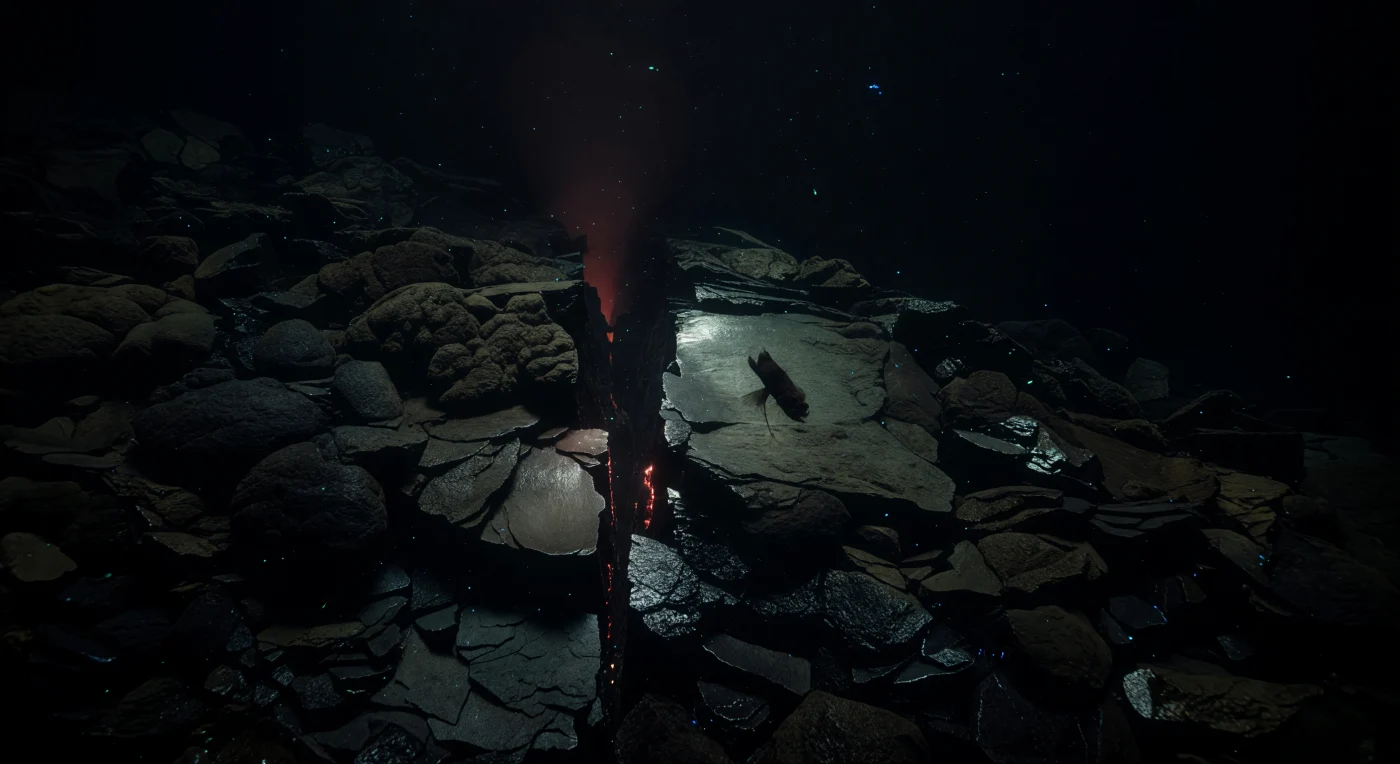
Along a mid-ocean ridge fault scarp at roughly 2,500 to 3,500 metres depth, tectonic plates draw apart with geological patience, forcing fresh basalt upward through eruptive fissures and leaving pillow lavas and volcanic glass stacked in fractured ledges that plunge into absolute darkness below. At these pressures — exceeding 250 atmospheres — seawater percolates deep into newly formed crust, is superheated by underlying magma, and rises again as diffuse hydrothermal outflow, carrying dissolved minerals that shimmer faintly against dark rock faces and feed chemosynthetic microbial films along warm crack margins; a distant vent plume bleeds a ruddy orange-red haze up the wall, the only chromatic warmth in an otherwise lightless world. Against this faint thermal backlight, a viperfish — *Chauliodus* sp. — hangs suspended in the water column, its elongated body and grotesque needle dentition rendered as a pure razor silhouette, a predator shaped by millions of years of selection for ambush and lure in a realm where metabolic economy is survival. Scattered cyan-blue-green bioluminescent points pulse in the surrounding blackness, likely from small mesopelagic migrants or invertebrate drifters carried on slow ridge-driven currents, while marine snow and mineral particles settle without interruption through water that has never known sunlight. This is ocean as deep-earth process: volcanic, chemical, pressurized, and entirely indifferent to any witness.
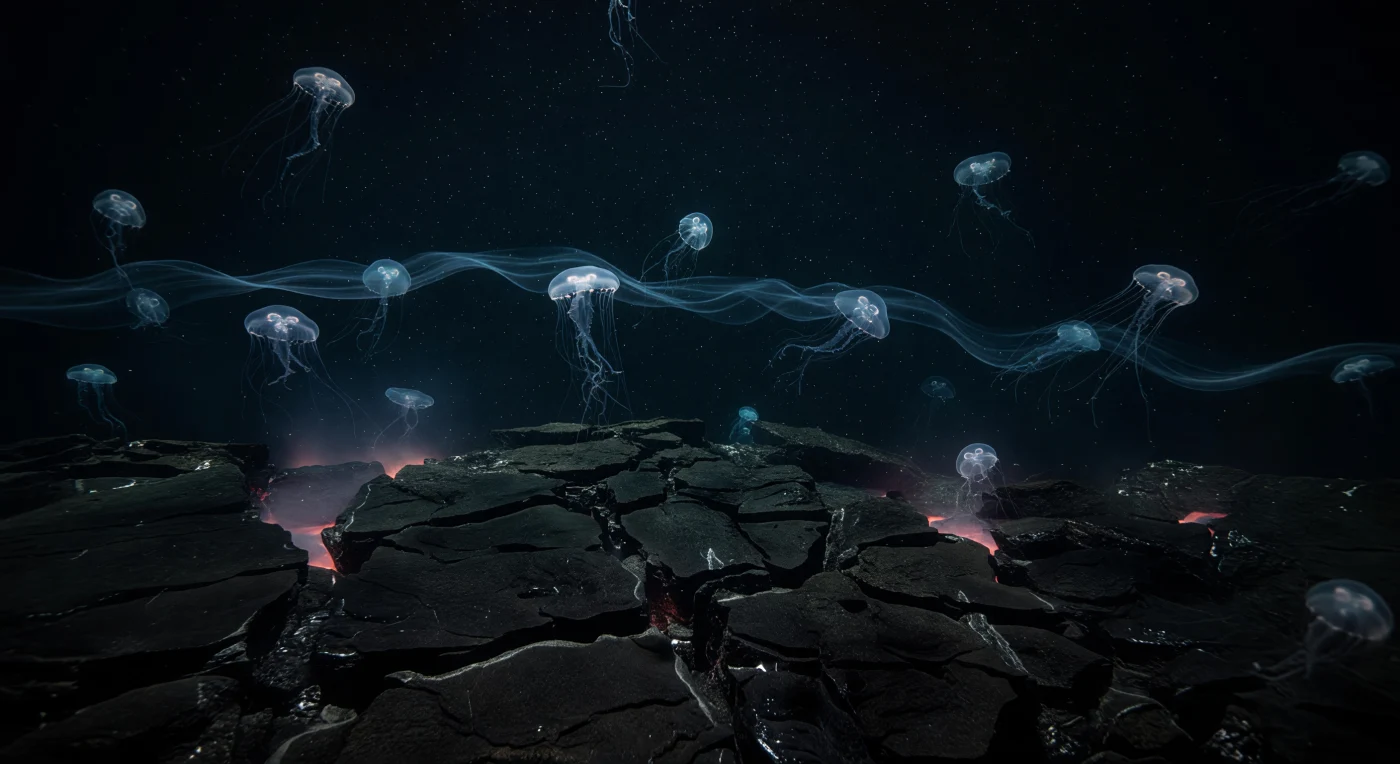
Above a mid-ocean ridge crest where tectonic plates are slowly wrenched apart, transparent pelagic jellies — medusae and siphonophores among them — pulse through water held at near-freezing temperatures under pressures exceeding 200 to 300 atmospheres, their soft bodies utterly indifferent to forces that would crush any rigid structure. The only illumination here is biological: cyan and blue-violet bioluminescent pulses ripple through radial canals and trailing filaments, each animal's photophores triggering neighbors in a chain reaction that maps the invisible layered currents flowing over the volcanic spine below. That spine is freshly born geology — black glassy pillow lavas, eruptive fissures still sharp-edged, basaltic hummocks built by magma rising where the lithosphere tears — and from narrow cracks along the crest, diffuse hydrothermal circulation exhales a faint thermal shimmer and chemiluminescent haze, a ghost-glow of chemical energy that underwrites an entire food web unconnected to the sun. Marine snow — the perpetual slow rain of organic particles, mineral flakes, and microbial aggregates — drifts freely past bell margins and hair-thin tentilla, marking the stillness of a water column so removed from the surface that it constitutes its own interior ocean, ancient, pressurized, and entirely self-sufficient, pulsing with cold light long before anything capable of witnessing it ever existed.
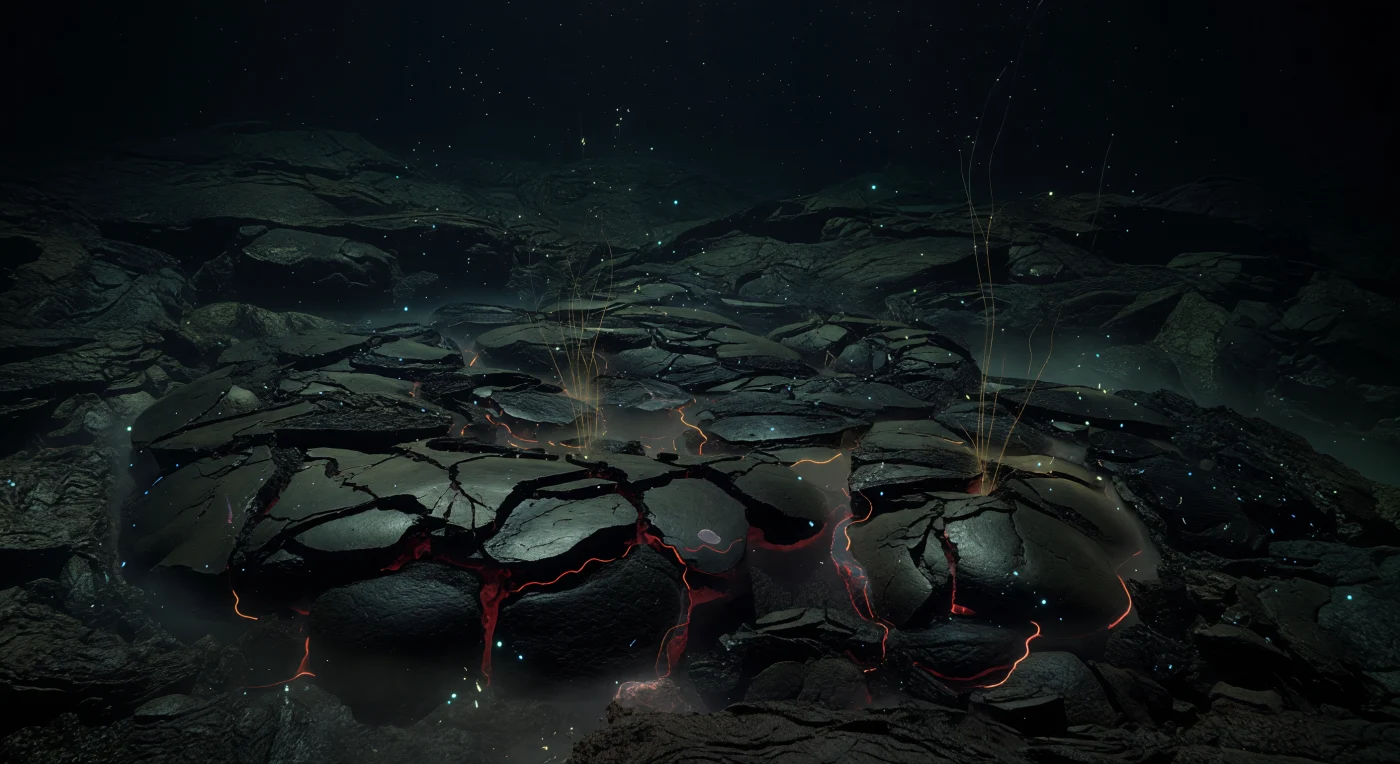
At roughly 2,500 to 3,000 meters below the surface, where the weight of water above reaches 250 to 300 atmospheres, a broad terrace of freshly erupted pillow basalts steps down from the axial valley of a mid-ocean spreading center — one of the most geologically active environments on Earth, where diverging tectonic plates draw magma upward through the crust and freeze it into these characteristic rounded lobes the moment it meets seawater near freezing. Each glossy black pillow bears the glassy rind of rapid quenching, its surface laced with cooling fractures and collapsed seams that record the precise moment the ocean claimed it, while narrower eruptive fissures thread between the lobes like sutures in new crust. Through the freshest of these cracks, diffuse hydrothermal fluids — heated by the magma chamber kilometers below, enriched with dissolved minerals, sulfides, and chemical energy — seep upward in delicate shimmering veils that carry faint gold and amber warmth, forming chemiluminescent halos and sustaining microbial films that cling to the hottest fractures in a ghostly sheen, the base of a food web entirely independent of sunlight. Beyond the foreground terrace, the fault-broken ridge topography dissolves into absolute blackness, crossed only by slow drifts of marine snow and suspended mineral particles, while scattered cyan and blue-green bioluminescent sparks mark the silent passage of pressure-adapted fauna navigating a primordial volcanic world that has never required a witness.
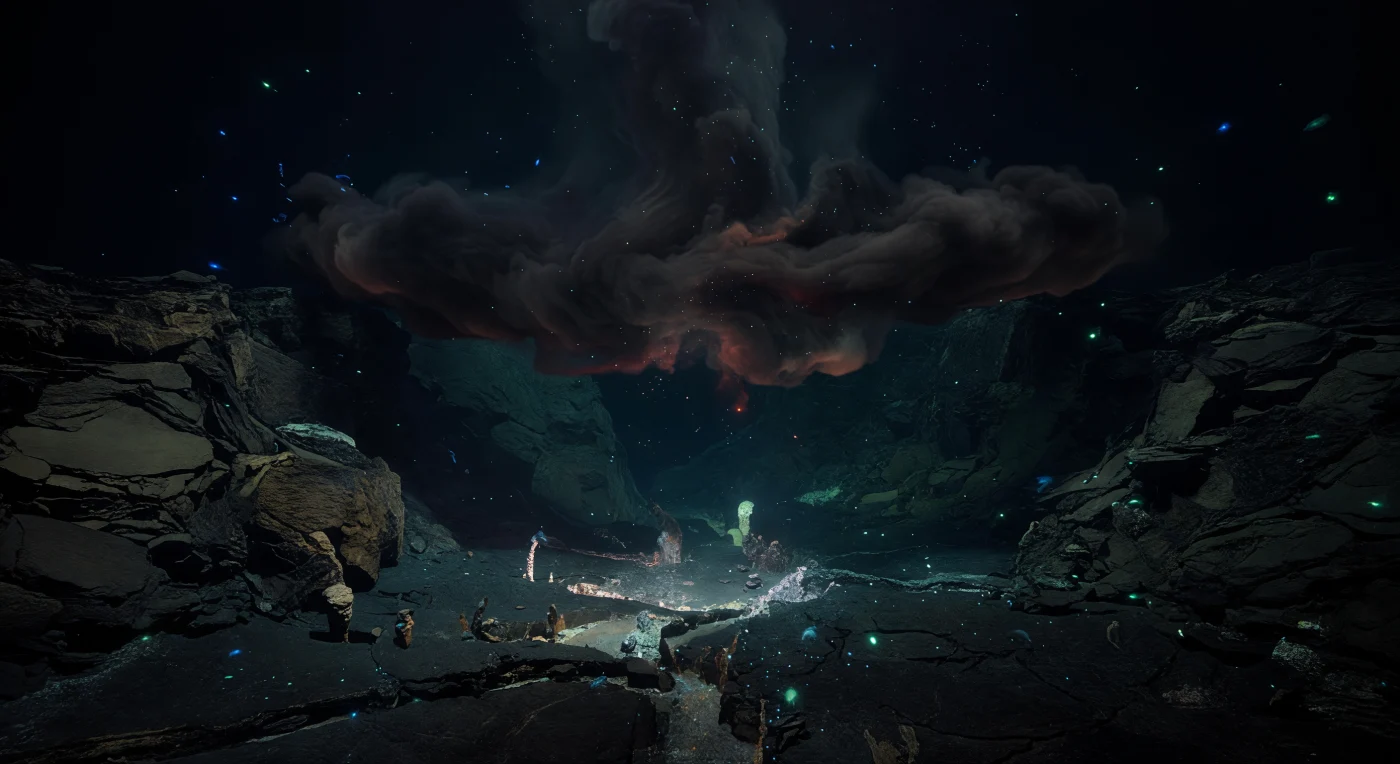
Kilometres below any reach of sunlight, the axial valley of a mid-ocean ridge opens like a drowned cathedral, its fractured basalt walls rising through the water column in tiers of fault scarps and collapsed lava shelves, all of it utterly dark save for what the earth itself provides. Far above the vent field, a suspended mineral plume drifts beneath the ridge walls like a slow-moving weather system, its layered underside faintly tinged with the orange-red chemiluminescent glow rising from hydrothermal chimneys below — sulfide structures venting superheated fluid laden with iron, manganese, and fine particulate minerals that spread outward in neutrally buoyant hazes for tens of kilometres along the ridge axis. At these pressures, approaching four hundred atmospheres, seawater has circulated deep into fractured young crust, been superheated by magmatic heat, and returned to the water column stripped of oxygen and loaded with reduced chemical compounds that sustain dense microbial communities and the entire chemosynthetic food web anchored to this volcanic spine. Across the vast blackness of the axial valley, isolated flashes of cyan and blue bioluminescence pulse briefly from drifting medusae and siphonophores — each spark lasting only a fraction of a second, yet illuminating enough of the surrounding darkness to suggest the true scale of this space — before vanishing, leaving the plume, the basalt, the shimmering diffuse flow over fresh pillow lava, and the slow rain of marine snow to continue entirely on their own terms.
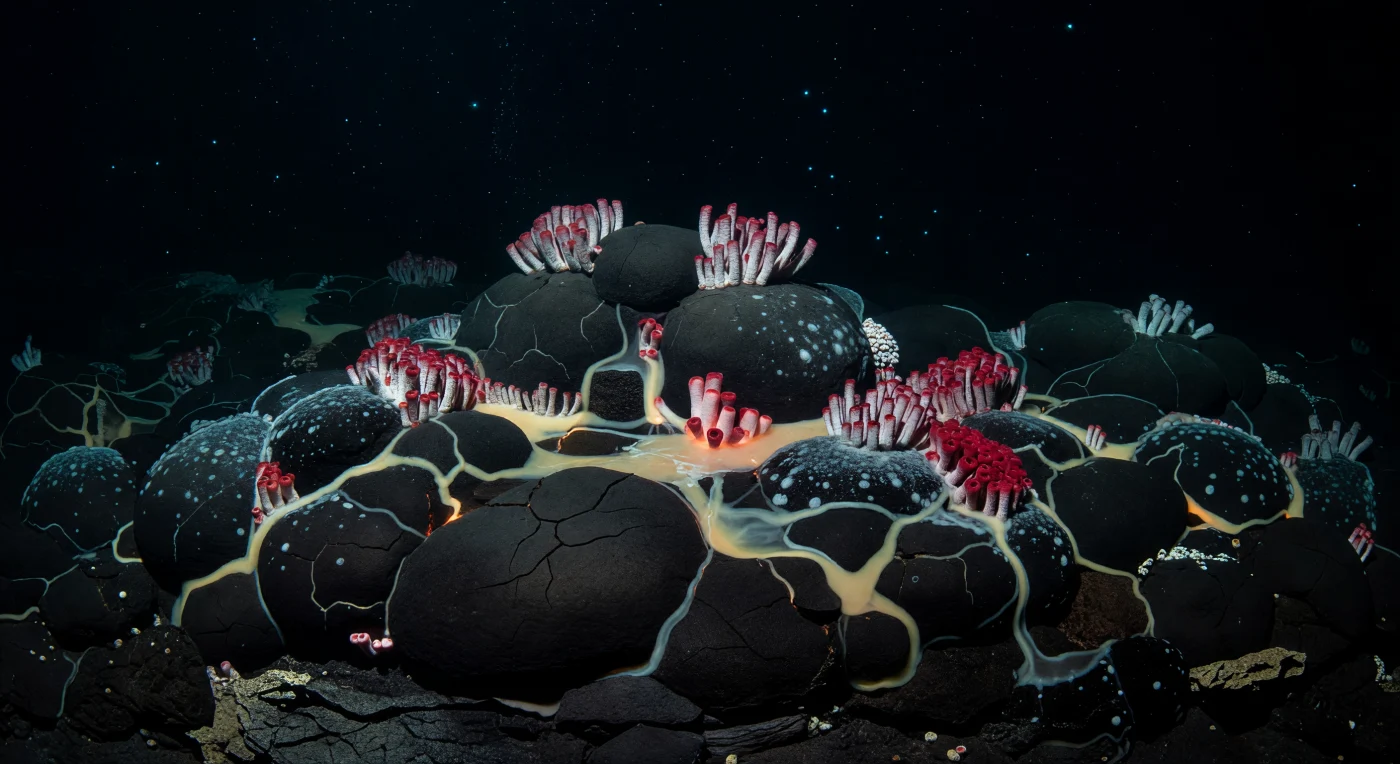
At roughly 2,500 metres below the surface, where tectonic plates slowly tear apart along one of Earth's longest mountain chains, fresh basalt has erupted in rounded pillow forms whose glassy skins still carry the memory of heat, split by fine eruptive cracks through which pale amber hydrothermal fluid trembles upward in wavering, near-invisible veils. Here, sunlight has been absent for kilometres of water column, yet life organises itself densely and purposefully around chemical energy alone — colonies of Riftia pachyptila tube worms crowd the warm fissures in tight red-plumed forests, their bodies sustained entirely by sulphur-oxidising bacteria living within them, while white microbial mats spread across the cracked basalt like slow exhalations, tracing the invisible circulation of vent fluids through the crust below. The pressure at this depth — roughly 250 atmospheres — compresses the water into a cold, dense, crystalline medium through which particles of marine snow and suspended mineral precipitates drift with extraordinary patience, catching the faintest chemiluminescent glow rising from within the diffuse outflow itself. This is a landscape driven not by the sun but by the interior heat of a living planet, a primordial chemistry that preceded photosynthesis in Earth's history and that persists here in absolute darkness, unwitnessed and continuous.
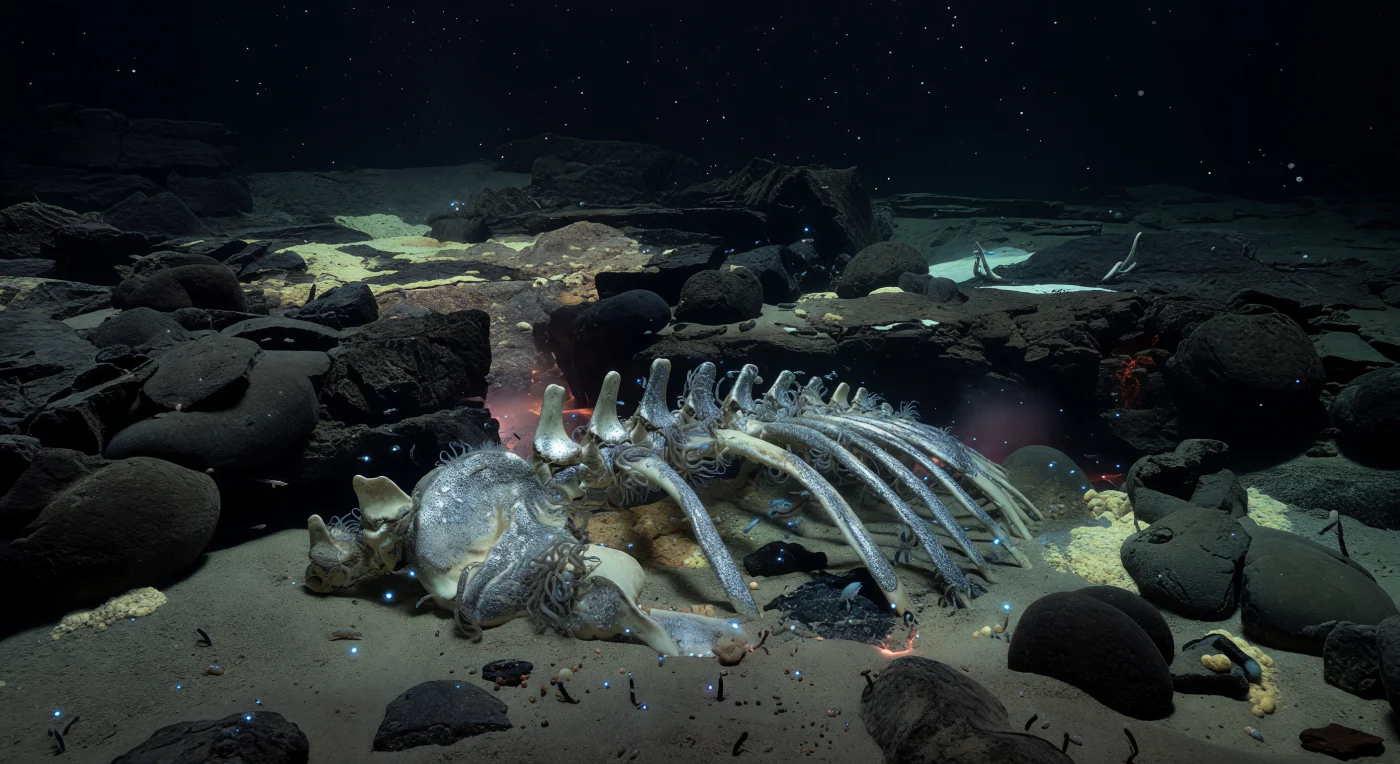
Between 2,500 and 3,000 metres below the surface, on the dark flank of a mid-ocean ridge where tectonic plates pull slowly apart and magma periodically breaches young basalt, a whale skeleton has come to rest in sulfur-stained sediment — a sunken continent of carbon and lipid that sustains entire successions of life long after the whale's death. The exposed vertebrae and ribs arch from the seabed like pale monuments, their surfaces colonised by dense bacterial films that oxidise bone lipids through sulfate reduction, releasing hydrogen sulfide and sustaining chemosynthetic communities in the same chemical language as the nearby hydrothermal fissure, whose diffuse warm outflow seeps through fractured basalt and tints the surrounding sediment with pale sulfur precipitates. Osedax worms — the bone-eaters — anchor their root-like tissues into marrow cavities and collagen remnants, their delicate plumes trembling in imperceptible currents, while amphipods and deep-sea shrimp drift through the darkness, their bodies producing brief cyan and blue bioluminescent pulses that trace the geometry of ribs and joints with cold fire. At this pressure — roughly 270 to 300 atmospheres — no sunlight has reached the water column for hundreds of metres above, and the entire scene persists in total photonic isolation, governed by chemistry, tectonics, and the slow patient metabolism of organisms that have never required the sun.