At roughly 2,500 metres below the surface, where tectonic plates slowly tear apart along one of Earth's longest mountain chains, fresh basalt has erupted in rounded pillow forms whose glassy skins still carry the memory of heat, split by fine eruptive cracks through which pale amber hydrothermal fluid trembles upward in wavering, near-invisible veils. Here, sunlight has been absent for kilometres of water column, yet life organises itself densely and purposefully around chemical energy alone — colonies of Riftia pachyptila tube worms crowd the warm fissures in tight red-plumed forests, their bodies sustained entirely by sulphur-oxidising bacteria living within them, while white microbial mats spread across the cracked basalt like slow exhalations, tracing the invisible circulation of vent fluids through the crust below. The pressure at this depth — roughly 250 atmospheres — compresses the water into a cold, dense, crystalline medium through which particles of marine snow and suspended mineral precipitates drift with extraordinary patience, catching the faintest chemiluminescent glow rising from within the diffuse outflow itself. This is a landscape driven not by the sun but by the interior heat of a living planet, a primordial chemistry that preceded photosynthesis in Earth's history and that persists here in absolute darkness, unwitnessed and continuous.
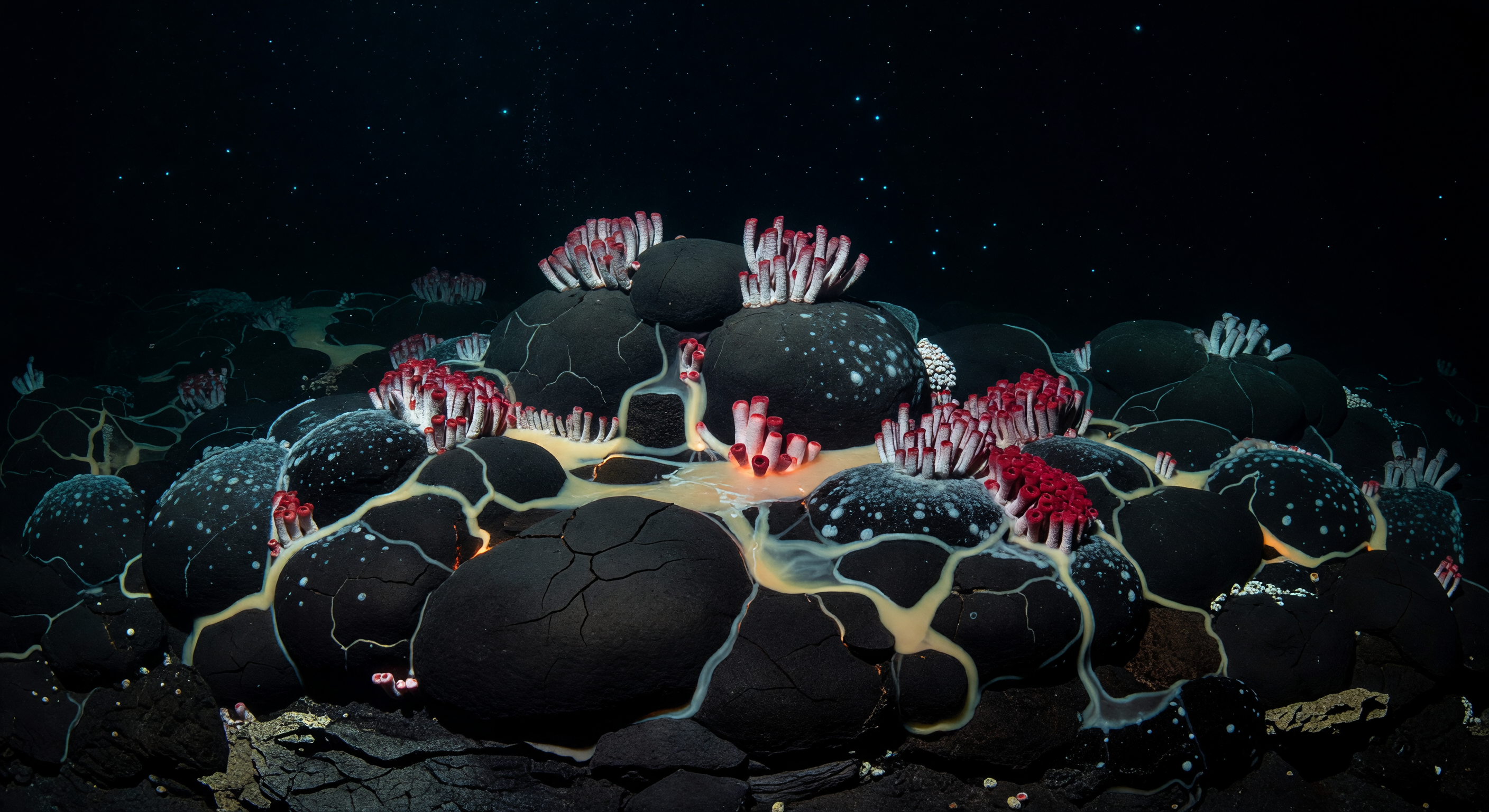
Mid-ocean ridge