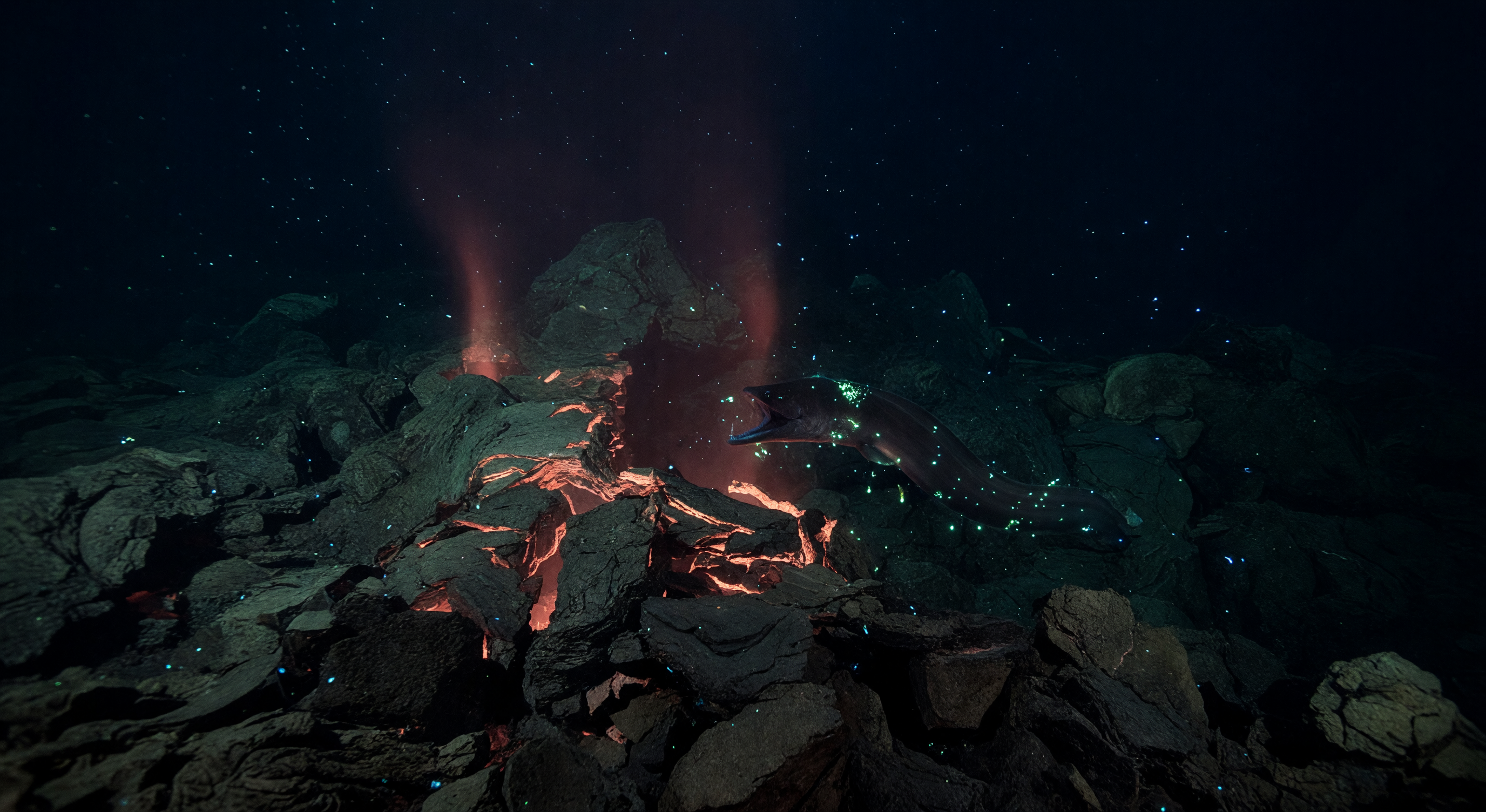
At roughly 2,500 to 3,000 metres depth along an active spreading centre, where tectonic plates pull apart and fresh basalt erupts in slow, dark violence, the water column carries the memory of heat even where no chimney rises — diffuse hydrothermal fluids seep through fractured pillow lava and ascend as trembling curtains of chemically altered seawater, bending the darkness with faint orange-red shimmer and suspending fine mineral particles that catch whatever light the living world produces. Here, under pressure approaching 300 atmospheres, a gulper eel — Eurypharynx pelecanoides — traces its serpentine arc through the column, its disproportionate pelican jaw parted in a passive sweep, an evolutionary solution to a world where prey is rare and every encounter must be seized; its charcoal-translucent skin briefly ignites with scattered emerald sparks as disturbed bioluminescent plankton burst along its flanks, a chain reaction of cold biological light entirely unwitnessed except by the darkness itself. Below, the fractured basalt record layers of eruption — black glassy rinds over still-warm interiors, fissures where seawater descends to be chemically transformed and returned — a geology measured not in millions of years but in decades, some surfaces younger than living organisms nearby. This is a place where chemical energy, not sunlight, anchors the food web, where the ridge exhales warmth through stone, and where life has organised itself around processes that would proceed identically whether any creature observed them or not.
Mid-ocean ridge