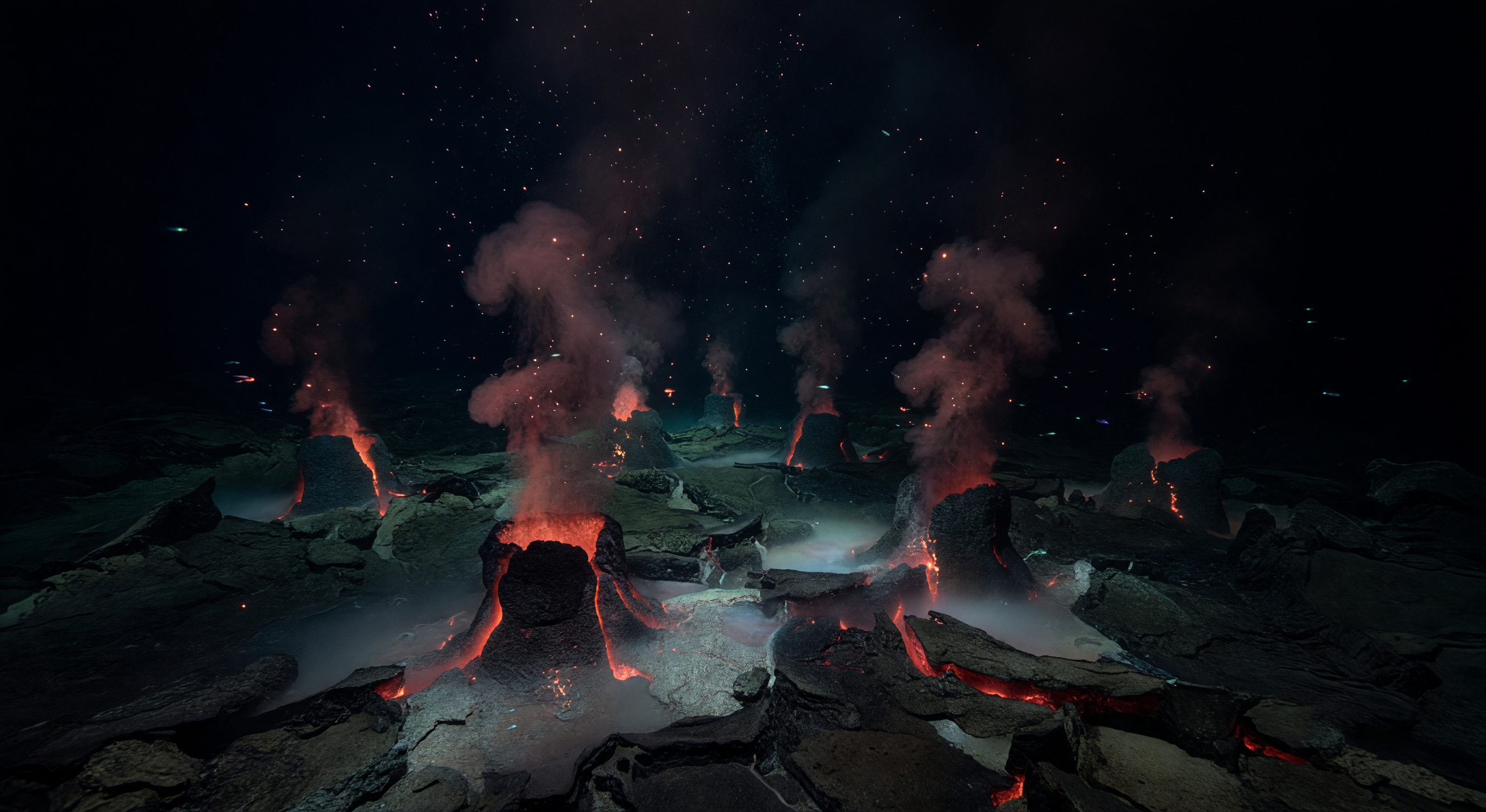
Where two tectonic plates tear slowly apart on the deep ocean floor, magma wells upward and seawater seeps into the fractured crust, emerging again as superheated, mineral-laden fluid at temperatures exceeding 400 °C — far beyond boiling, kept liquid only by pressures of 250 to 400 atmospheres bearing down at these depths between 2,500 and 3,500 meters. The sulfide chimneys that result grow in clustered formations across the axial floor, their walls precipitated from iron, copper, and zinc sulfides that crystallize the instant superheated fluid meets near-freezing ambient water, each chimney exhaling a dense dark plume edged with a faint copper-red chemiluminescent glow — a thermal radiation faint enough to be invisible to most instruments yet real, casting no illumination beyond itself, only a dim spectral warmth against the total blackness. Around the base of each structure, pale anhydrite and barite mineral crusts spread across broken pillow lavas and fresh basalt talus, slick with microbial mats of sulfur-oxidizing Archaea and Bacteria that form the true foundation of this ecosystem, replacing photosynthesis entirely with chemosynthesis. No sunlight has reached this place since the crust beneath it first cracked open; marine snow drifts down through the cold black water column above, while sparse bioluminescent flickers from small pelagic animals pulse briefly beyond the chimneys — a world of chemical fire and biological invention, wholly indifferent to the surface above it.
Other languages
- Français: Constellation de Fumeurs Noirs
- Español: Constelación de Fumadores Negros
- Português: Constelação de Fumegadores Negros
- Deutsch: Schwarzraucher Konstellation
- العربية: كوكبة المدخنات السوداء
- हिन्दी: काले धुआंदार तारामंडल
- 日本語: 黒煙突の星座
- 한국어: 블랙 스모커 성좌
- Italiano: Costellazione di Fumatori Neri
- Nederlands: Zwarte Roker Constellatie