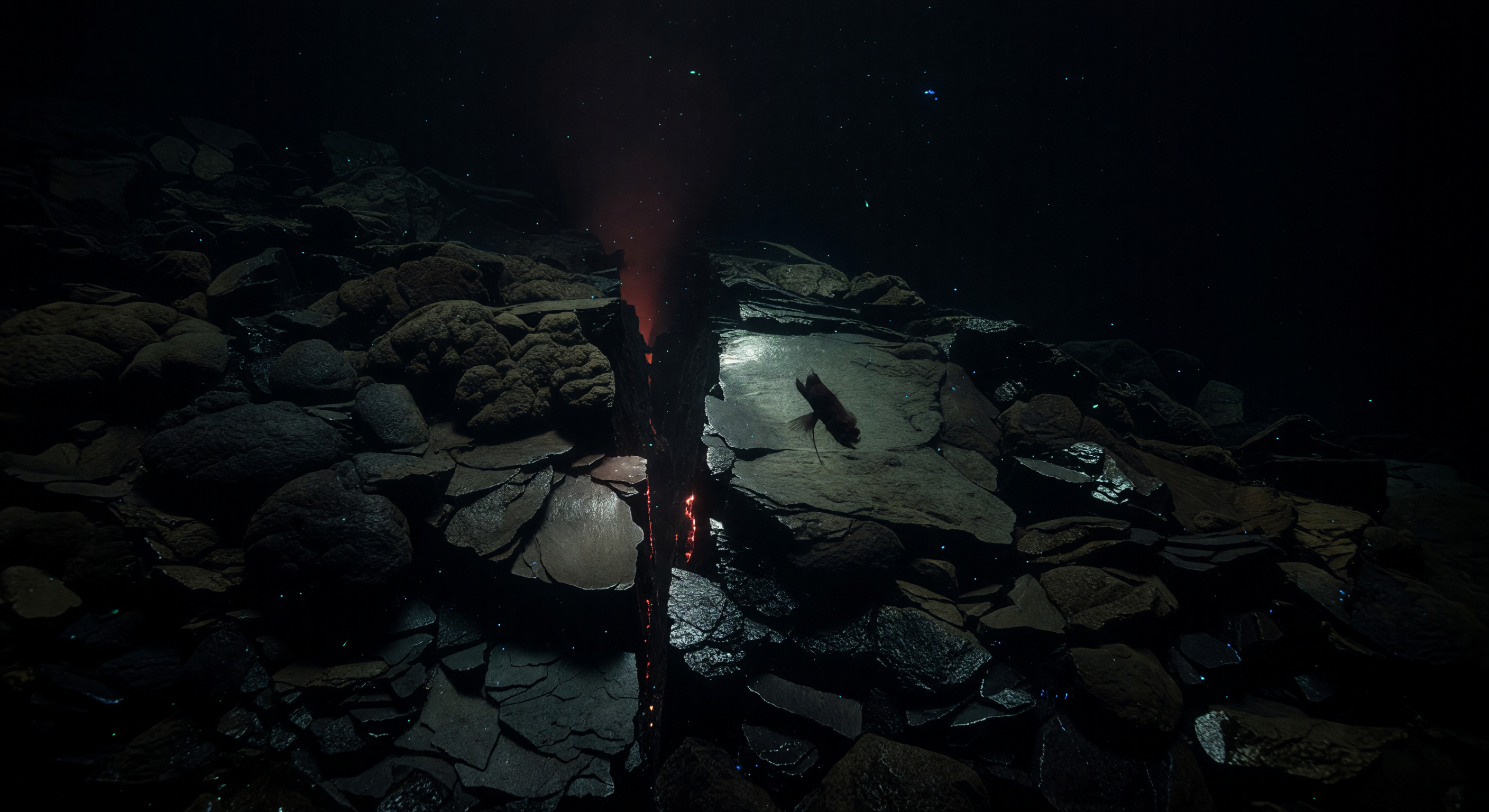
Along a mid-ocean ridge fault scarp at roughly 2,500 to 3,500 metres depth, tectonic plates draw apart with geological patience, forcing fresh basalt upward through eruptive fissures and leaving pillow lavas and volcanic glass stacked in fractured ledges that plunge into absolute darkness below. At these pressures — exceeding 250 atmospheres — seawater percolates deep into newly formed crust, is superheated by underlying magma, and rises again as diffuse hydrothermal outflow, carrying dissolved minerals that shimmer faintly against dark rock faces and feed chemosynthetic microbial films along warm crack margins; a distant vent plume bleeds a ruddy orange-red haze up the wall, the only chromatic warmth in an otherwise lightless world. Against this faint thermal backlight, a viperfish — *Chauliodus* sp. — hangs suspended in the water column, its elongated body and grotesque needle dentition rendered as a pure razor silhouette, a predator shaped by millions of years of selection for ambush and lure in a realm where metabolic economy is survival. Scattered cyan-blue-green bioluminescent points pulse in the surrounding blackness, likely from small mesopelagic migrants or invertebrate drifters carried on slow ridge-driven currents, while marine snow and mineral particles settle without interruption through water that has never known sunlight. This is ocean as deep-earth process: volcanic, chemical, pressurized, and entirely indifferent to any witness.
Mid-ocean ridge