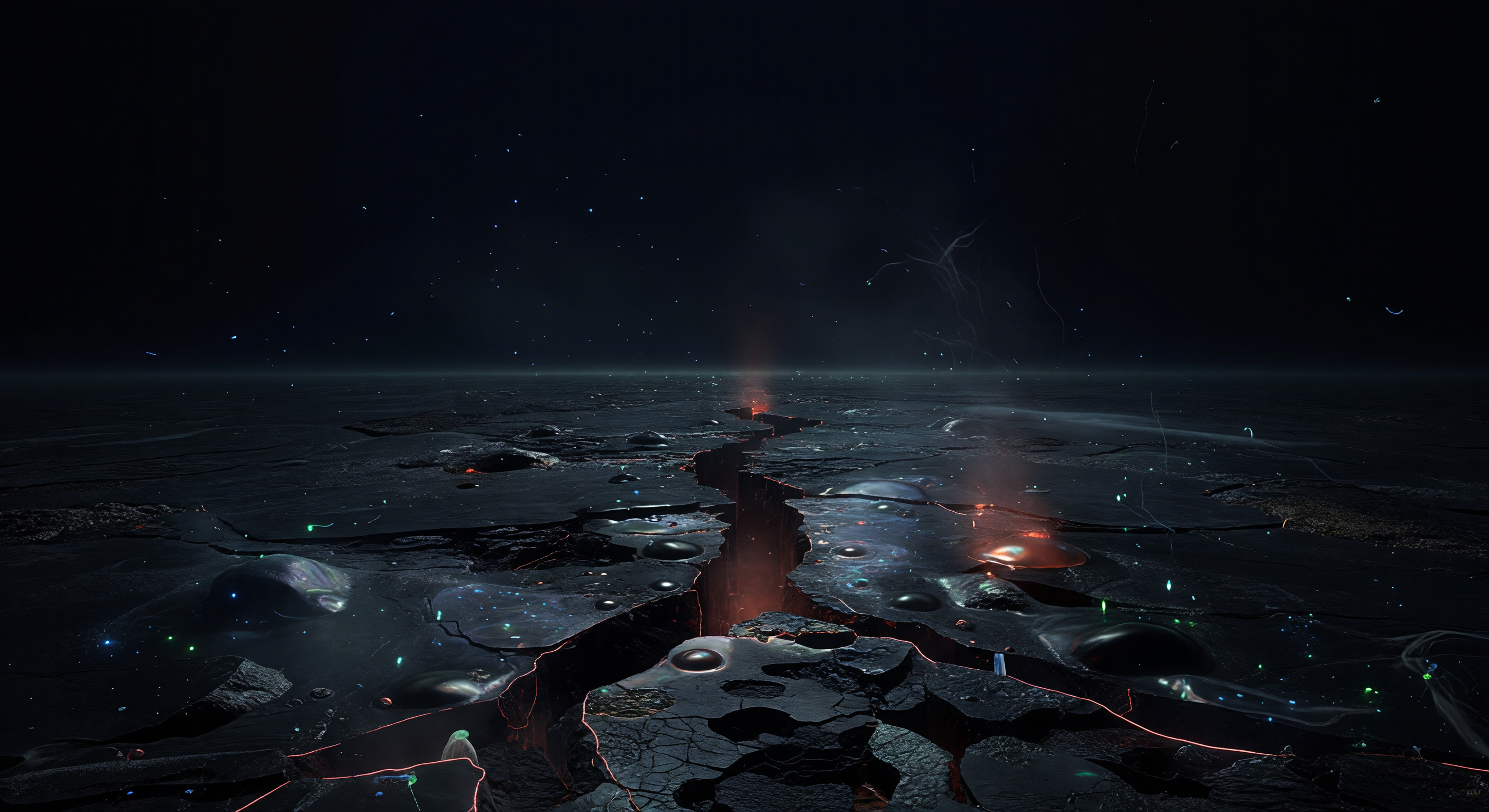
Along the axial crest of a mid-ocean spreading ridge, roughly 2,500 to 3,000 meters below the last trace of sunlight, a fresh eruptive fissure has torn open the volcanic plain, exposing the living interior of the planet's crust in near-total darkness. Molten basalt extruded along the fracture margins cools almost instantly against seawater at near-freezing temperatures and pressures exceeding 250 atmospheres, its outermost skin solidifying into jet-black volcanic glass while the still-hot interior continues to swell into the rounded forms of nascent pillow lavas — a process that has built most of Earth's oceanic crust since the planet formed. Sulfur-bearing hydrothermal fluids seep diffusely through hairline cracks in the collapsing crust, their faint chemiluminescent veil and the residual thermal glow of the freshest basalt providing the only illumination in an otherwise lightless world, while thin mineral hazes drift upward into water already carrying a slow suspension of marine snow descending from the sunlit ocean kilometers above. Sparse bioluminescent organisms — microscopic pressure-adapted plankton and vent-associated fauna — trace faint cyan sparks at the periphery of the hydrothermal shimmer, their presence a quiet testament to chemosynthetic food webs that owe nothing to the sun. Here, geology and biology exist in a state of primordial intimacy, the ridge breathing magma, the ocean absorbing it, and life persisting at the seam between them in absolute silence.
Mid-ocean ridge