Above a mid-ocean ridge crest where tectonic plates are slowly wrenched apart, transparent pelagic jellies — medusae and siphonophores among them — pulse through water held at near-freezing temperatures under pressures exceeding 200 to 300 atmospheres, their soft bodies utterly indifferent to forces that would crush any rigid structure. The only illumination here is biological: cyan and blue-violet bioluminescent pulses ripple through radial canals and trailing filaments, each animal's photophores triggering neighbors in a chain reaction that maps the invisible layered currents flowing over the volcanic spine below. That spine is freshly born geology — black glassy pillow lavas, eruptive fissures still sharp-edged, basaltic hummocks built by magma rising where the lithosphere tears — and from narrow cracks along the crest, diffuse hydrothermal circulation exhales a faint thermal shimmer and chemiluminescent haze, a ghost-glow of chemical energy that underwrites an entire food web unconnected to the sun. Marine snow — the perpetual slow rain of organic particles, mineral flakes, and microbial aggregates — drifts freely past bell margins and hair-thin tentilla, marking the stillness of a water column so removed from the surface that it constitutes its own interior ocean, ancient, pressurized, and entirely self-sufficient, pulsing with cold light long before anything capable of witnessing it ever existed.
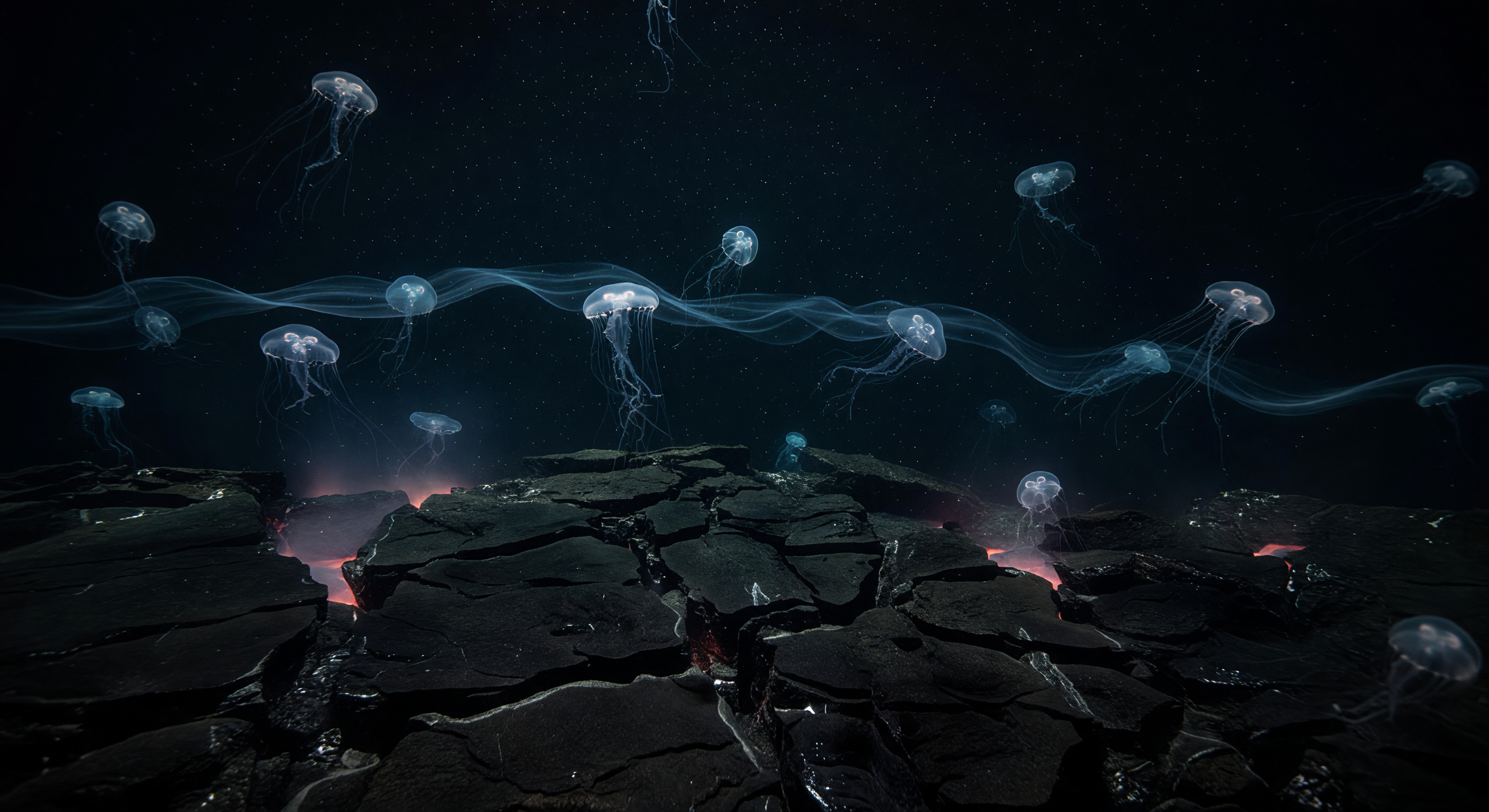
Mid-ocean ridge