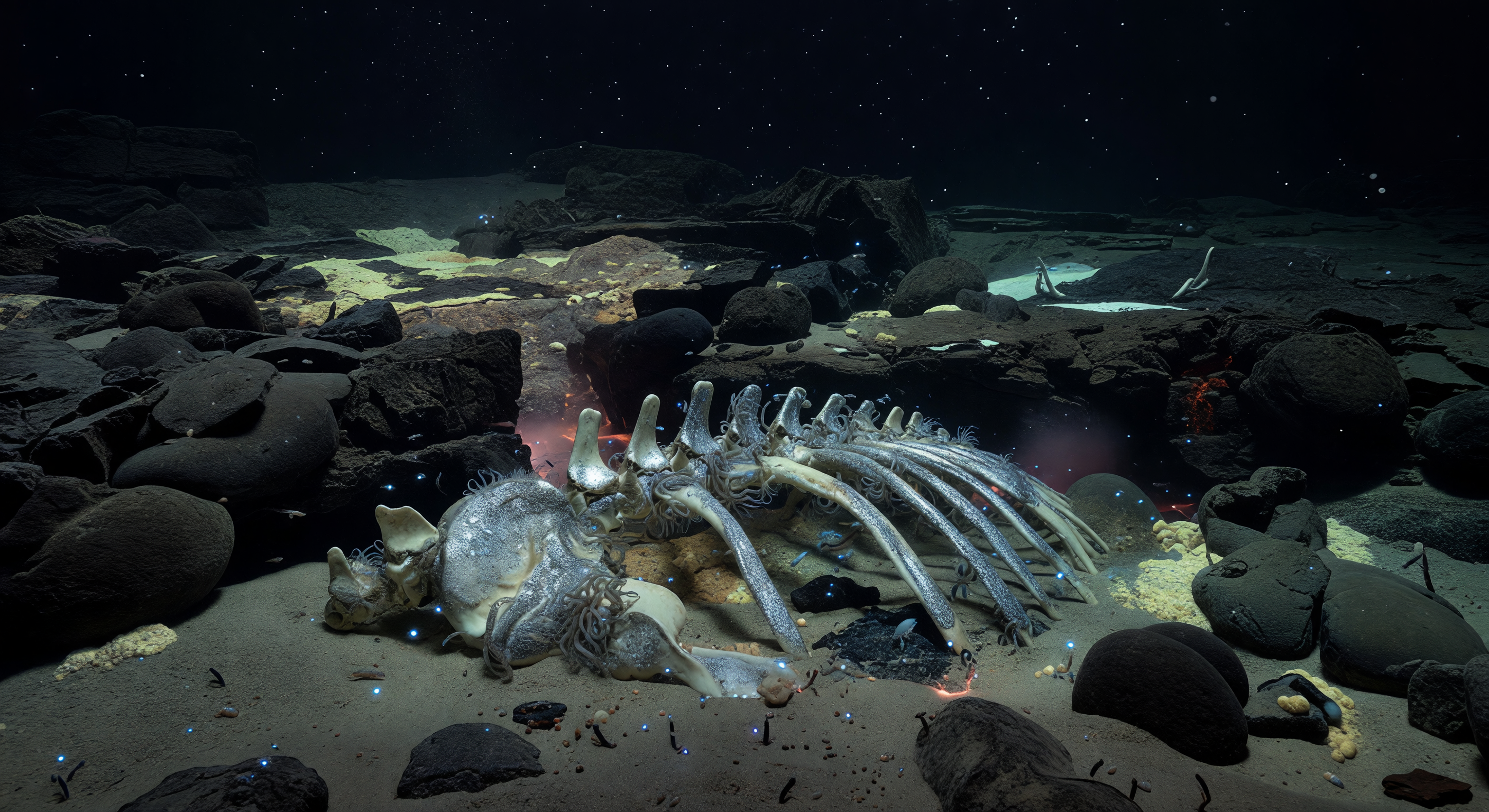
Between 2,500 and 3,000 metres below the surface, on the dark flank of a mid-ocean ridge where tectonic plates pull slowly apart and magma periodically breaches young basalt, a whale skeleton has come to rest in sulfur-stained sediment — a sunken continent of carbon and lipid that sustains entire successions of life long after the whale's death. The exposed vertebrae and ribs arch from the seabed like pale monuments, their surfaces colonised by dense bacterial films that oxidise bone lipids through sulfate reduction, releasing hydrogen sulfide and sustaining chemosynthetic communities in the same chemical language as the nearby hydrothermal fissure, whose diffuse warm outflow seeps through fractured basalt and tints the surrounding sediment with pale sulfur precipitates. Osedax worms — the bone-eaters — anchor their root-like tissues into marrow cavities and collagen remnants, their delicate plumes trembling in imperceptible currents, while amphipods and deep-sea shrimp drift through the darkness, their bodies producing brief cyan and blue bioluminescent pulses that trace the geometry of ribs and joints with cold fire. At this pressure — roughly 270 to 300 atmospheres — no sunlight has reached the water column for hundreds of metres above, and the entire scene persists in total photonic isolation, governed by chemistry, tectonics, and the slow patient metabolism of organisms that have never required the sun.
Mid-ocean ridge