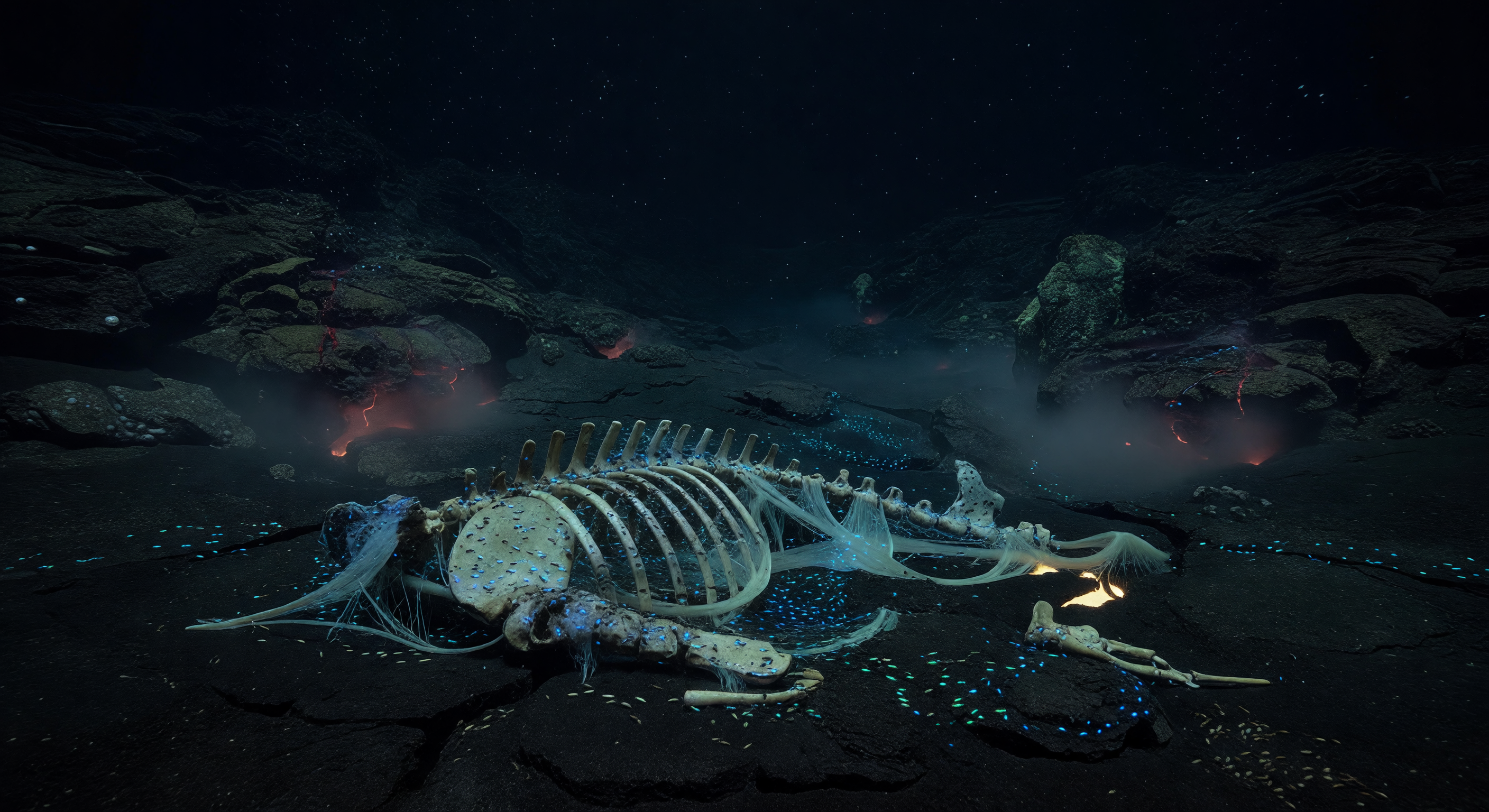
At roughly 2,500 to 3,000 metres below the surface, where tectonic plates slowly peel apart along a volcanic spine of black basalt, the crushed skeleton of a great whale has come to rest on a valley floor of pillow lavas and fractured eruptive fissures — a serendipitous collision between two of the deep ocean's most profound events. Pressure here exceeds 250 atmospheres, sunlight has been extinct for kilometres above, and yet the carcass pulses with cold blue and cyan bioluminescence as dense amphipod swarms move in coordinated feeding waves across pale tissue that still bridges the arcing ribs in translucent strands, each scavenger briefly tracing a green-blue flash before vanishing between exposed vertebrae. Farther across the basaltic sediment, diffuse hydrothermal outflow seeps silently from hairline fissures, lending a faint orange-red chemiluminescent veil to the surrounding volcanic hummocks — a reminder that this ridge already sustains chemoautotrophic life entirely independent of the sun — while mineral particles and marine snow drift freely through the absolute darkness of the water column, unhurried and unwitnessed. The whale fall transforms an otherwise austere rift valley into a sudden oasis of organic energy, a phenomenon that deep-sea ecologists recognise as a succession of ecological stages that can sustain distinct biological communities for decades, drawing mobile scavengers, enrichment-opportunist fauna, and ultimately sulfophilic bacteria that chemically mirror the hydrothermal ecosystems already colonising the basalt nearby. In the immensity of this black ridge valley, the luminous carcass reads as both catastrophe and gift — a brief, cold star settling into geological time.
Mid-ocean ridge