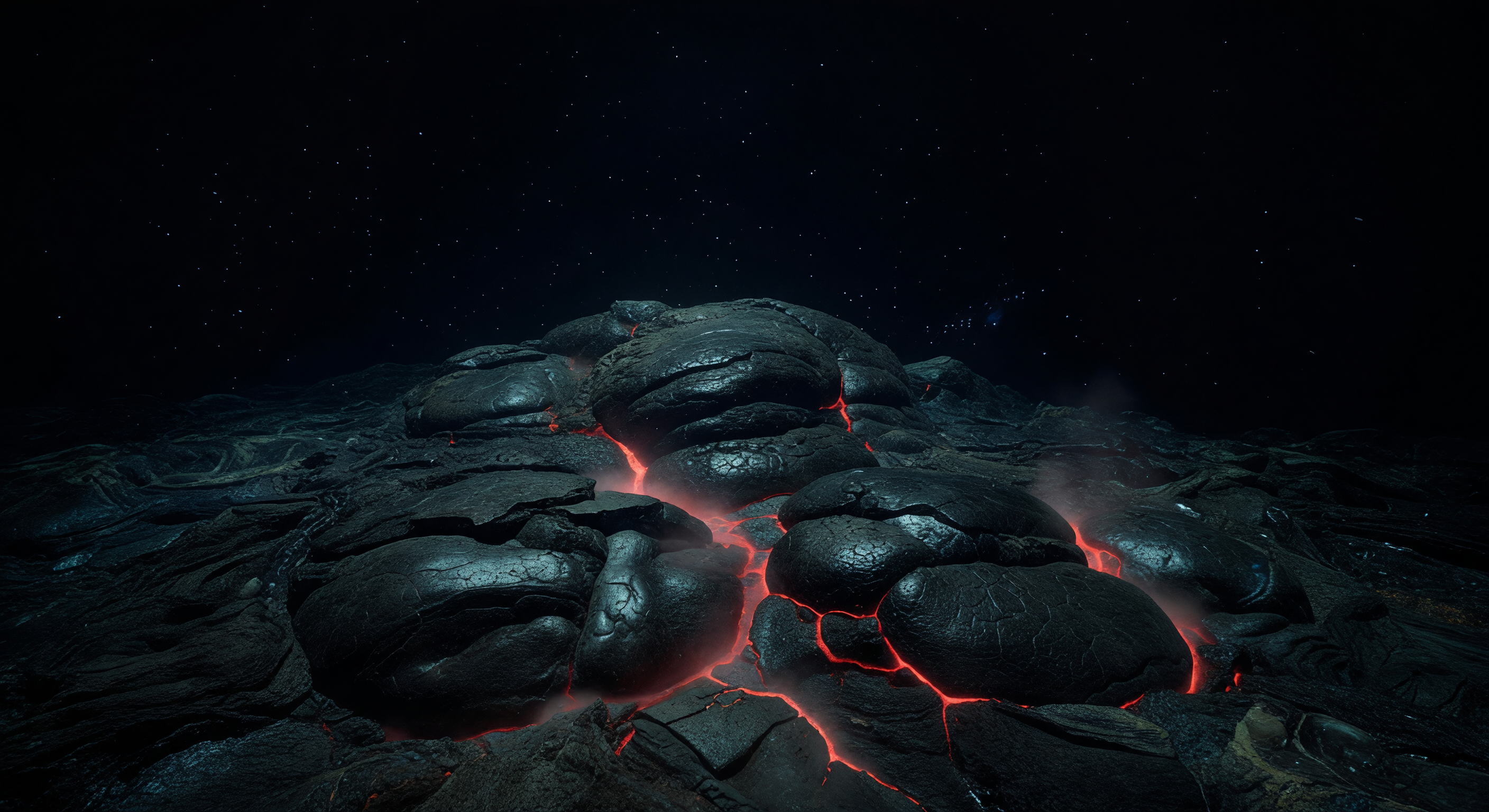
At roughly 2,500 to 3,000 meters beneath the surface, where no photon of sunlight has ever reached and hydrostatic pressure exceeds 250 atmospheres, the mid-ocean ridge crest erupts in slow volcanic breath — fresh pillow lavas heaped like swollen obsidian spheres, their quench-cracked skins still radiating a dull cherry glow where molten basalt continues to pulse through narrow eruptive seams. This is a spreading center, a place where two tectonic plates pull apart and the mantle responds by forcing magma upward, building new oceanic crust at rates of centimeters per year; the glassy, sediment-free surfaces of these pillows confirm the eruption is geologically instantaneous, the lava too newly solidified for any biological or mineral veil to have settled upon it. Along the warmest fissures, shimmering thermal distortion rises invisibly through the abyssal water column as chemically enriched hydrothermal outflow seeps between basalt contacts, carrying dissolved iron, sulfur, and silica in soft orange-red veils that betray the heat beneath without ever fully illuminating the surrounding darkness. Scattered through the black water, a few cyan-blue bioluminescent pinpricks mark the passage of deep-pelagic organisms — copepods, small medusae, or bristlemouth fish — drifting through a world powered entirely by geochemical energy rather than photosynthesis. The scene exists in absolute silence and crushing stillness, marine snow descending grain by grain through water that has never known the surface, indifferent to any witness.
Mid-ocean ridge