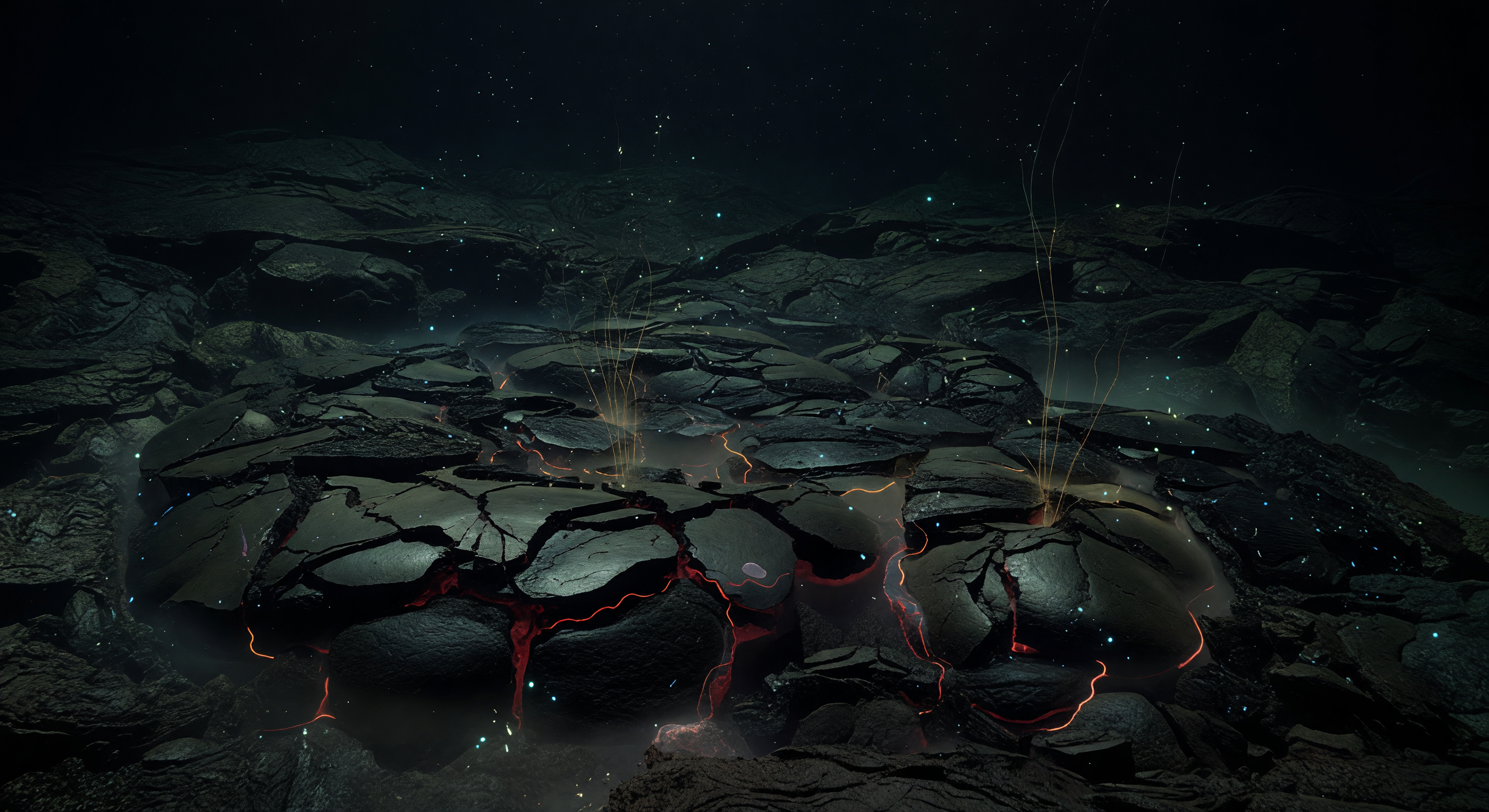
At roughly 2,500 to 3,000 meters below the surface, where the weight of water above reaches 250 to 300 atmospheres, a broad terrace of freshly erupted pillow basalts steps down from the axial valley of a mid-ocean spreading center — one of the most geologically active environments on Earth, where diverging tectonic plates draw magma upward through the crust and freeze it into these characteristic rounded lobes the moment it meets seawater near freezing. Each glossy black pillow bears the glassy rind of rapid quenching, its surface laced with cooling fractures and collapsed seams that record the precise moment the ocean claimed it, while narrower eruptive fissures thread between the lobes like sutures in new crust. Through the freshest of these cracks, diffuse hydrothermal fluids — heated by the magma chamber kilometers below, enriched with dissolved minerals, sulfides, and chemical energy — seep upward in delicate shimmering veils that carry faint gold and amber warmth, forming chemiluminescent halos and sustaining microbial films that cling to the hottest fractures in a ghostly sheen, the base of a food web entirely independent of sunlight. Beyond the foreground terrace, the fault-broken ridge topography dissolves into absolute blackness, crossed only by slow drifts of marine snow and suspended mineral particles, while scattered cyan and blue-green bioluminescent sparks mark the silent passage of pressure-adapted fauna navigating a primordial volcanic world that has never required a witness.
Mid-ocean ridge