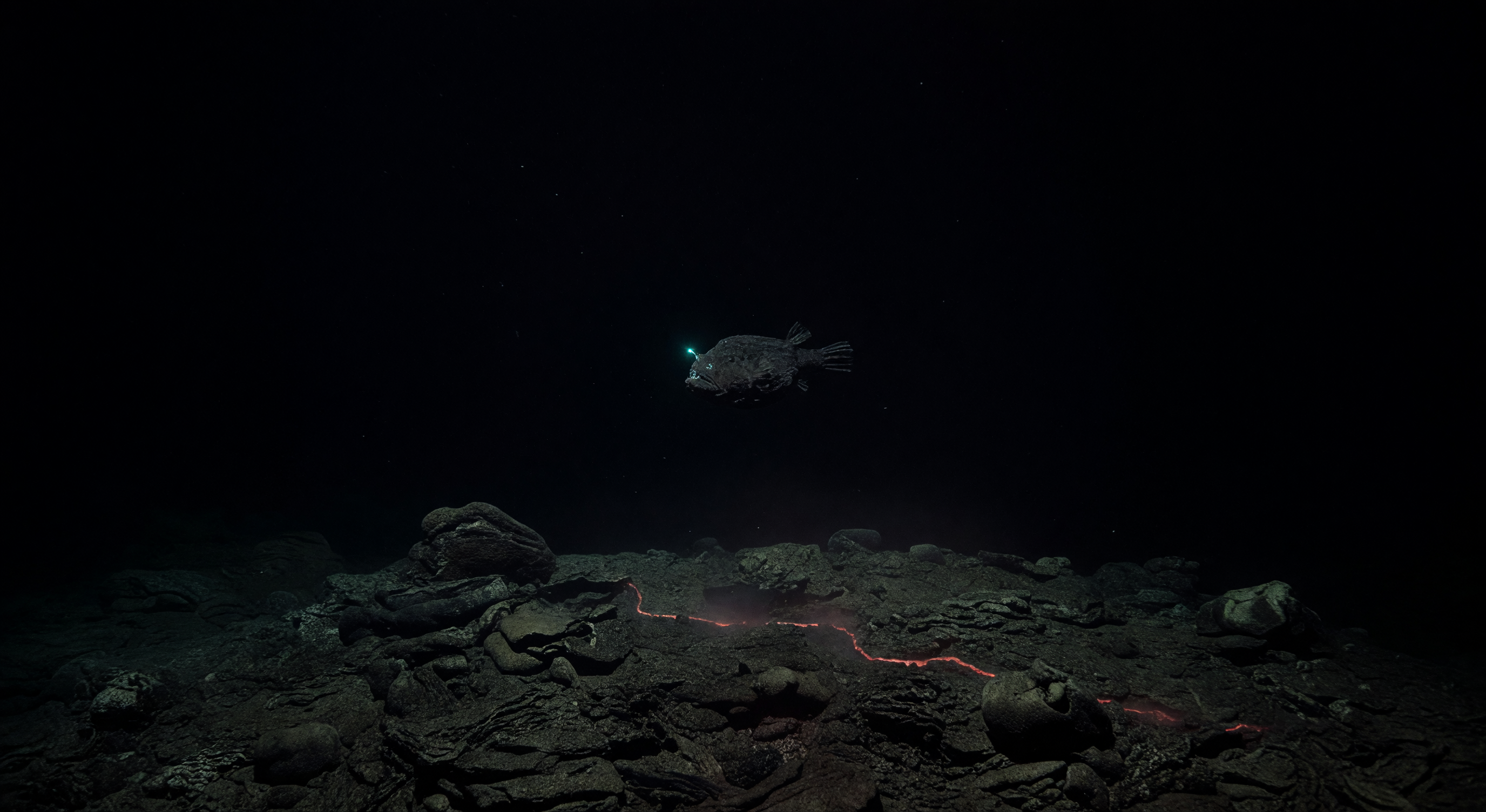
At roughly 2,500 to 3,000 meters below the surface, where the Mid-Atlantic or East Pacific Rise fractures the seafloor into a broken volcanic spine, a solitary ceratioid anglerfish drifts motionless above fresh basalt — its esca, a chemically sustained bioluminescent organ colonized by symbiotic bacteria, burning as the only resolved point of light in an otherwise absolute void. The lure belongs to a lineage perfected by millions of years of selection in perpetual darkness, where producing light costs metabolic currency and attracting prey or a mate across the crushing silence of 250 to 300 atmospheres of pressure is worth every photon. Below the animal, the ridge hummock reads as barely differentiated relief: collapsed pillow-lava lobes, glassy black crust quenched instantly against near-freezing seawater, and a narrow eruptive fissure from which diffuse hydrothermal circulation seeps a faint orange warmth — chemiluminescent oxidation reactions in mineral-laden fluid, not fire, tracing the boundary between young oceanic crust and the cold column above it. Sparse marine snow — the slow rain of organic aggregates, fecal pellets, and mineral particles descending from the productive ocean far overhead — drifts through the frame freely, each particle a long-traveled calorie in a world where sunlight has been entirely absent for hundreds of meters, and where chemical energy threading up through volcanic rock sustains the entire ecosystem below.
Mid-ocean ridge