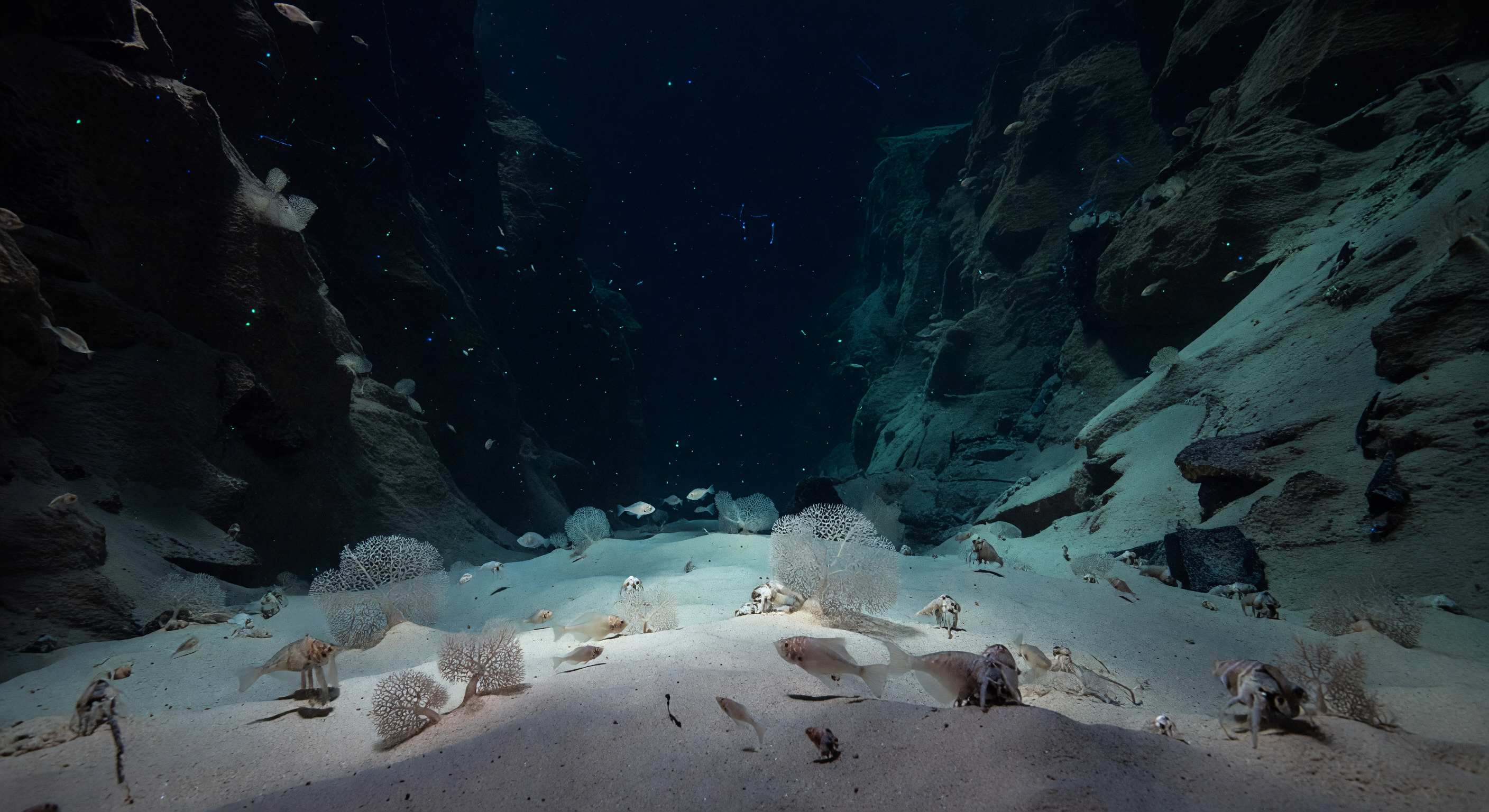
Scientific confidence: High
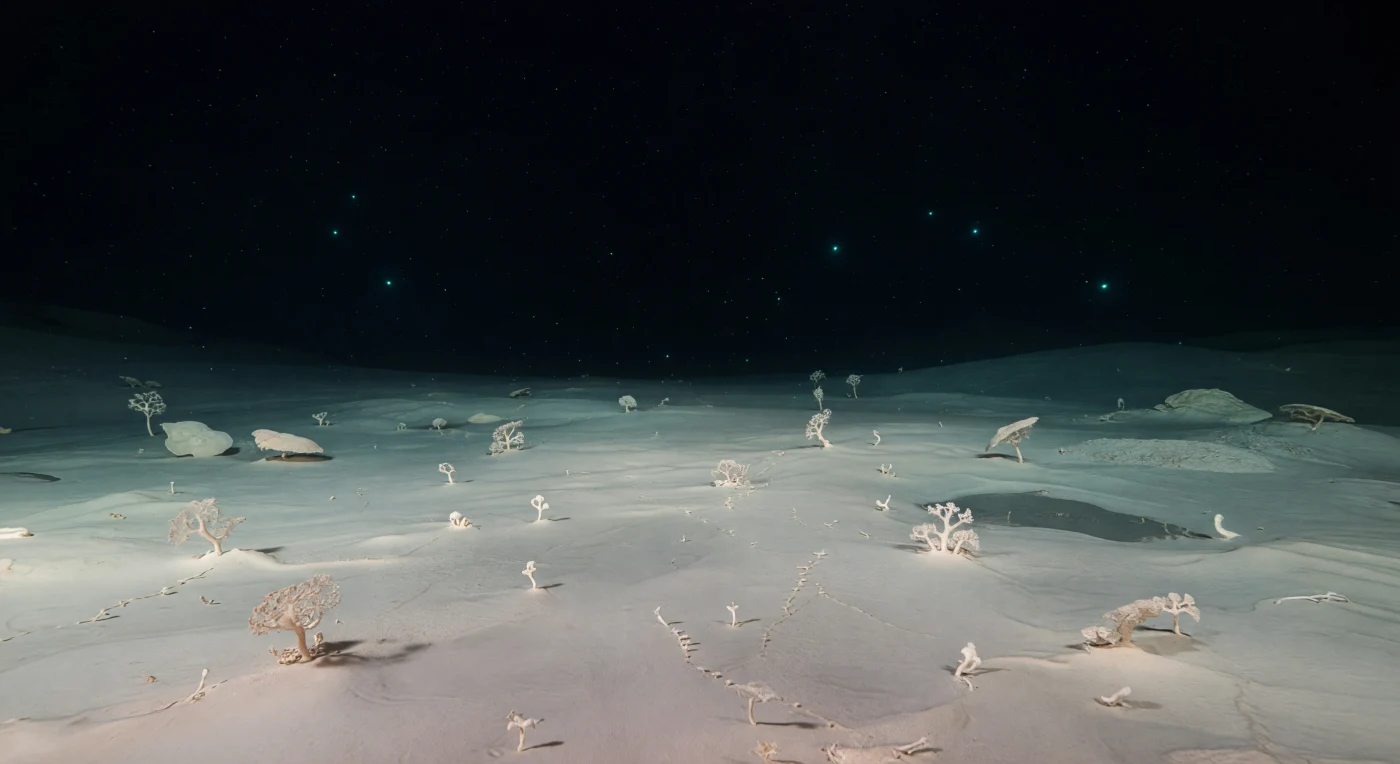
At the very bottom of the world's deepest known point, roughly eleven kilometers beneath the surface, the seafloor of Challenger Deep spreads outward as a vast ivory-pale plain of compacted calcareous sediment — the accumulated remains of foraminifera, radiolaria, and microscopic organisms that have drifted down through the entire water column across geological time. Pressure here approaches 1,100 atmospheres, cold and absolute at barely above 1.5 °C, and no sunlight has ever penetrated to this depth; the darkness is structural, a permanent condition of physics rather than mere absence of day. Scattered across the pale sediment like pale, irregular medallions, giant xenophyophores — single-celled organisms that can reach centimeters or even decimeters in diameter, among the largest individual cells known on Earth — lie half-embedded in the mud, their fragile, chalky tests recording the chemistry and particle flux of this hadal basin in their own living tissue. Faint sinuous trails pressed into the sediment surface trace the passage of amphipods, small crustaceans uniquely adapted to piezophilic existence, their bodies biochemically tuned to function where no surface organism could survive uncompressed. Far above the plain, suspended in the black water column, rare bioluminescent organisms emit isolated points of cold blue-green light — brief, sourceless sparks in an otherwise total darkness — while marine snow drifts in every direction through water so cold and still that this ancient, featureless basin exists in a silence older than almost any landscape on the surface of the planet.
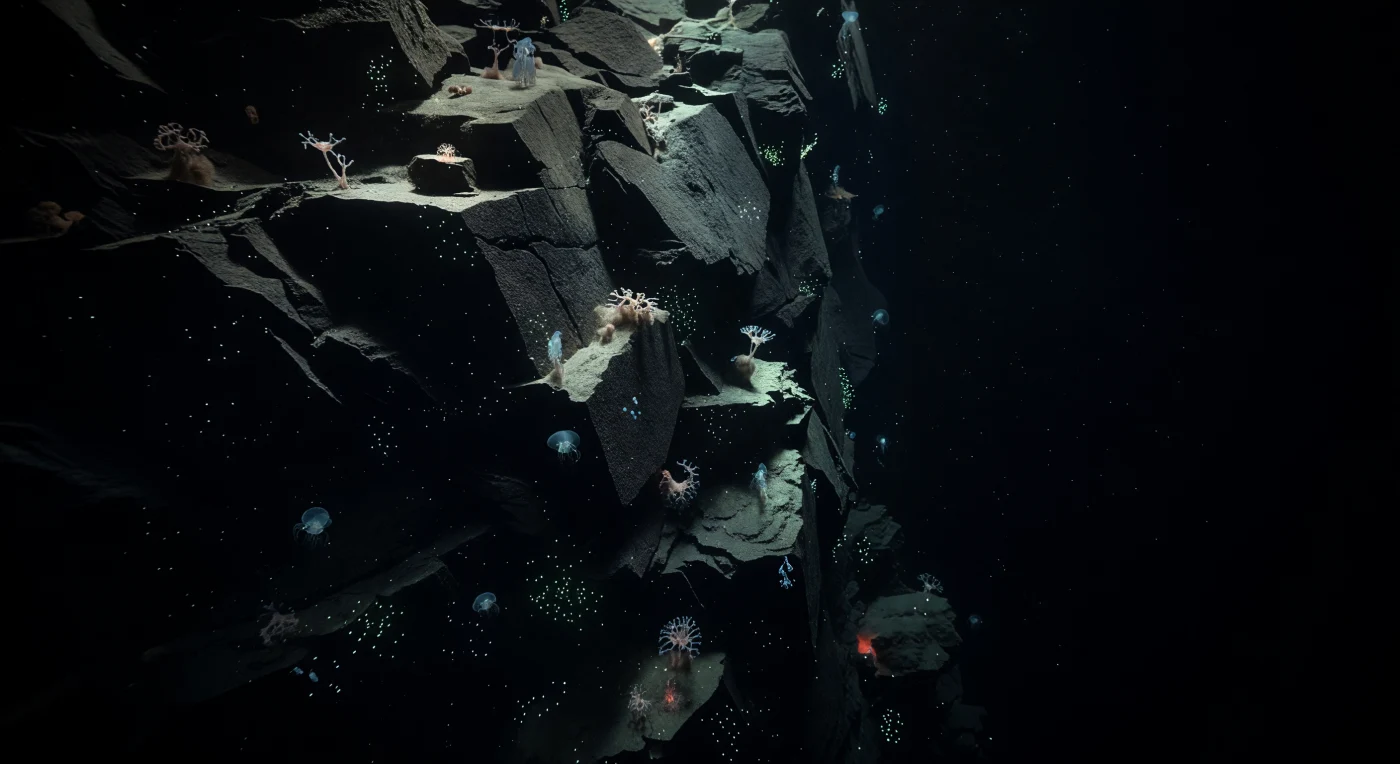
At the deepest recess of the Mariana Trench's subduction architecture, where the Pacific Plate's descent beneath the Philippine Sea Plate has sculpted this near-vertical scarp over millions of years, charcoal-black fractured basalt drops away in successive ledges and fault-controlled gullies under pressure approaching 1,100 atmospheres — a force that compresses every cubic centimeter of water and would collapse any air space instantaneously. Fine marine snow settles in perpetual slow drift across the rock face, accumulating in pale beige draperies on sheltered ledges where xenophyophore-like forms — giant single-celled foraminifera among the largest unicellular organisms on Earth — anchor themselves to the sediment veneer, feeding on the sparse organic particles descending from a sunlit surface nearly eleven kilometers above. Permanent, absolute aphotic darkness fills the void beside the wall, broken only by the cold cyan-blue and faint green pulses of gelatinous drifters and microscopic bioluminescent plankton whose chemical light sketches the wall's relief in fleeting, sourceless glimmers — the only illumination this environment has ever known. Here, in a stillness that silence cannot adequately describe, pressure-adapted microbial communities colonize the pore spaces of sediment and fractured rock, sustaining a hadal food web that functions entirely on the rain of organic matter from above, indifferent to any world beyond this crushing, lightless trench.
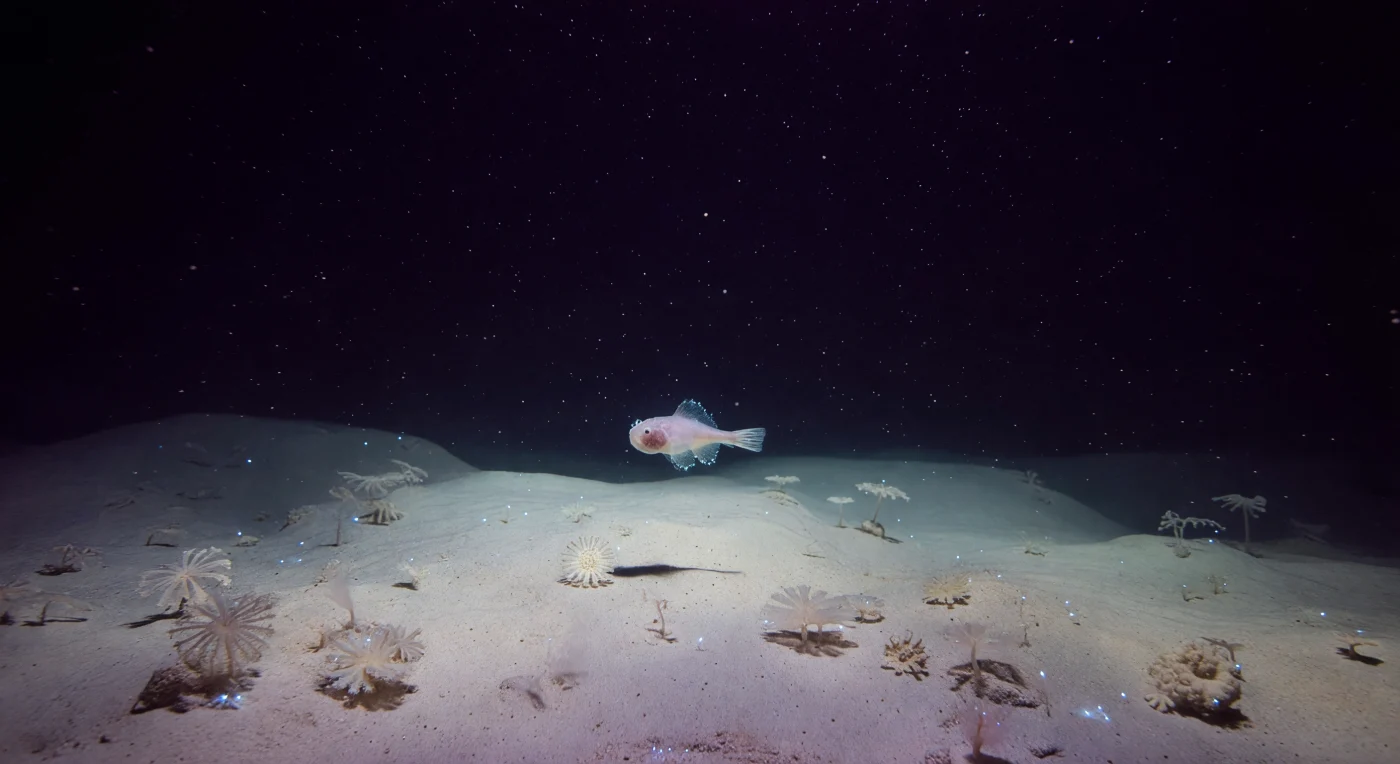
At the bottom of the deepest wound in Earth's crust, where hydrostatic pressure climbs to roughly 1,100 atmospheres and temperatures hover near 1.5°C, a single hadal snailfish — *Pseudoliparis* — drifts in motionless suspension just centimeters above pale beige sediment that has settled here over geological ages, carried down from the sunlit surface world in an unbroken rain of particles that now dust the trench floor in fine, undisturbed silt. The fish's body is soft and gelatinous by biological necessity, its cellular membranes and pressure-adapted enzymes loaded with piezolytes that prevent protein collapse under compression no surface vertebrate could survive; its translucent flesh glows faintly where minute cyan-blue bioluminescent pinpricks from drifting microorganisms briefly edge its fin membranes before winking out into the surrounding void. Scattered across the sediment around it, giant xenophyophores — single-celled foraminifera of extraordinary size, their fragile tests like pale rosettes and lumpy stars half-submerged in silt — stand as testament to a deposit-feeding community sustained entirely by the slow nutritional trickle of marine snow descending through eleven kilometers of darkness. Sparse particles of that snow continue their unhurried fall through black-violet water of absolute clarity and absolute cold, each flake a fragment of biological material from a photosynthetic world so remote it might as well be another planet. No current stirs this place, no sound carries, and the snailfish hangs in the stillness of a world that has existed, pressurized and lightless and complete, entirely without witness.
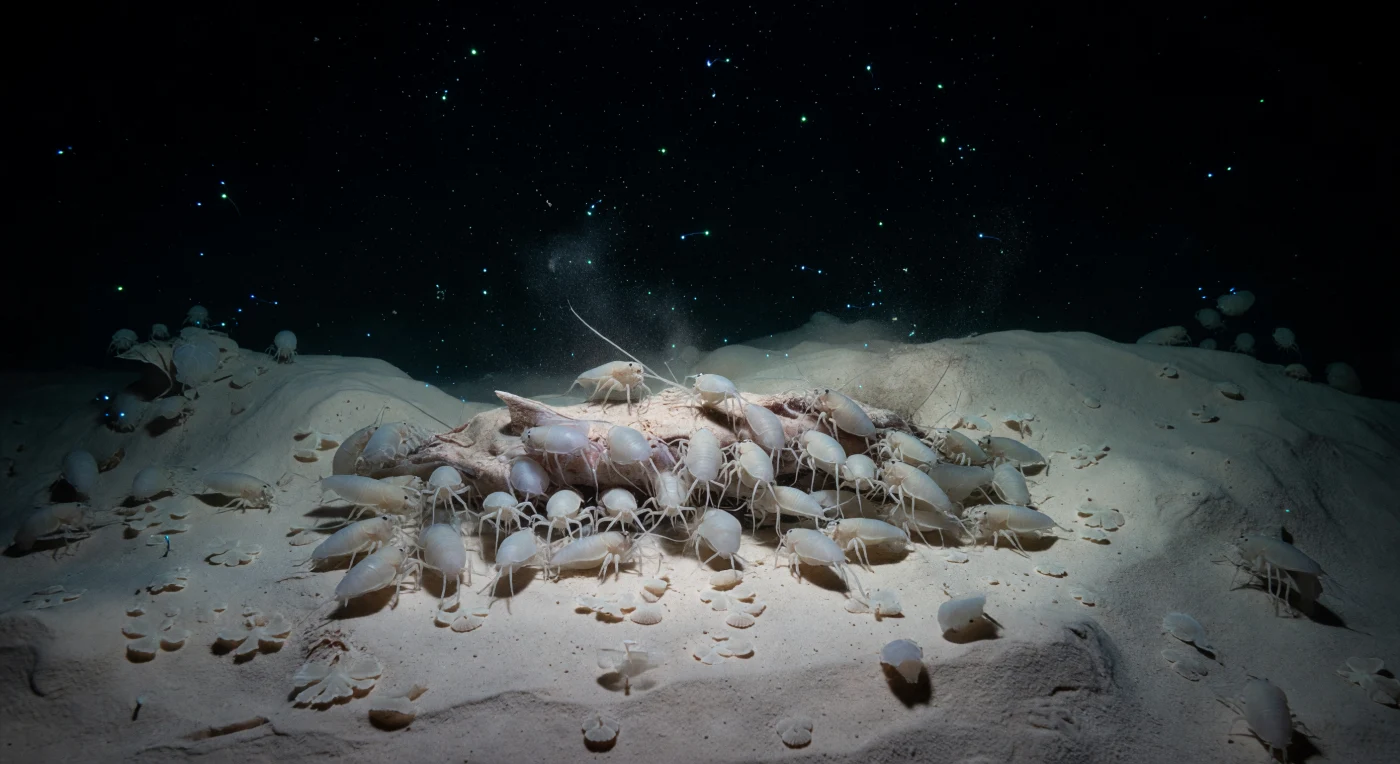
At the deepest point any ocean floor reaches on this planet, beneath roughly 1,100 atmospheres of crushing hydrostatic pressure, dozens of giant amphipods — *Hirondellea gigas* and related hadal scavengers — swarm in dense, overlapping masses over a naturally fallen carcass, their milky, opalescent bodies layered across pale tissue and cream-white sediment in a feeding aggregation that may have drawn them from kilometers away through chemosensory detection of dissolved organic plumes drifting up through the water column. The trench floor here is a ponded sediment basin at the southern terminus of the Mariana Trench, where the Pacific Plate subducts beneath the Philippine Sea Plate and concentrates organic matter into a biological trap, making these rare carcass falls disproportionately significant energy subsidies in an environment where photosynthesis-derived carbon must travel nearly eleven kilometers to arrive. Scattered across the surrounding sediment, giant xenophyophores — single-celled foraminifera sometimes exceeding ten centimeters across — persist as lobed, irregular discs among fine rippled silt, while disturbed clouds of pale sediment hang suspended above the feeding mass, catching intermittent blue-green bioluminescent pulses from small organisms moving through the darkness. Water here is permanently aphotic, permanently cold near 1.5°C, and laden with marine snow — the slow rain of organic particles from the surface world far above — each suspended speck a faint record of sunlit productivity in a realm where no sunlight has ever reached. This is a world that requires nothing from us to exist: complete, ancient, and silently functional under pressures that would destroy any unprotected biological tissue not shaped by millions of years of hadal evolution.
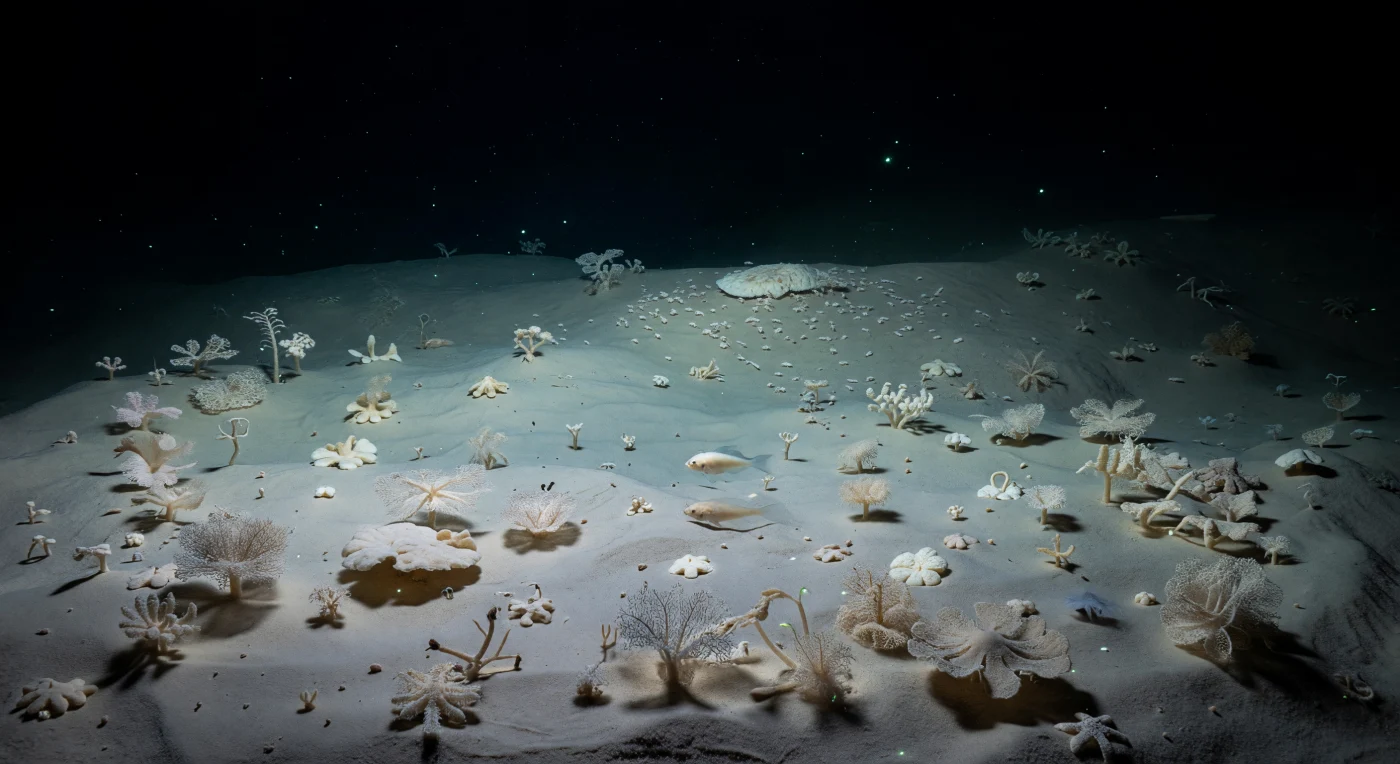
At the bottom of the deepest known wound in Earth's crust, where hydrostatic pressure exceeds one thousand atmospheres and no photon of sunlight has ever penetrated, a vast silent plain of silken beige sediment stretches outward in every direction, its surface so undisturbed that the finest marine snow — organic detritus drifting down from the sunlit world nearly eleven kilometers above — settles without disturbance, accumulating across millennia into a pale, velvety record of the ocean's biological history. Across this floor spreads one of the most remarkable biological communities on the planet: fields of giant xenophyophores, single-celled organisms among the largest known to science, their fragile architectures of agglutinated sediment grains forming rosettes, branching fans, and lace-like nets that rise only centimeters from the mud, each one a solitary living cell binding the trench floor's chemistry to its own body. A hadal snailfish — *Pseudoliparis* or close kin — glides translucent and boneless just above the sediment, its fluid-filled tissues equilibrated to the crushing pressure that would implode any unprotected gas space, its pale form catching the only light that exists here: sparse cold cyan-green bioluminescent pinpricks from pelagic organisms drifting in the black water column above, and faint ghostly glimmers from minute benthic life stirring between the xenophyophore clusters. Farther across the basin, amphipods — hyperiid and lysianassid species adapted to piezophilic biochemistry through specialized membrane lipids and osmolyte systems — gather around sunken organic matter, their translucent carapaces and rapid antennae the dominant animal motion in a world otherwise defined by absolute stillness. This is a place that has existed in darkness, cold, and crushing silence for geological ages, its ecology sustained entirely by the slow rain of organic material from above and the patient chemistry of sediment and seawater, indifferent to and unaware of any world beyond its own.
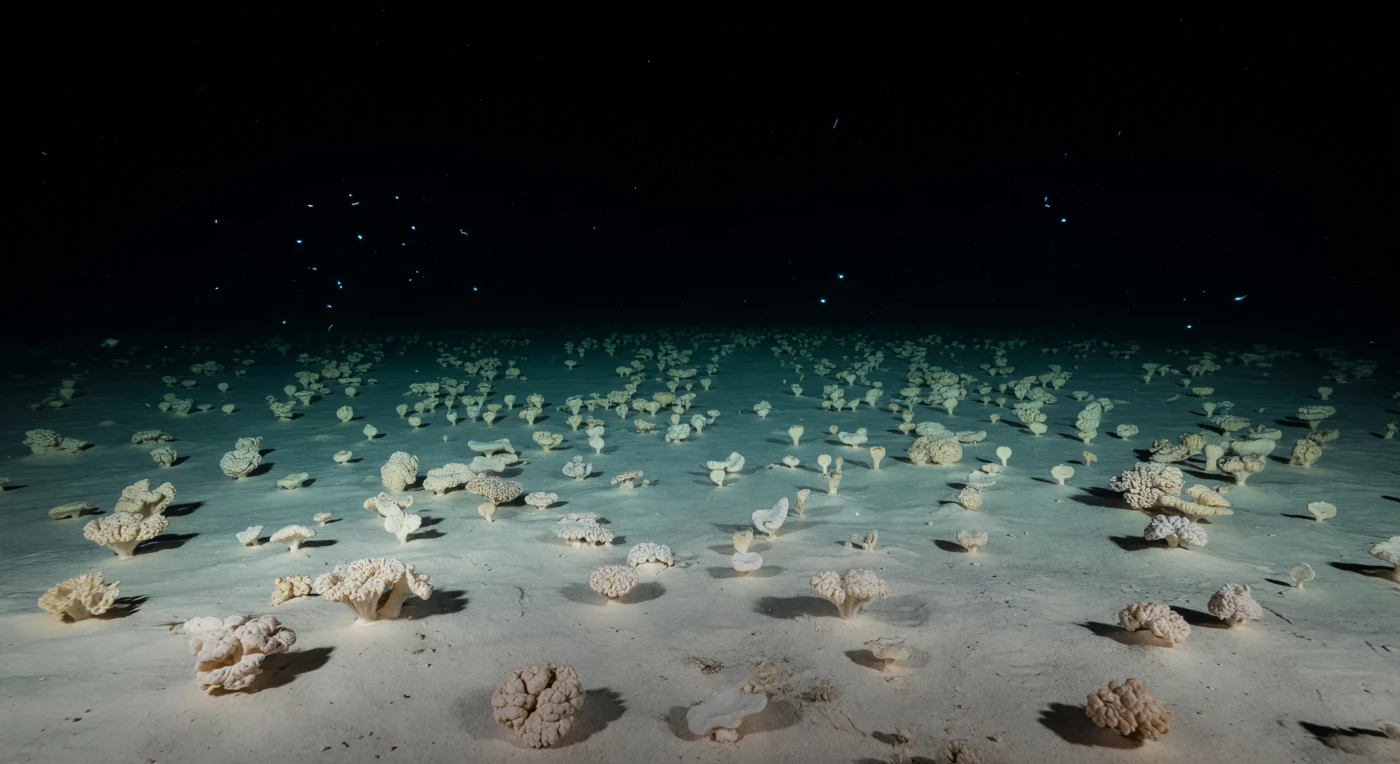
At the deepest known point in Earth's crust, nearly eleven kilometers beneath the surface, the hadal floor of Challenger Deep extends outward as an immense, near-featureless plain of powder-fine white-beige sediment — the accumulated fall of countless millennia of foraminifera, organic detritus, and marine snow that has settled through the entire water column above. Across this silty depocenter, xenophyophores rise in ghostly clusters: giant single-celled organisms, among the largest individual cells known to biology, their pale lobed and reticulate bodies forming fragile moundlike structures only centimeters tall yet clearly dominating the benthos as primary architects of this sediment landscape. Under roughly 1,100 atmospheres of hydrostatic pressure, water molecules are themselves marginally compressed, and the cold — a near-constant 1.5 to 2 °C — holds the basin in thermal stasis, the still water carrying only the thinnest suspended veil of particulates drifting with imperceptible current. Faint bioluminescent pinpricks flicker among microscopic hadal fauna, their cold cyan light too diffuse and brief to illuminate but just sufficient to suggest the vast, unbroken geometry of xenophyophore fields dissolving into absolute darkness in every direction. This is a world defined entirely by patience, pressure, and biological minimalism — a depocenter where life persists not despite the extremity of conditions but in precise evolutionary negotiation with them, unseen and unwitnessed, exactly as it has been for millions of years.
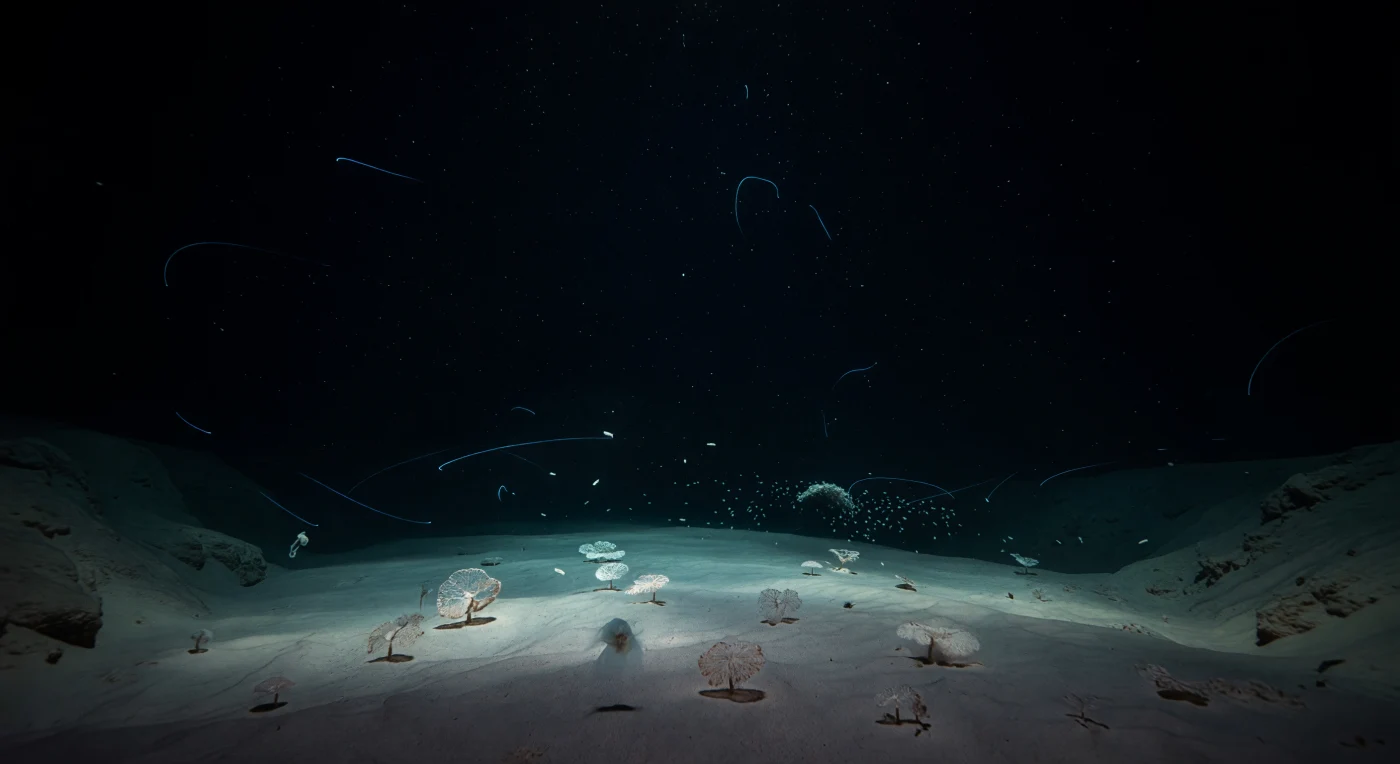
At roughly eleven kilometers beneath the surface, where the Pacific Plate plunges beneath the Philippine Sea Plate in the most extreme expression of subduction on Earth, the water column pressing down from above generates approximately 1,100 atmospheres of hydrostatic force — a pressure that shapes every molecular adaptation of the organisms that have colonized this place. The darkness is absolute and unbroken except by life itself: faint cyan arcs of bioluminescence trace brief, dissolving ribbons through the water, the biochemical signatures of drifting microbial aggregates and small pelagic organisms whose light-producing chemistry persists even at these crushing depths, momentarily illuminating sparse marine snow — fragile organic particles descending from the sunlit world more than ten kilometers above. Below, intermittently sketched into pale existence by those passing glows, the hadal floor extends as a softly undulating plain of white-beige foraminiferan ooze, where giant xenophyophores — single-celled organisms among the largest on Earth, their agglutinated tests sprawling like delicate mineral lacework — rest on the sediment surface, and a translucent hadal snailfish, its bones reduced and its body adapted to transmit rather than resist pressure, drifts just above the substrate in search of the amphipod aggregations that cluster around any organic fall. Here, temperature hovers near 1.5 °C and salinity remains stable at roughly 34.7 PSU, and in this cold, crushingly still basin the silence is not absence but the condition of a world that has always existed entirely without witness.
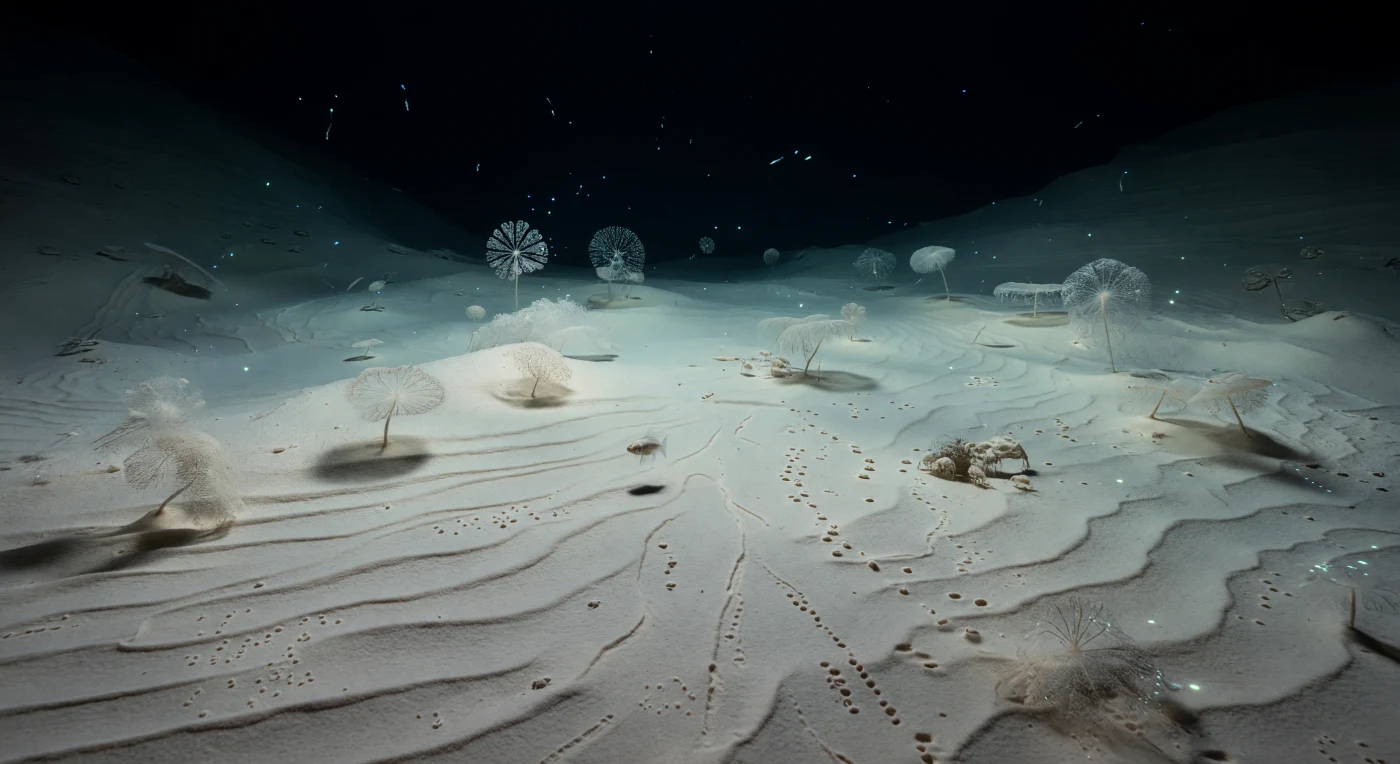
At the very bottom of the world's deepest known point, beneath roughly 1,100 atmospheres of cold, still Pacific water, the hadal floor of Challenger Deep spreads outward in pale cream-colored sediment sculpted by imperceptible currents into delicate ripple fields — a landscape shaped not by violence but by the slow, patient work of deposition and biology over geological time. The soft mud is alive with evidence of its inhabitants: meandering furrows trace the paths of unseen deposit feeders, pellet strings mark where organic matter has passed through small bodies, and tiny burrow openings punctuate the surface where meiofaunal and macrofaunal organisms process the thin rain of marine snow that drifts down from sunlit waters more than ten kilometers above. Giant xenophyophores — single-celled foraminifera among the largest individual cells known to biology — rest like fragile translucent rosettes across the sediment surface, their lacy architectures half-veiled in fine silt, while a hadal snailfish, Pseudoliparis sphyraenops or kin, drifts in extraordinary stillness just above the floor, its body adapted at the molecular level — piezolyte-stabilized proteins, highly unsaturated membranes — to function where no vertebrate physiology should reasonably persist. Small pale amphipods congregate around a fragment of sunken organic matter partly swallowed by the mud, scavengers fulfilling their role as hadal recyclers in a darkness punctuated only by rare cold bioluminescent flickers from drifting organisms, the entire scene pressing inward with immense silent pressure, untouched and indifferent to any witness.
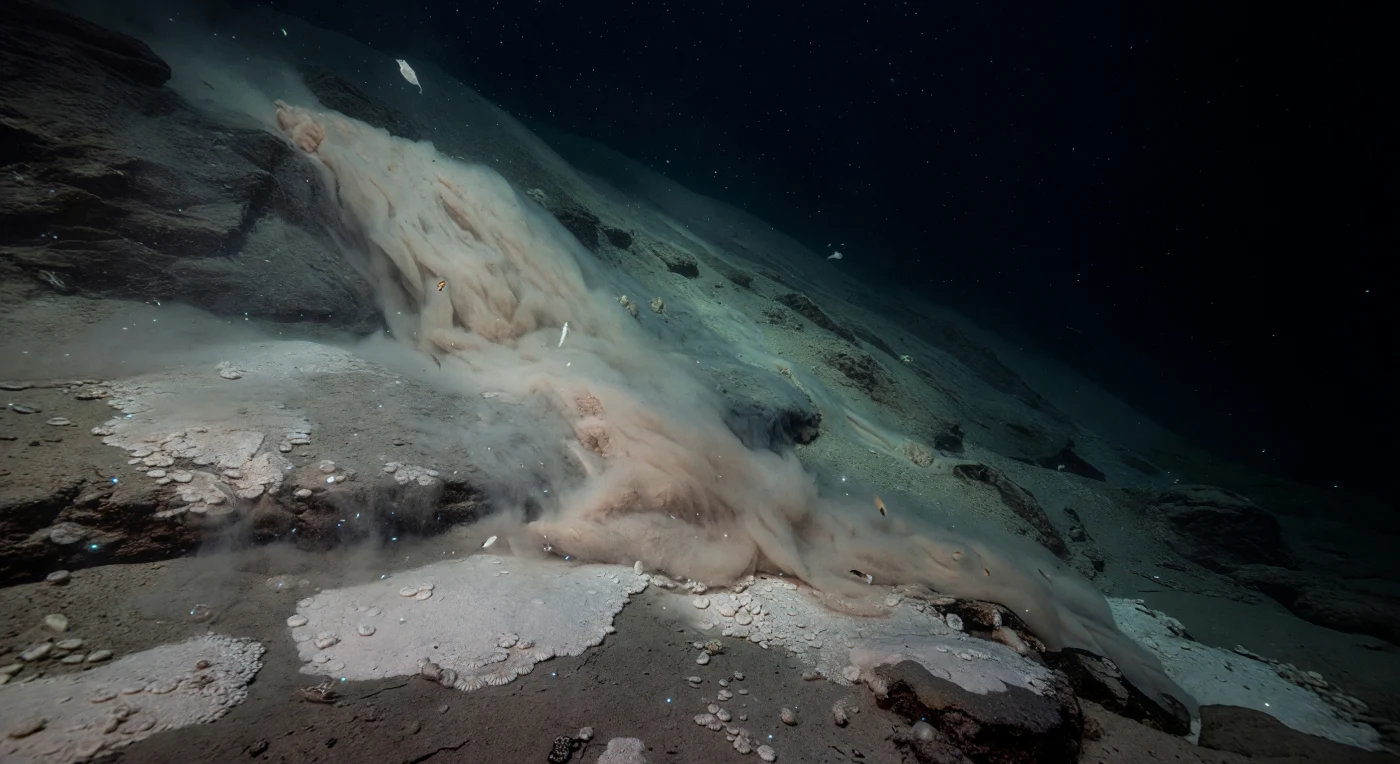
At nearly eleven kilometers beneath the surface, where hydrostatic pressure crushes water itself into a denser, marginally altered phase at roughly 1,100 atmospheres, a fresh sediment slump moves in slow, inexorable silence down the hadal incline of the Mariana Trench's deepest basin. The beige-white turbidity sheet rolls over fractured basaltic ground like powdery silk, partially entombing fields of giant xenophyophores — those extraordinary single-celled organisms that can exceed ten centimeters and represent some of the largest individual cells known to biology — along with pale foraminiferal aggregates that have accumulated across millennia of marine snow fall from waters six miles above. Suspended within the drifting sediment cloud, scattered sparks of cyan and blue-green bioluminescence flicker briefly into existence as disturbed hadal fauna respond to the disruption, their chemical light catching resuspended silt particles and tracing the moving front of the flow without illuminating anything beyond its immediate source. A ghostly snailfish — likely *Pseudoliparis swirei*, the deepest-dwelling vertebrate known to science, its translucent body adapted to pressures that would collapse the gas spaces of any untreated surface organism — hovers at the furthest margin of perception, its pale musculature barely resolved against absolute blackness, metabolizing slowly in water near 2°C. This slope exists in permanent, total darkness, shaped by gravity, chemistry, and deep geological time, entirely indifferent to observation.
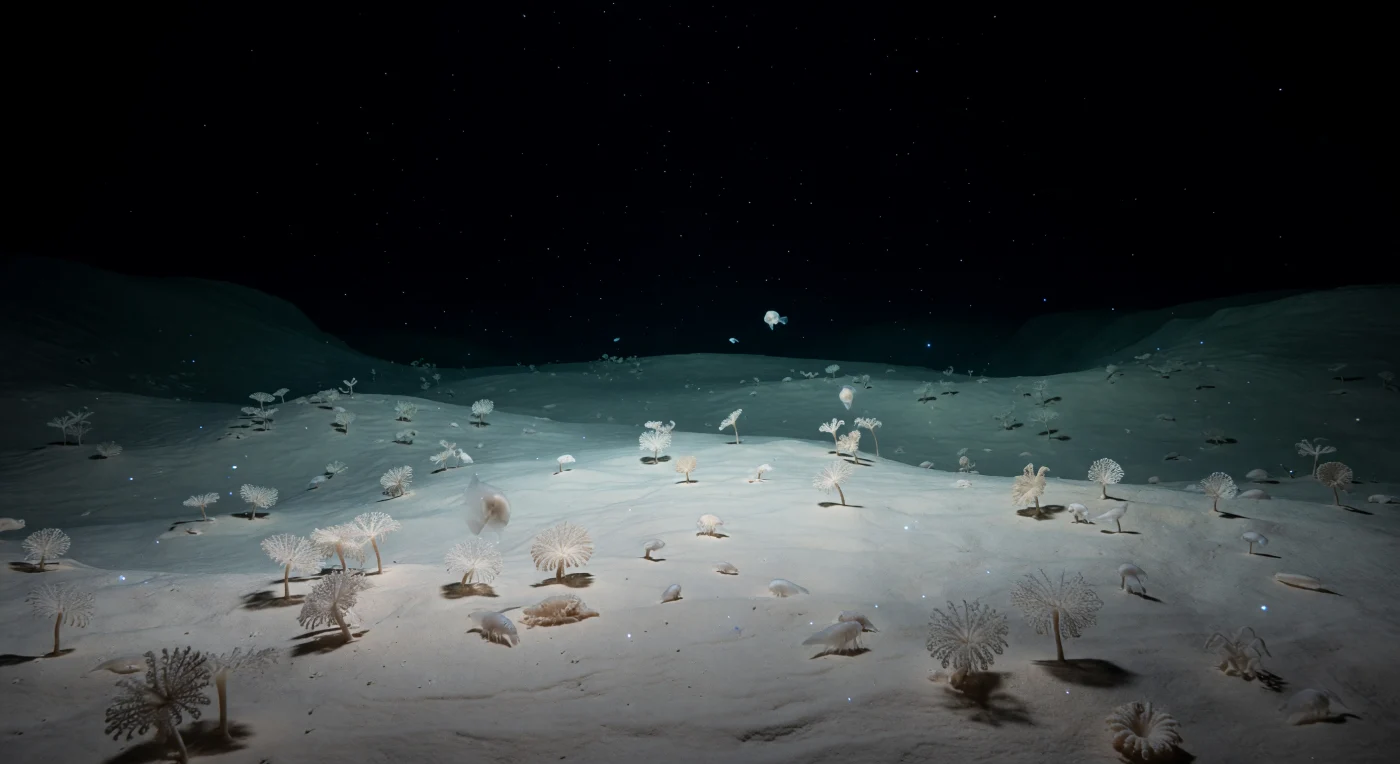
At the uttermost reach of the ocean's descent, nearly eleven kilometers beneath the surface, the floor of Challenger Deep spreads in eerie stillness as a pale white-beige plain of ponded sediment compressed beneath approximately 1,100 atmospheres of hydrostatic pressure — a force sufficient to collapse any unspecialized biology instantly. Here, in permanent and absolute aphotic darkness, giant xenophyophores rise from the soft mud like ivory rosettes, their single-celled bodies among the largest on Earth, built to thrive precisely where crushing pressure and perpetual cold define every boundary of survival. Hadal amphipods trace low arcs over the sediment near a sunken carcass slowly disappearing into the ooze, while translucent snailfish — the deepest-living vertebrates known to science — drift above the basin floor, their gelatinous bodies an evolutionary answer to pressures that would denature ordinary proteins. Fine marine snow descends without interruption through frigid, utterly clear water, each particle a fragment of biological material fallen from the sunlit world nearly eleven kilometers above, the sole thread connecting this remote basin to the productive ocean surface. Faint bioluminescent sparks drift through the black water column, brief cold-blue points of light produced by organisms whose chemistry requires no sun, signaling or hunting in a world that has existed in this silence, under this weight, entirely without witness.
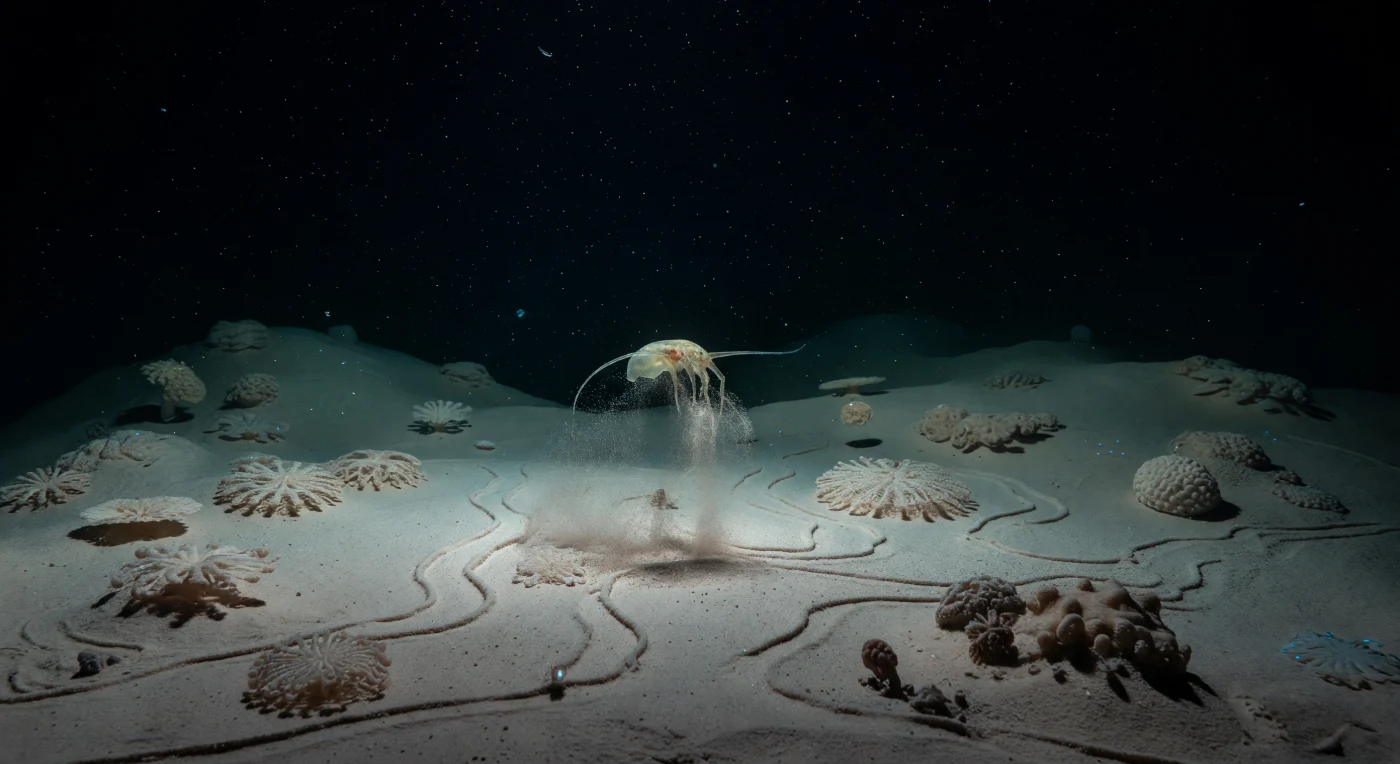
At the very bottom of Earth's ocean, where pressure reaches approximately 1,100 atmospheres and temperature hovers just above freezing, a single giant amphipod — Hirondellea gigas or a close relative, its body enlarged by the gigantism that hadal evolution favors — glides centimeters above a pale beige-white sediment plain that has accumulated over geological time from the slow descent of marine snow and lithogenic particles through nearly eleven kilometers of water column. Its translucent carapace and long articulated appendages catch the faintest biological luminescence, a ghostly cyan-green outline so dim it is almost indistinguishable from the absolute aphotic darkness that defines this world permanently and completely. Beneath it, a veil of disturbed silt hangs suspended in water so still and dense that sediment grains settle with geological patience, while the older trackways pressed into the mud around it record the passage of unseen organisms — polychaetes, isopods, holothurians — in a silent archive of hadal life. Scattered across the soft floor, xenophyophores — giant single-celled foraminiferans reaching centimeters in diameter, among the largest individual cells known on Earth — rest as pale rosettes and irregular mounds, filtering organic particles from sediment in this nutrient-scarce extreme. This is a world that requires nothing from the surface to exist, operating on pressures, chemistries, and biological architectures shaped entirely by its own profound remoteness.
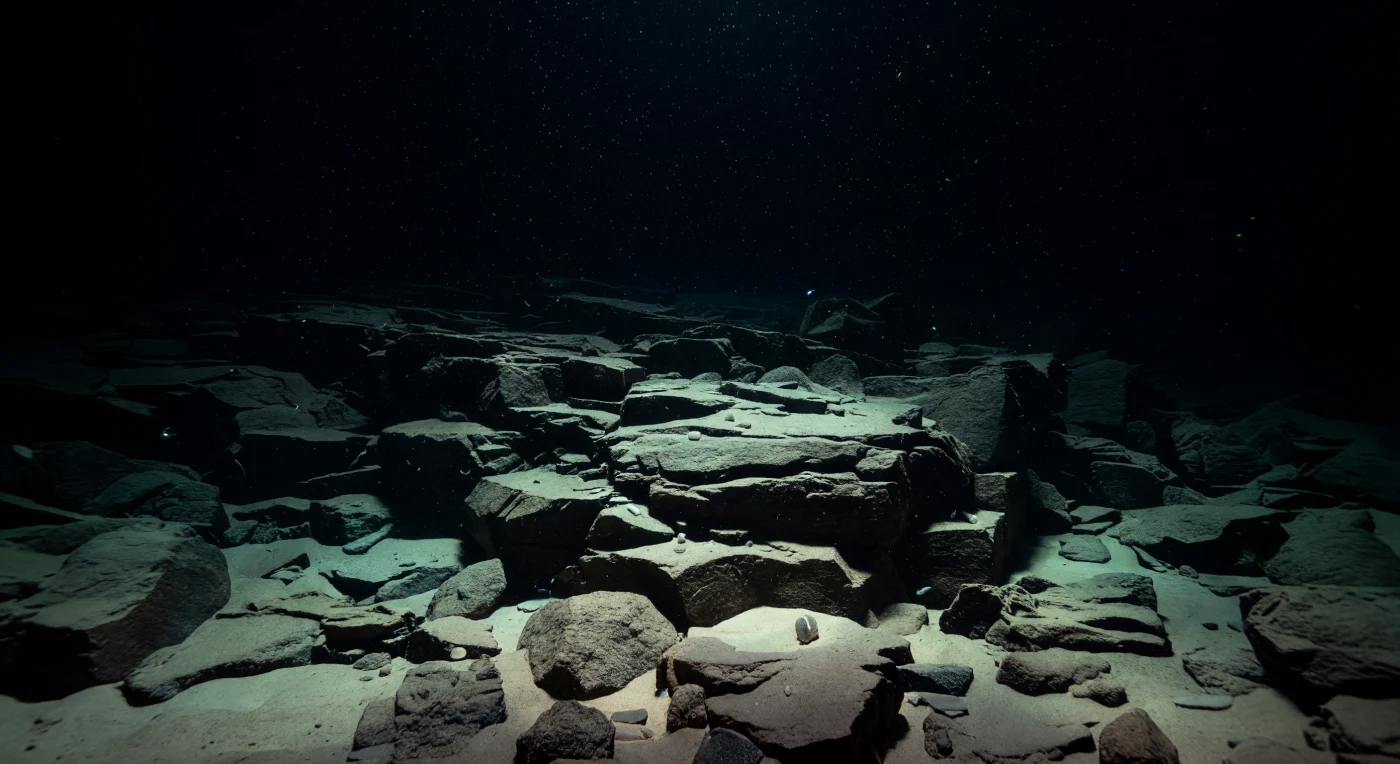
At nearly eleven kilometres below the surface, the exposed hadal scarp of Challenger Deep bears the full weight of approximately 1,100 atmospheres, a pressure so immense that water itself becomes fractionally compressible, altering the speed of sound and the behaviour of every molecule within it. Dark angular slabs of basalt, fractured by the slow mechanical stress of subduction where the Pacific Plate descends beneath the Philippine Sea Plate, rise in stepped relief from a floor dusted with cream-white foraminiferal ooze and terrigenous silt that has taken centuries to settle from the sunlit world far above. A continuous veil of marine snow — organic aggregates, mineral grains, the skeletal remains of surface plankton — descends through absolute aphotic darkness in perfect, unhurried silence, accumulating in fine drifts along every horizontal ledge and crevice with no current strong enough to disturb them. Pale xenophyophore-like forms, among the largest single-celled organisms on Earth, rest motionless against quieter sediment patches near the scarp base, while hadal amphipods — scavenging crustaceans evolved for piezophilic existence at these extreme pressures — ghost along the rock-sediment interface, their biology sustained by biochemical adaptations that would fail entirely at lesser depths. Sparse, isolated points of blue-green bioluminescence drift through the void, tiny living signals separated by vast and indifferent darkness, the only light this world has ever known.