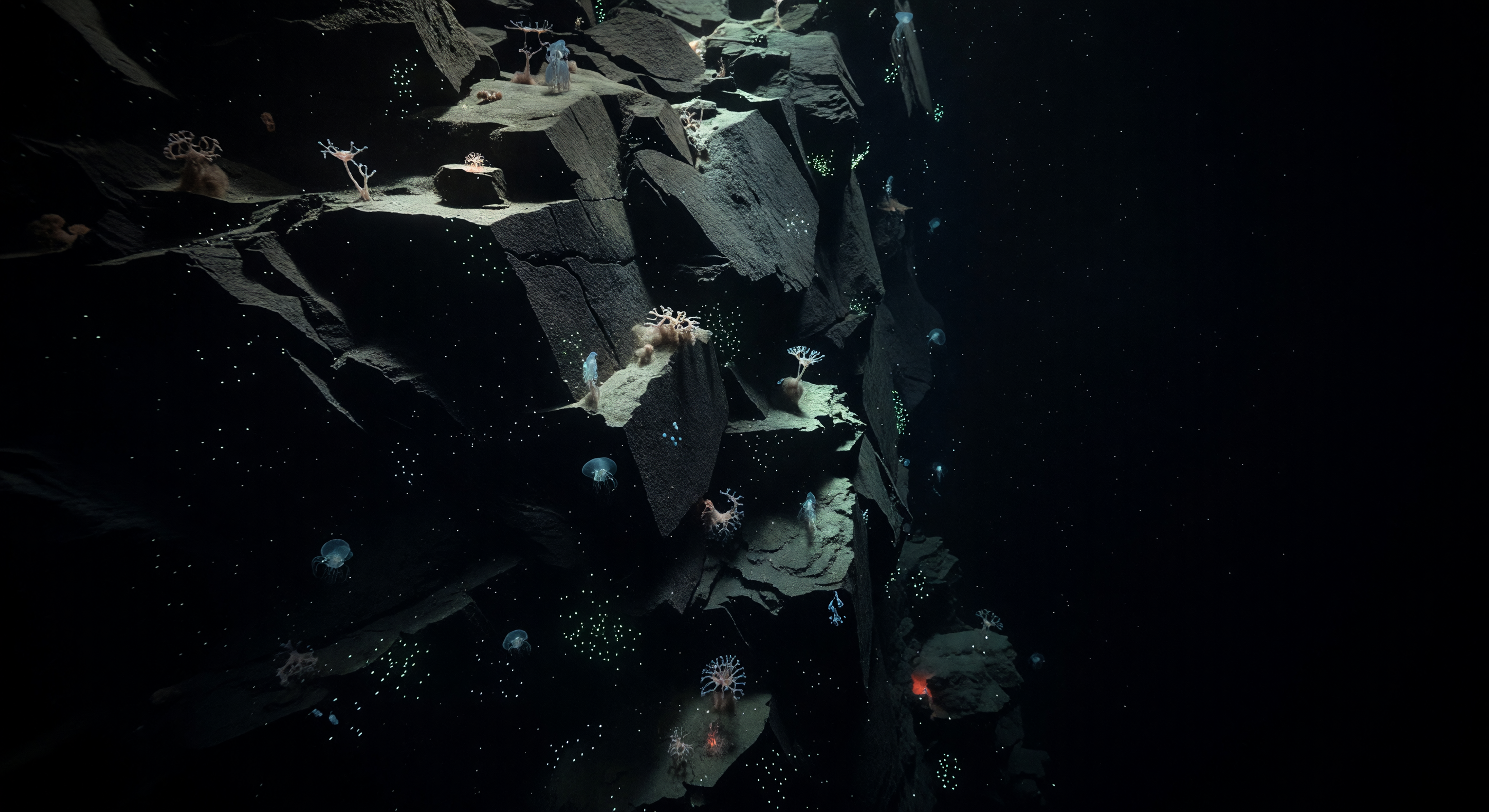
At the deepest recess of the Mariana Trench's subduction architecture, where the Pacific Plate's descent beneath the Philippine Sea Plate has sculpted this near-vertical scarp over millions of years, charcoal-black fractured basalt drops away in successive ledges and fault-controlled gullies under pressure approaching 1,100 atmospheres — a force that compresses every cubic centimeter of water and would collapse any air space instantaneously. Fine marine snow settles in perpetual slow drift across the rock face, accumulating in pale beige draperies on sheltered ledges where xenophyophore-like forms — giant single-celled foraminifera among the largest unicellular organisms on Earth — anchor themselves to the sediment veneer, feeding on the sparse organic particles descending from a sunlit surface nearly eleven kilometers above. Permanent, absolute aphotic darkness fills the void beside the wall, broken only by the cold cyan-blue and faint green pulses of gelatinous drifters and microscopic bioluminescent plankton whose chemical light sketches the wall's relief in fleeting, sourceless glimmers — the only illumination this environment has ever known. Here, in a stillness that silence cannot adequately describe, pressure-adapted microbial communities colonize the pore spaces of sediment and fractured rock, sustaining a hadal food web that functions entirely on the rain of organic matter from above, indifferent to any world beyond this crushing, lightless trench.
Challenger Deep