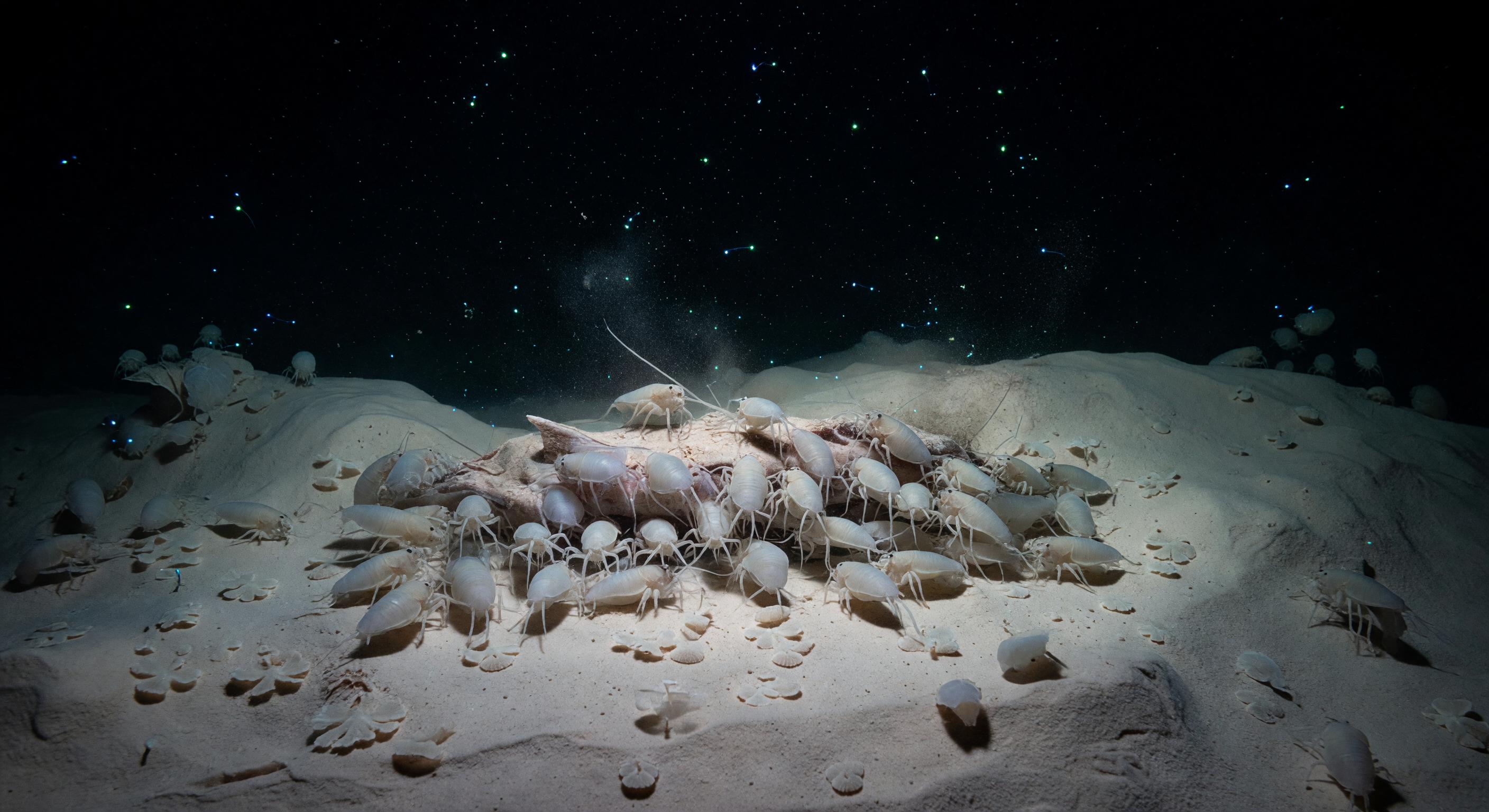
At the deepest point any ocean floor reaches on this planet, beneath roughly 1,100 atmospheres of crushing hydrostatic pressure, dozens of giant amphipods — *Hirondellea gigas* and related hadal scavengers — swarm in dense, overlapping masses over a naturally fallen carcass, their milky, opalescent bodies layered across pale tissue and cream-white sediment in a feeding aggregation that may have drawn them from kilometers away through chemosensory detection of dissolved organic plumes drifting up through the water column. The trench floor here is a ponded sediment basin at the southern terminus of the Mariana Trench, where the Pacific Plate subducts beneath the Philippine Sea Plate and concentrates organic matter into a biological trap, making these rare carcass falls disproportionately significant energy subsidies in an environment where photosynthesis-derived carbon must travel nearly eleven kilometers to arrive. Scattered across the surrounding sediment, giant xenophyophores — single-celled foraminifera sometimes exceeding ten centimeters across — persist as lobed, irregular discs among fine rippled silt, while disturbed clouds of pale sediment hang suspended above the feeding mass, catching intermittent blue-green bioluminescent pulses from small organisms moving through the darkness. Water here is permanently aphotic, permanently cold near 1.5°C, and laden with marine snow — the slow rain of organic particles from the surface world far above — each suspended speck a faint record of sunlit productivity in a realm where no sunlight has ever reached. This is a world that requires nothing from us to exist: complete, ancient, and silently functional under pressures that would destroy any unprotected biological tissue not shaped by millions of years of hadal evolution.
Other languages
- Français: Rassemblement sur Carcasse Naturelle
- Español: Reunión Natural de Carroña
- Português: Reunião Natural de Carcaça
- Deutsch: Natürliche Kadaverversammlung
- العربية: تجمع الجيف الطبيعي
- हिन्दी: प्राकृतिक शव संग्रह
- 日本語: 自然死骸への集結
- 한국어: 자연 사체 군집
- Italiano: Raduno Naturale di Carcassa
- Nederlands: Natuurlijke Kadaververzameling