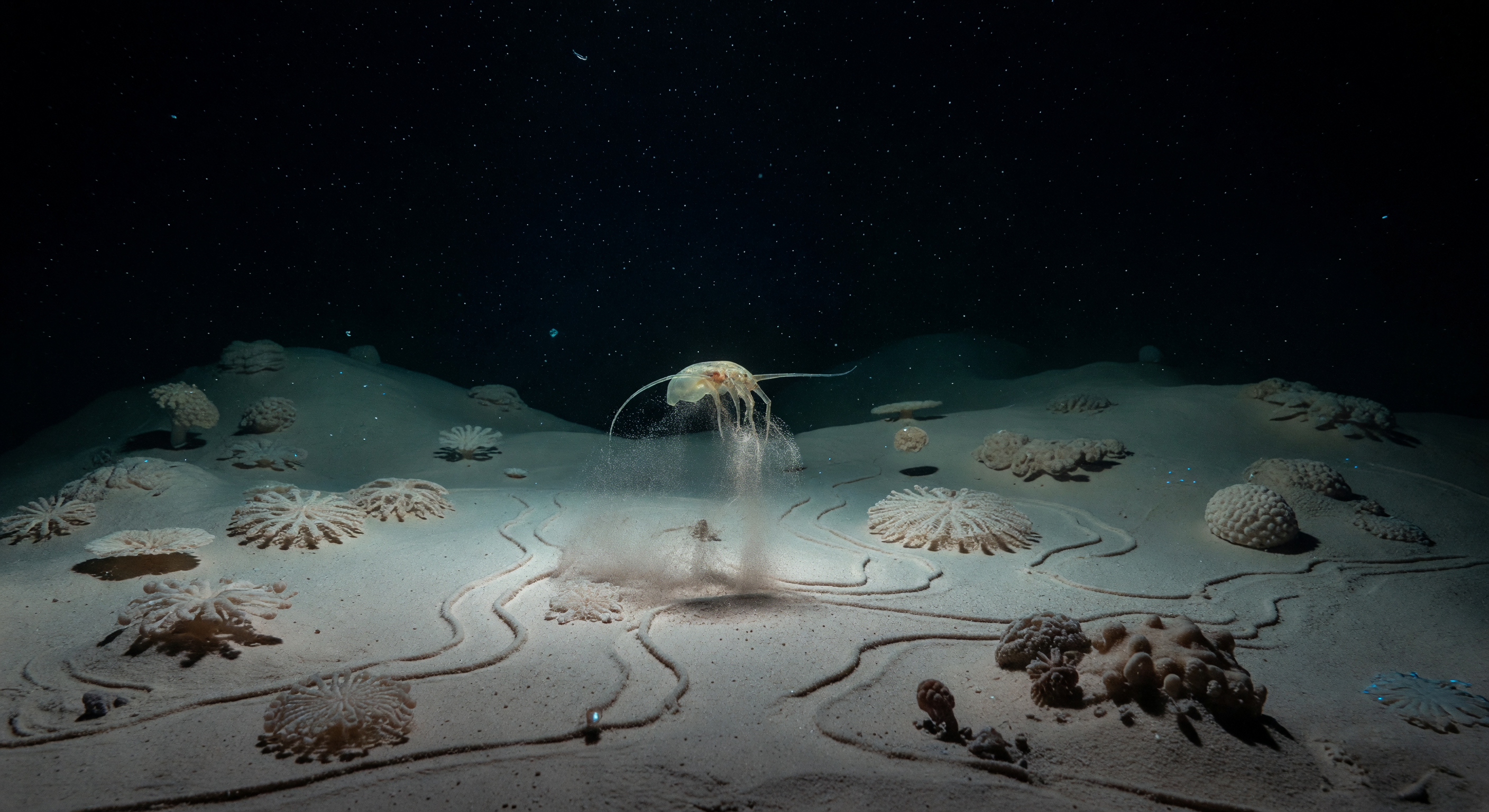
At the very bottom of Earth's ocean, where pressure reaches approximately 1,100 atmospheres and temperature hovers just above freezing, a single giant amphipod — Hirondellea gigas or a close relative, its body enlarged by the gigantism that hadal evolution favors — glides centimeters above a pale beige-white sediment plain that has accumulated over geological time from the slow descent of marine snow and lithogenic particles through nearly eleven kilometers of water column. Its translucent carapace and long articulated appendages catch the faintest biological luminescence, a ghostly cyan-green outline so dim it is almost indistinguishable from the absolute aphotic darkness that defines this world permanently and completely. Beneath it, a veil of disturbed silt hangs suspended in water so still and dense that sediment grains settle with geological patience, while the older trackways pressed into the mud around it record the passage of unseen organisms — polychaetes, isopods, holothurians — in a silent archive of hadal life. Scattered across the soft floor, xenophyophores — giant single-celled foraminiferans reaching centimeters in diameter, among the largest individual cells known on Earth — rest as pale rosettes and irregular mounds, filtering organic particles from sediment in this nutrient-scarce extreme. This is a world that requires nothing from the surface to exist, operating on pressures, chemistries, and biological architectures shaped entirely by its own profound remoteness.
Challenger Deep