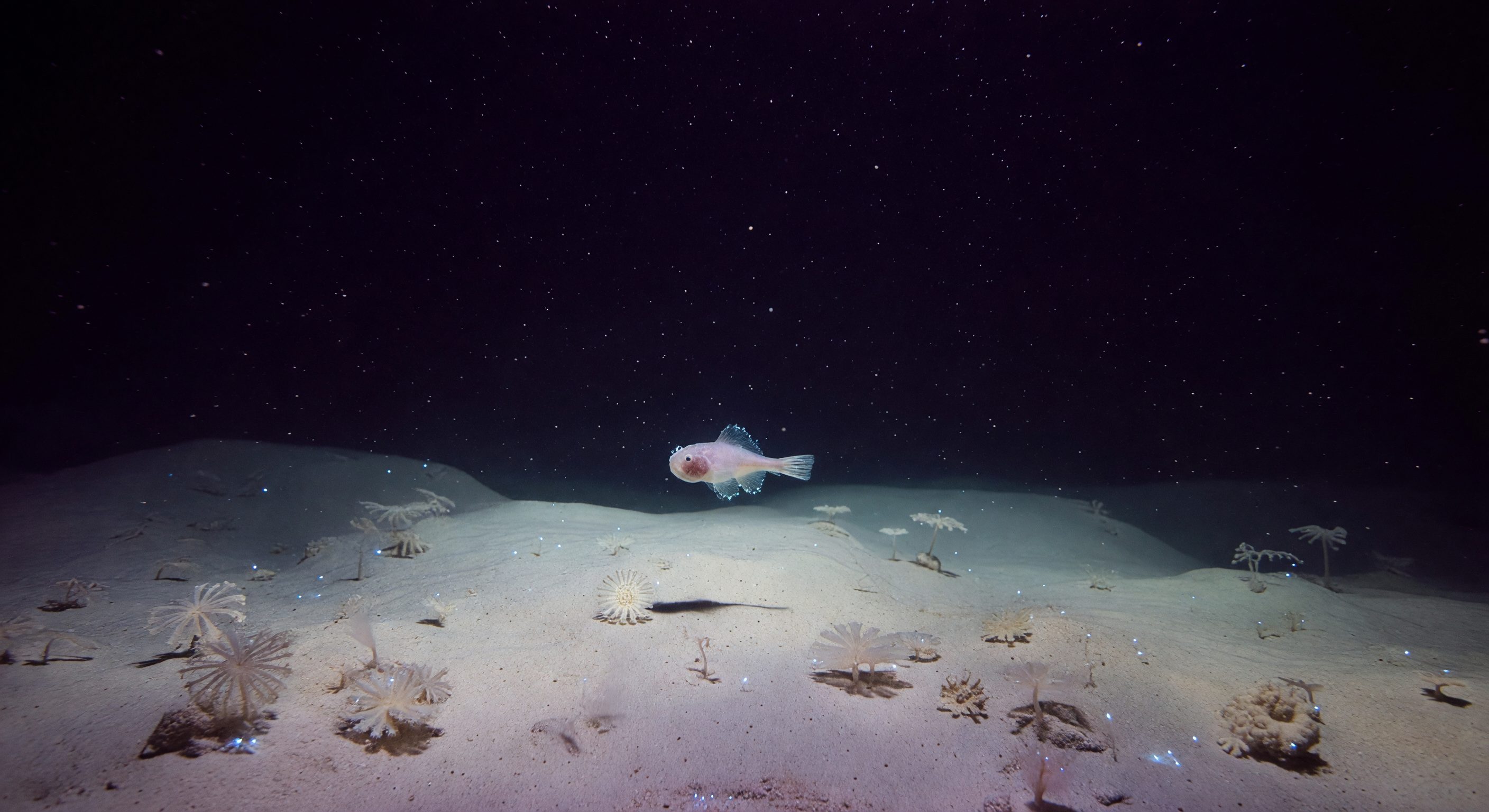
At the bottom of the deepest wound in Earth's crust, where hydrostatic pressure climbs to roughly 1,100 atmospheres and temperatures hover near 1.5°C, a single hadal snailfish — *Pseudoliparis* — drifts in motionless suspension just centimeters above pale beige sediment that has settled here over geological ages, carried down from the sunlit surface world in an unbroken rain of particles that now dust the trench floor in fine, undisturbed silt. The fish's body is soft and gelatinous by biological necessity, its cellular membranes and pressure-adapted enzymes loaded with piezolytes that prevent protein collapse under compression no surface vertebrate could survive; its translucent flesh glows faintly where minute cyan-blue bioluminescent pinpricks from drifting microorganisms briefly edge its fin membranes before winking out into the surrounding void. Scattered across the sediment around it, giant xenophyophores — single-celled foraminifera of extraordinary size, their fragile tests like pale rosettes and lumpy stars half-submerged in silt — stand as testament to a deposit-feeding community sustained entirely by the slow nutritional trickle of marine snow descending through eleven kilometers of darkness. Sparse particles of that snow continue their unhurried fall through black-violet water of absolute clarity and absolute cold, each flake a fragment of biological material from a photosynthetic world so remote it might as well be another planet. No current stirs this place, no sound carries, and the snailfish hangs in the stillness of a world that has existed, pressurized and lightless and complete, entirely without witness.
Other languages
- Français: Dérive du Poisson Solitaire
- Español: Deriva del Pez Caracol
- Português: Deriva do Peixe Caracol
- Deutsch: Einsamer Schneckenfisch Treibt
- العربية: انجراف سمكة الحلزون
- हिन्दी: एकाकी स्नेलफिश प्रवाह
- 日本語: 孤独なクサウオの漂流
- 한국어: 고독한 달팽이물고기 표류
- Italiano: Deriva del Pesce Lumaca
- Nederlands: Eenzame Slakvisdrif