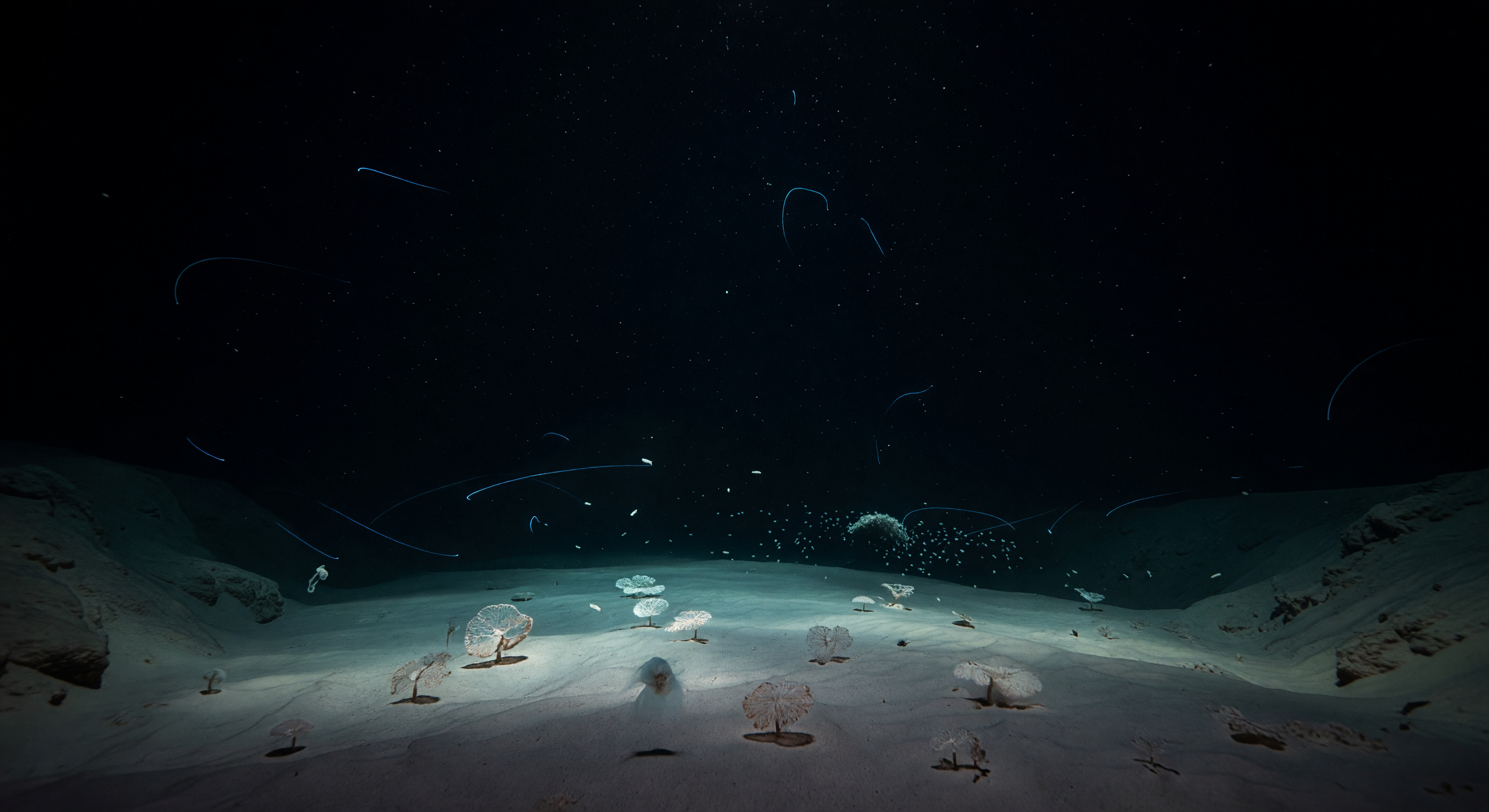
At roughly eleven kilometers beneath the surface, where the Pacific Plate plunges beneath the Philippine Sea Plate in the most extreme expression of subduction on Earth, the water column pressing down from above generates approximately 1,100 atmospheres of hydrostatic force — a pressure that shapes every molecular adaptation of the organisms that have colonized this place. The darkness is absolute and unbroken except by life itself: faint cyan arcs of bioluminescence trace brief, dissolving ribbons through the water, the biochemical signatures of drifting microbial aggregates and small pelagic organisms whose light-producing chemistry persists even at these crushing depths, momentarily illuminating sparse marine snow — fragile organic particles descending from the sunlit world more than ten kilometers above. Below, intermittently sketched into pale existence by those passing glows, the hadal floor extends as a softly undulating plain of white-beige foraminiferan ooze, where giant xenophyophores — single-celled organisms among the largest on Earth, their agglutinated tests sprawling like delicate mineral lacework — rest on the sediment surface, and a translucent hadal snailfish, its bones reduced and its body adapted to transmit rather than resist pressure, drifts just above the substrate in search of the amphipod aggregations that cluster around any organic fall. Here, temperature hovers near 1.5 °C and salinity remains stable at roughly 34.7 PSU, and in this cold, crushingly still basin the silence is not absence but the condition of a world that has always existed entirely without witness.
Challenger Deep