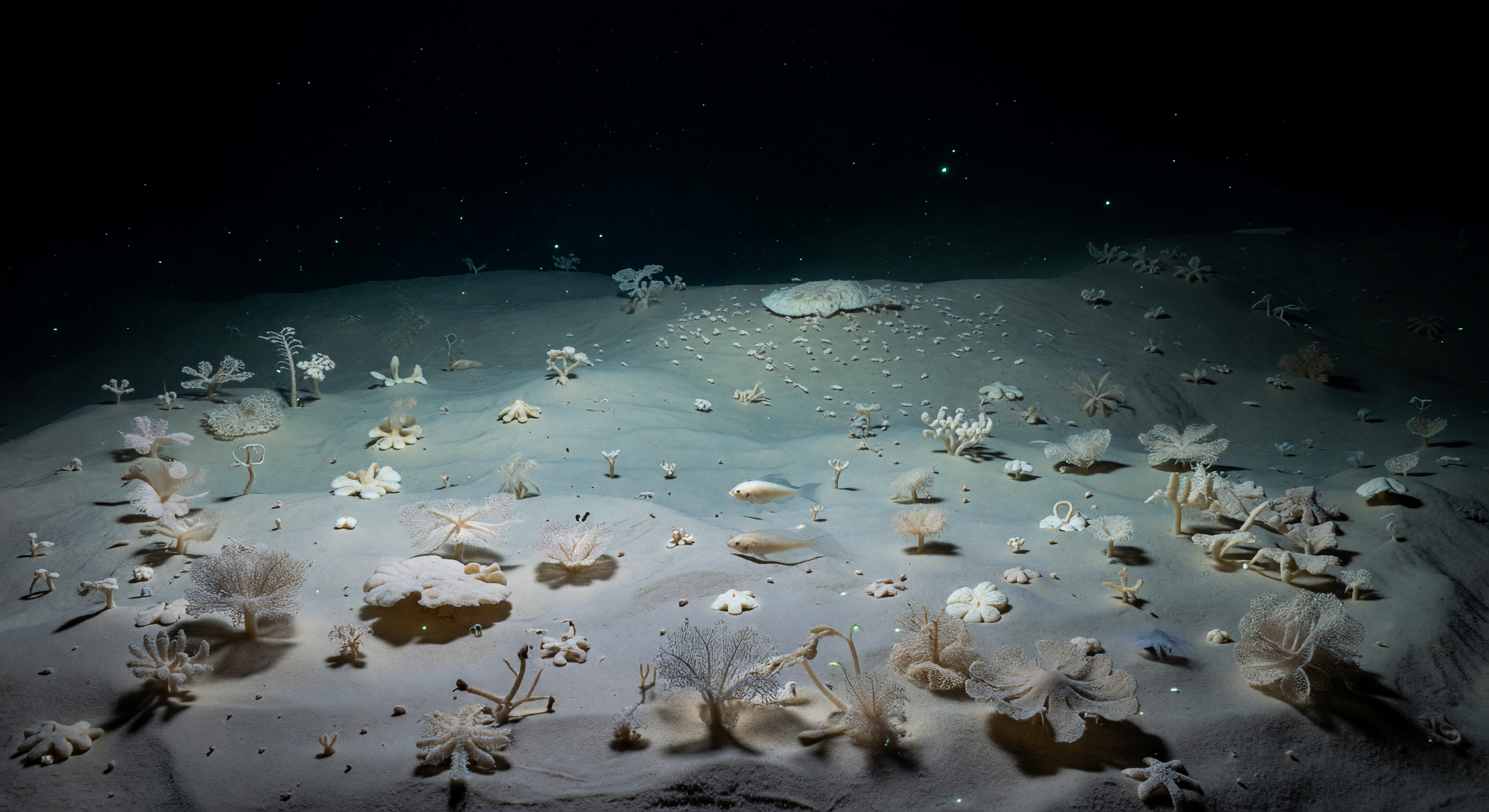
At the bottom of the deepest known wound in Earth's crust, where hydrostatic pressure exceeds one thousand atmospheres and no photon of sunlight has ever penetrated, a vast silent plain of silken beige sediment stretches outward in every direction, its surface so undisturbed that the finest marine snow — organic detritus drifting down from the sunlit world nearly eleven kilometers above — settles without disturbance, accumulating across millennia into a pale, velvety record of the ocean's biological history. Across this floor spreads one of the most remarkable biological communities on the planet: fields of giant xenophyophores, single-celled organisms among the largest known to science, their fragile architectures of agglutinated sediment grains forming rosettes, branching fans, and lace-like nets that rise only centimeters from the mud, each one a solitary living cell binding the trench floor's chemistry to its own body. A hadal snailfish — *Pseudoliparis* or close kin — glides translucent and boneless just above the sediment, its fluid-filled tissues equilibrated to the crushing pressure that would implode any unprotected gas space, its pale form catching the only light that exists here: sparse cold cyan-green bioluminescent pinpricks from pelagic organisms drifting in the black water column above, and faint ghostly glimmers from minute benthic life stirring between the xenophyophore clusters. Farther across the basin, amphipods — hyperiid and lysianassid species adapted to piezophilic biochemistry through specialized membrane lipids and osmolyte systems — gather around sunken organic matter, their translucent carapaces and rapid antennae the dominant animal motion in a world otherwise defined by absolute stillness. This is a place that has existed in darkness, cold, and crushing silence for geological ages, its ecology sustained entirely by the slow rain of organic material from above and the patient chemistry of sediment and seawater, indifferent to and unaware of any world beyond its own.
Other languages
- Français: Dentelle sur Boue Pâle
- Español: Encaje en Lodo Pálido
- Português: Renda em Lama Clara
- Deutsch: Spitzenwerk auf Hellem Schlamm
- العربية: دانتيل فوق الطين الشاحب
- हिन्दी: पीली मिट्टी पर जालकारी
- 日本語: 淡い泥上の透かし模様
- 한국어: 연한 진흙 위 레이스
- Italiano: Merletto sul Fango Pallido
- Nederlands: Kantwerk op Bleke Modder