At the very bottom of the world's deepest known point, roughly eleven kilometers beneath the surface, the seafloor of Challenger Deep spreads outward as a vast ivory-pale plain of compacted calcareous sediment — the accumulated remains of foraminifera, radiolaria, and microscopic organisms that have drifted down through the entire water column across geological time. Pressure here approaches 1,100 atmospheres, cold and absolute at barely above 1.5 °C, and no sunlight has ever penetrated to this depth; the darkness is structural, a permanent condition of physics rather than mere absence of day. Scattered across the pale sediment like pale, irregular medallions, giant xenophyophores — single-celled organisms that can reach centimeters or even decimeters in diameter, among the largest individual cells known on Earth — lie half-embedded in the mud, their fragile, chalky tests recording the chemistry and particle flux of this hadal basin in their own living tissue. Faint sinuous trails pressed into the sediment surface trace the passage of amphipods, small crustaceans uniquely adapted to piezophilic existence, their bodies biochemically tuned to function where no surface organism could survive uncompressed. Far above the plain, suspended in the black water column, rare bioluminescent organisms emit isolated points of cold blue-green light — brief, sourceless sparks in an otherwise total darkness — while marine snow drifts in every direction through water so cold and still that this ancient, featureless basin exists in a silence older than almost any landscape on the surface of the planet.
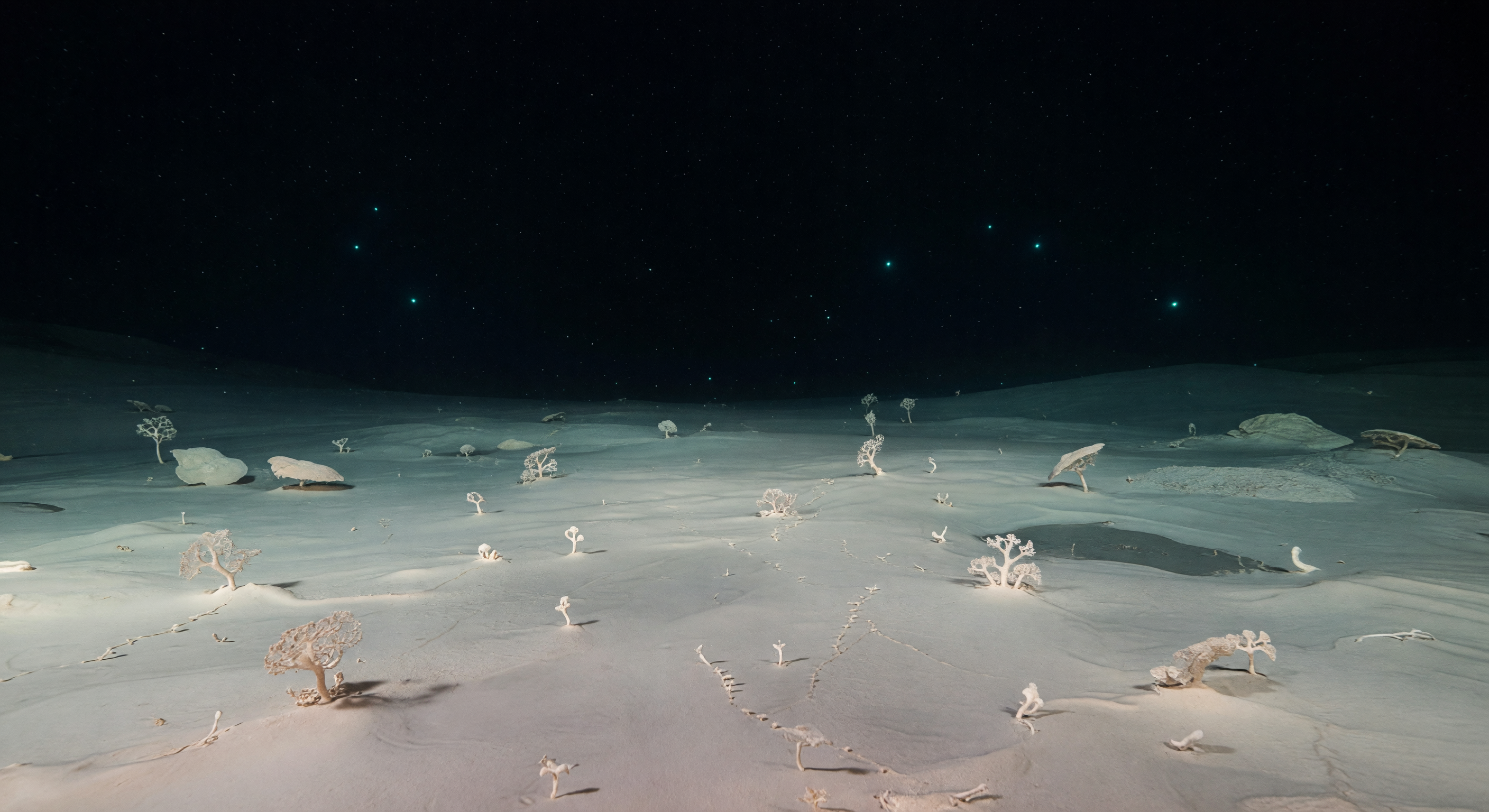
Challenger Deep