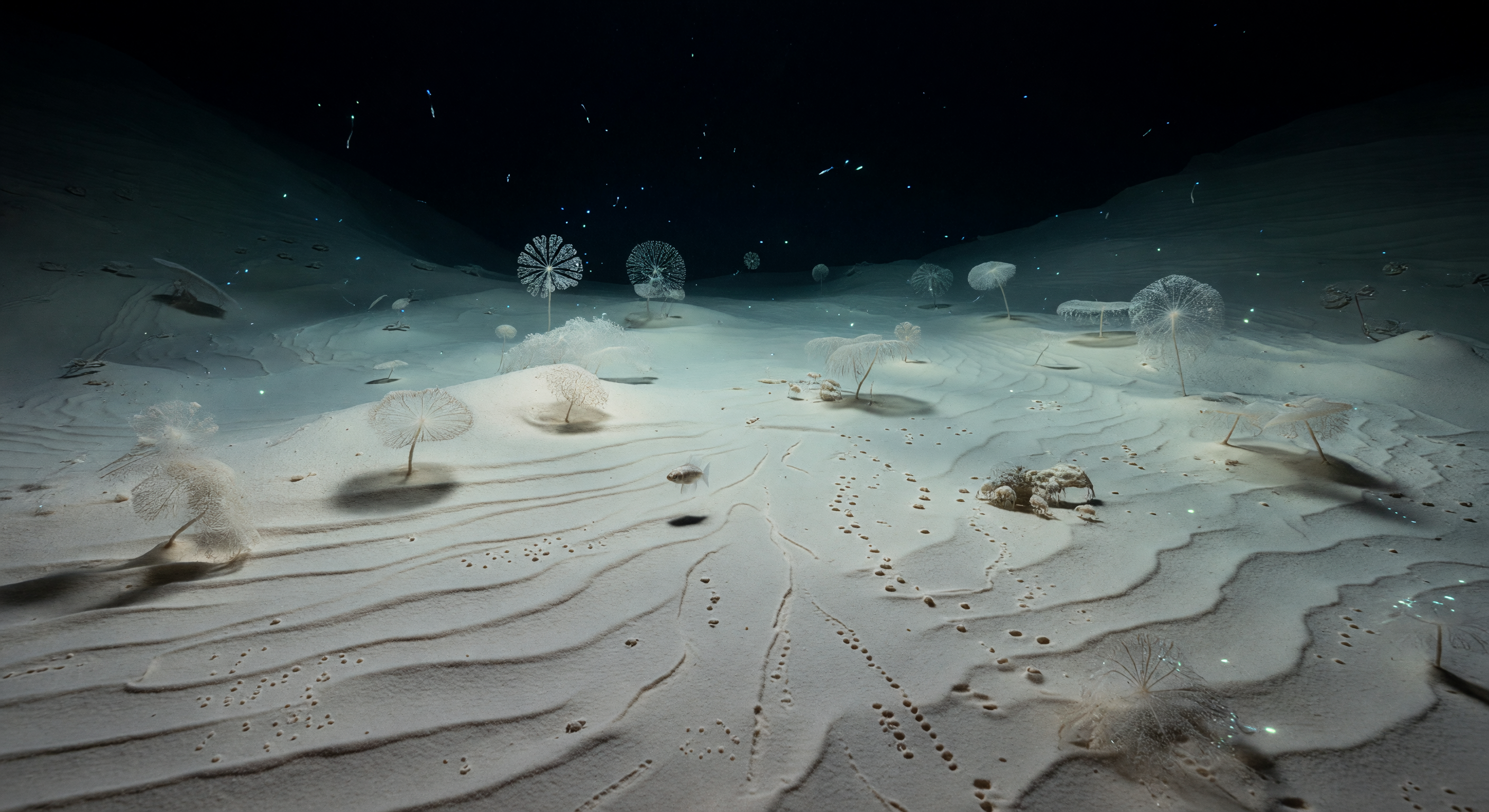
At the very bottom of the world's deepest known point, beneath roughly 1,100 atmospheres of cold, still Pacific water, the hadal floor of Challenger Deep spreads outward in pale cream-colored sediment sculpted by imperceptible currents into delicate ripple fields — a landscape shaped not by violence but by the slow, patient work of deposition and biology over geological time. The soft mud is alive with evidence of its inhabitants: meandering furrows trace the paths of unseen deposit feeders, pellet strings mark where organic matter has passed through small bodies, and tiny burrow openings punctuate the surface where meiofaunal and macrofaunal organisms process the thin rain of marine snow that drifts down from sunlit waters more than ten kilometers above. Giant xenophyophores — single-celled foraminifera among the largest individual cells known to biology — rest like fragile translucent rosettes across the sediment surface, their lacy architectures half-veiled in fine silt, while a hadal snailfish, Pseudoliparis sphyraenops or kin, drifts in extraordinary stillness just above the floor, its body adapted at the molecular level — piezolyte-stabilized proteins, highly unsaturated membranes — to function where no vertebrate physiology should reasonably persist. Small pale amphipods congregate around a fragment of sunken organic matter partly swallowed by the mud, scavengers fulfilling their role as hadal recyclers in a darkness punctuated only by rare cold bioluminescent flickers from drifting organisms, the entire scene pressing inward with immense silent pressure, untouched and indifferent to any witness.
Challenger Deep