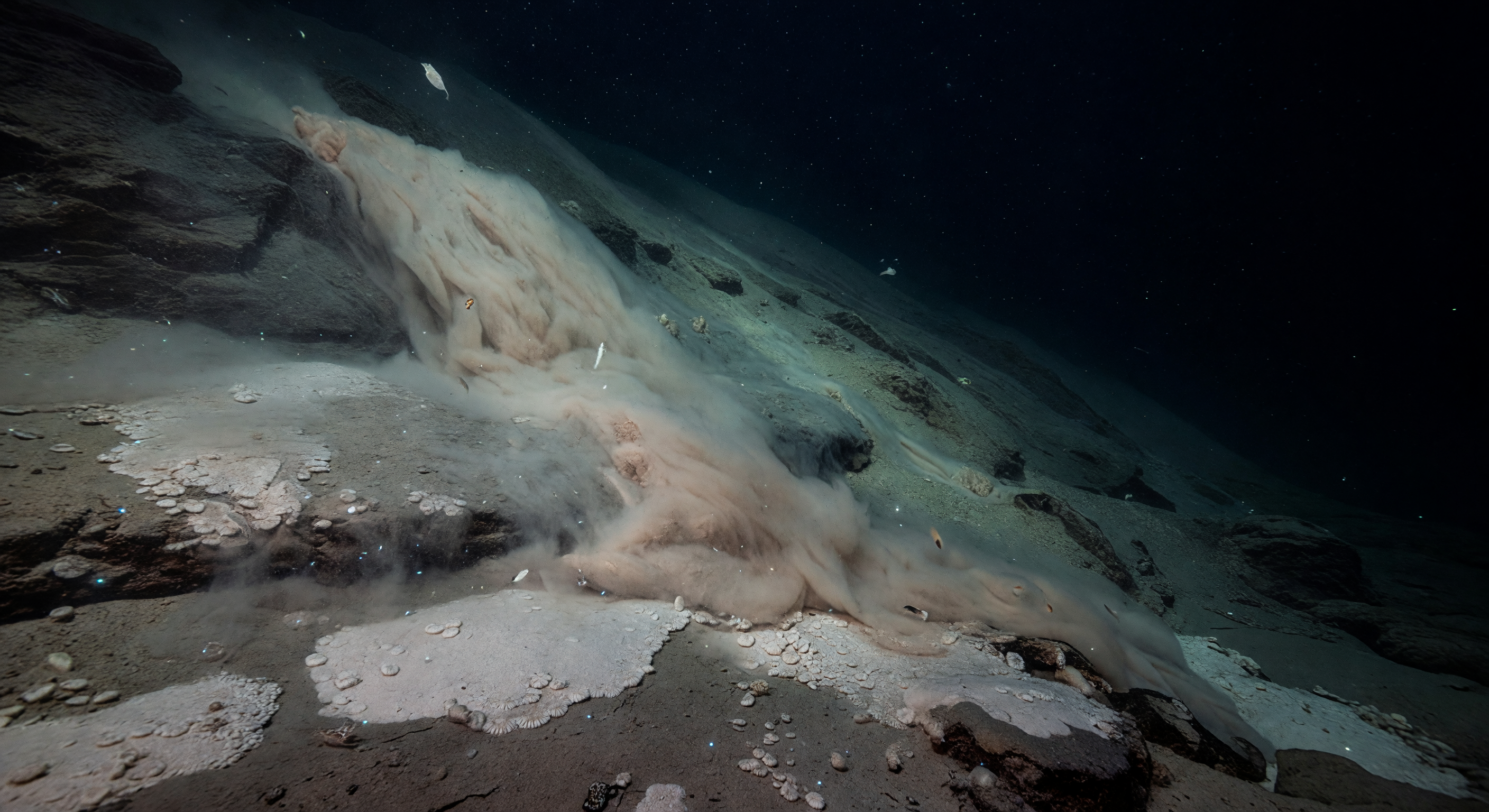
At nearly eleven kilometers beneath the surface, where hydrostatic pressure crushes water itself into a denser, marginally altered phase at roughly 1,100 atmospheres, a fresh sediment slump moves in slow, inexorable silence down the hadal incline of the Mariana Trench's deepest basin. The beige-white turbidity sheet rolls over fractured basaltic ground like powdery silk, partially entombing fields of giant xenophyophores — those extraordinary single-celled organisms that can exceed ten centimeters and represent some of the largest individual cells known to biology — along with pale foraminiferal aggregates that have accumulated across millennia of marine snow fall from waters six miles above. Suspended within the drifting sediment cloud, scattered sparks of cyan and blue-green bioluminescence flicker briefly into existence as disturbed hadal fauna respond to the disruption, their chemical light catching resuspended silt particles and tracing the moving front of the flow without illuminating anything beyond its immediate source. A ghostly snailfish — likely *Pseudoliparis swirei*, the deepest-dwelling vertebrate known to science, its translucent body adapted to pressures that would collapse the gas spaces of any untreated surface organism — hovers at the furthest margin of perception, its pale musculature barely resolved against absolute blackness, metabolizing slowly in water near 2°C. This slope exists in permanent, total darkness, shaped by gravity, chemistry, and deep geological time, entirely indifferent to observation.
Challenger Deep