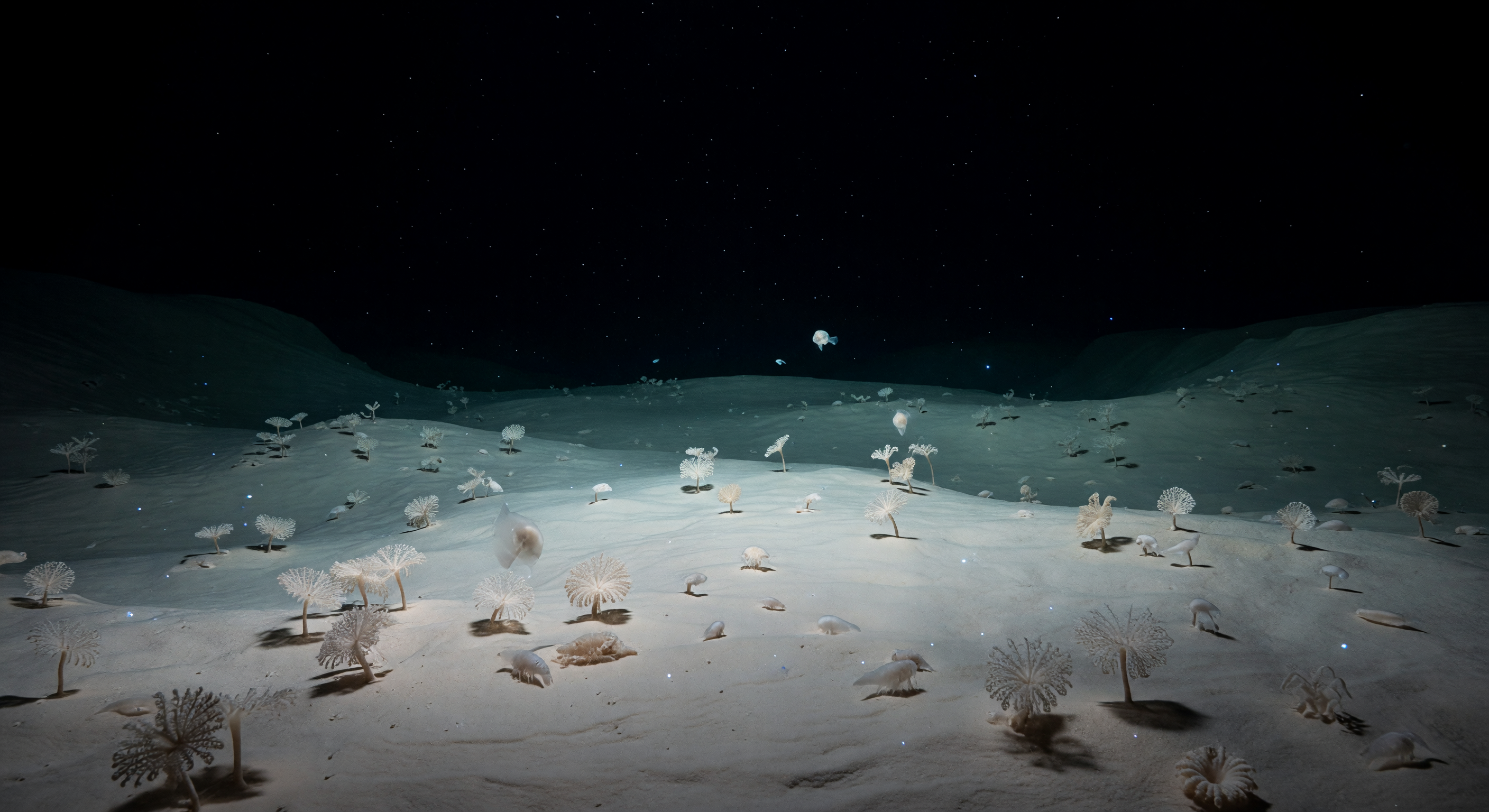
At the uttermost reach of the ocean's descent, nearly eleven kilometers beneath the surface, the floor of Challenger Deep spreads in eerie stillness as a pale white-beige plain of ponded sediment compressed beneath approximately 1,100 atmospheres of hydrostatic pressure — a force sufficient to collapse any unspecialized biology instantly. Here, in permanent and absolute aphotic darkness, giant xenophyophores rise from the soft mud like ivory rosettes, their single-celled bodies among the largest on Earth, built to thrive precisely where crushing pressure and perpetual cold define every boundary of survival. Hadal amphipods trace low arcs over the sediment near a sunken carcass slowly disappearing into the ooze, while translucent snailfish — the deepest-living vertebrates known to science — drift above the basin floor, their gelatinous bodies an evolutionary answer to pressures that would denature ordinary proteins. Fine marine snow descends without interruption through frigid, utterly clear water, each particle a fragment of biological material fallen from the sunlit world nearly eleven kilometers above, the sole thread connecting this remote basin to the productive ocean surface. Faint bioluminescent sparks drift through the black water column, brief cold-blue points of light produced by organisms whose chemistry requires no sun, signaling or hunting in a world that has existed in this silence, under this weight, entirely without witness.
Other languages
- Français: Panorama du Gouffre Profond
- Español: Panorama del Abismo Profundo
- Português: Panorama da Fossa Profunda
- Deutsch: Tiefste Becken Panorama
- العربية: بانوراما الحوض الأعمق
- हिन्दी: गहरा बेसिन दृश्य
- 日本語: 最深部の海盆全景
- 한국어: 가장 깊은 해분 파노라마
- Italiano: Panorama del Bacino Profondo
- Nederlands: Diepste Bekken Panorama