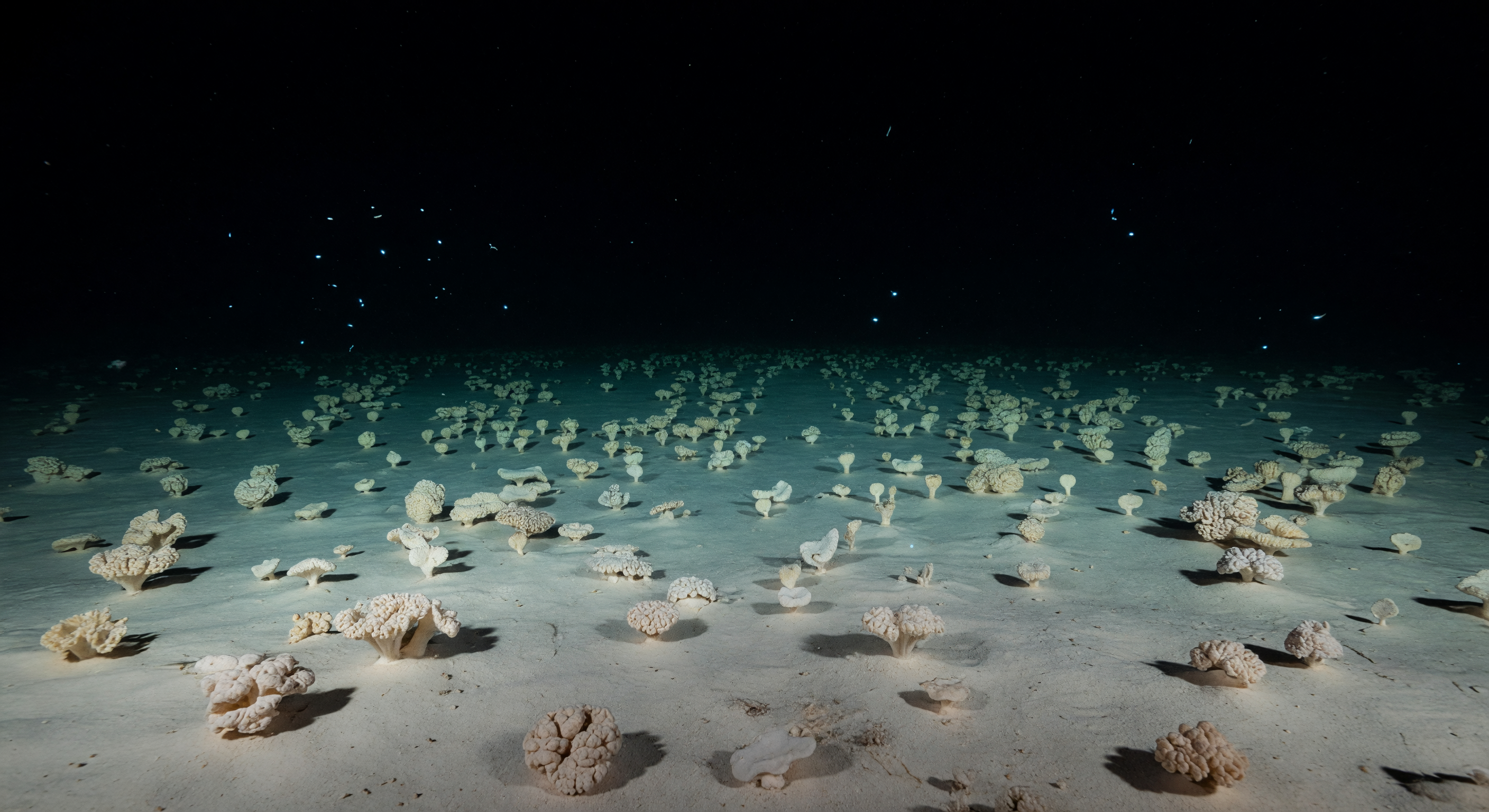
At the deepest known point in Earth's crust, nearly eleven kilometers beneath the surface, the hadal floor of Challenger Deep extends outward as an immense, near-featureless plain of powder-fine white-beige sediment — the accumulated fall of countless millennia of foraminifera, organic detritus, and marine snow that has settled through the entire water column above. Across this silty depocenter, xenophyophores rise in ghostly clusters: giant single-celled organisms, among the largest individual cells known to biology, their pale lobed and reticulate bodies forming fragile moundlike structures only centimeters tall yet clearly dominating the benthos as primary architects of this sediment landscape. Under roughly 1,100 atmospheres of hydrostatic pressure, water molecules are themselves marginally compressed, and the cold — a near-constant 1.5 to 2 °C — holds the basin in thermal stasis, the still water carrying only the thinnest suspended veil of particulates drifting with imperceptible current. Faint bioluminescent pinpricks flicker among microscopic hadal fauna, their cold cyan light too diffuse and brief to illuminate but just sufficient to suggest the vast, unbroken geometry of xenophyophore fields dissolving into absolute darkness in every direction. This is a world defined entirely by patience, pressure, and biological minimalism — a depocenter where life persists not despite the extremity of conditions but in precise evolutionary negotiation with them, unseen and unwitnessed, exactly as it has been for millions of years.
Other languages
- Français: Plaine des Xénophyophores
- Español: Llanura de Xenofiósforos
- Português: Planície de Xenofióforos
- Deutsch: Xenophyophoren Tiefebene
- العربية: سهل الكائنات العملاقة
- हिन्दी: गहरे सागर का विस्तार
- 日本語: 深海平原の広がり
- 한국어: 심해 평원의 광활함
- Italiano: Pianura degli Xenofiosfori
- Nederlands: Xenophyophoren Vlakte