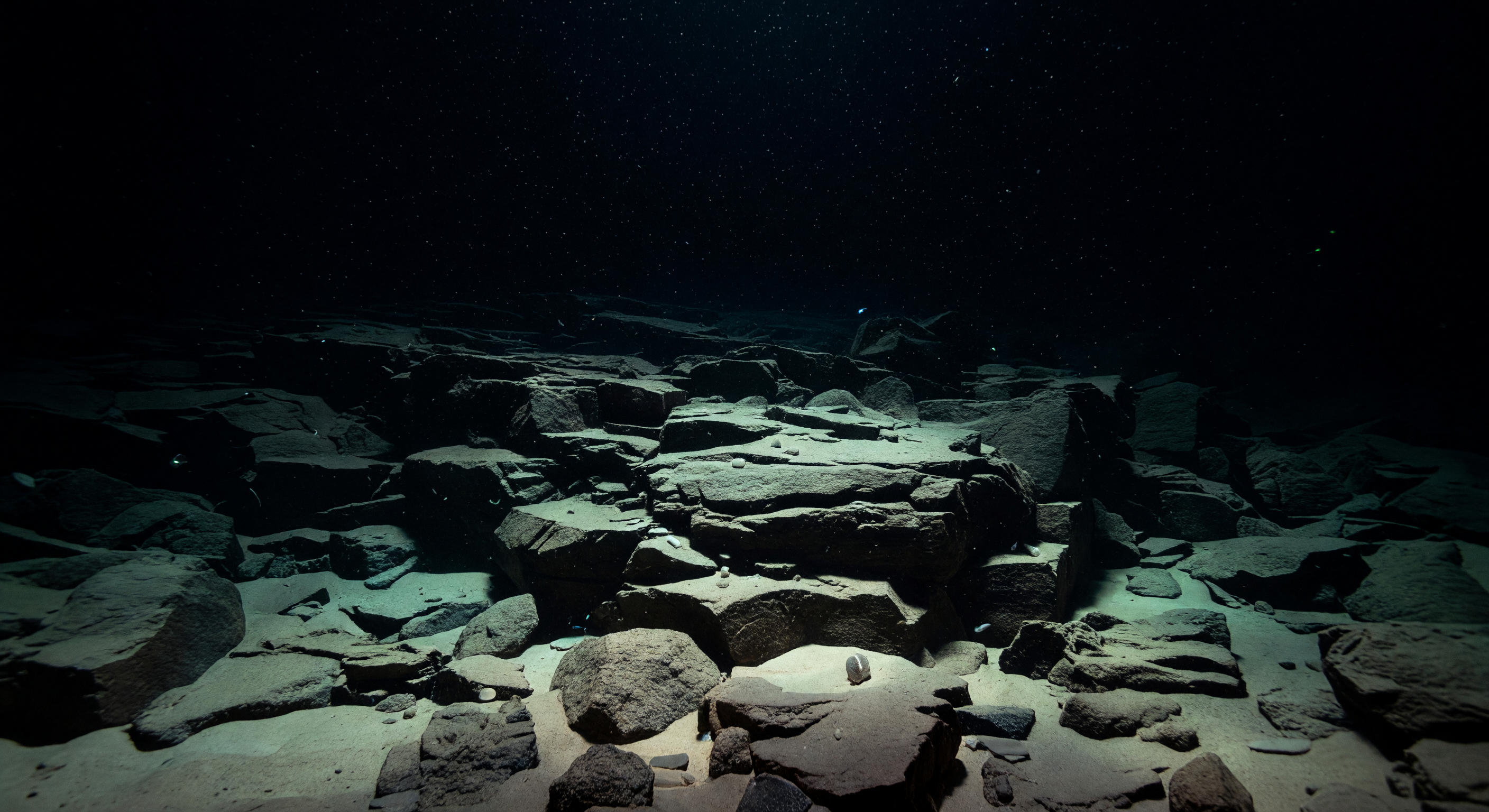
At nearly eleven kilometres below the surface, the exposed hadal scarp of Challenger Deep bears the full weight of approximately 1,100 atmospheres, a pressure so immense that water itself becomes fractionally compressible, altering the speed of sound and the behaviour of every molecule within it. Dark angular slabs of basalt, fractured by the slow mechanical stress of subduction where the Pacific Plate descends beneath the Philippine Sea Plate, rise in stepped relief from a floor dusted with cream-white foraminiferal ooze and terrigenous silt that has taken centuries to settle from the sunlit world far above. A continuous veil of marine snow — organic aggregates, mineral grains, the skeletal remains of surface plankton — descends through absolute aphotic darkness in perfect, unhurried silence, accumulating in fine drifts along every horizontal ledge and crevice with no current strong enough to disturb them. Pale xenophyophore-like forms, among the largest single-celled organisms on Earth, rest motionless against quieter sediment patches near the scarp base, while hadal amphipods — scavenging crustaceans evolved for piezophilic existence at these extreme pressures — ghost along the rock-sediment interface, their biology sustained by biochemical adaptations that would fail entirely at lesser depths. Sparse, isolated points of blue-green bioluminescence drift through the void, tiny living signals separated by vast and indifferent darkness, the only light this world has ever known.
Other languages
- Français: Voile de Sédiments Rocheux
- Español: Velo de Sedimento Rocoso
- Português: Véu de Sedimento Rochoso
- Deutsch: Felsvorsprung Sedimentschleier
- العربية: حجاب الرواسب الصخرية
- हिन्दी: शैल कगार तलछट आवरण
- 日本語: 岩棚堆積物のヴェール
- 한국어: 암벽 퇴적물 장막
- Italiano: Velo di Sedimento Roccioso
- Nederlands: Rotsrand Sedimentsluier