Scientific confidence: High
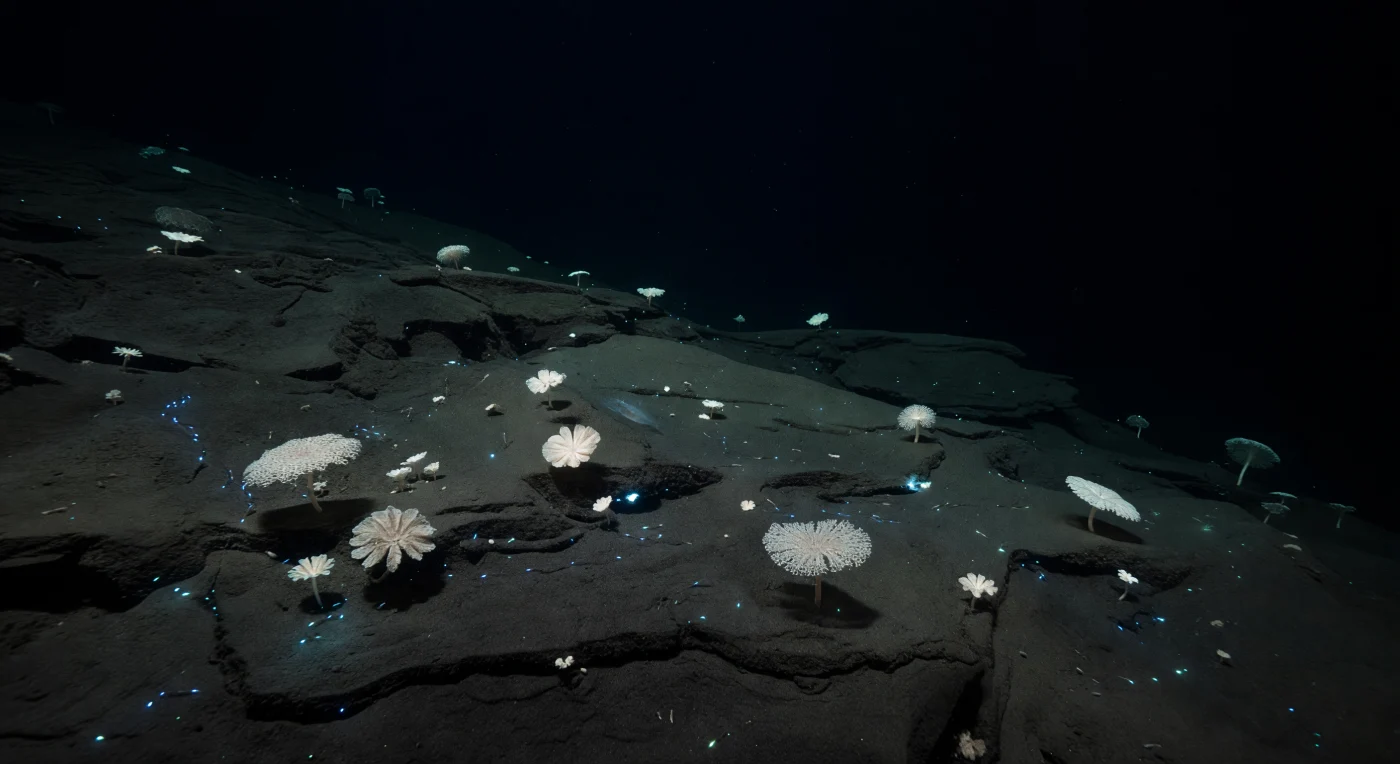
At roughly 7,500 to 8,500 metres below the surface, where pressure exceeds 800 atmospheres and water temperature hovers barely above freezing, a gently tilted terrace of graphite-dark mud extends across the trench shoulder in absolute aphotic silence. Scattered across this sediment drape, large xenophyophores — among the most enormous single-celled organisms on Earth — rise as pale, agglutinated rosettes and lacy disks, their chalk-ivory tests built grain by grain from particles scavenged from the seafloor, each structure a living archive of the marine snow that drifts perpetually downward from the sunlit world six miles above. No light from the surface has reached this place for geological ages; what briefly renders these forms legible are faint bioluminescent sparks — cool cyan and blue-green pinpricks produced by tiny animals moving low over the mud — tracing for a fleeting moment the delicate geometry of each xenophyophore before fading back into total blackness. A hadal snailfish drifts in the middle distance, its translucent, pressure-adapted body sustained by a biochemistry tuned to crushing depths that would destroy the cellular machinery of any shallow-water vertebrate, while amphipods cross the sediment between the xenophyophore colonies, scavenging in the thin benthic nepheloid haze. This terrace exists in primordial stillness, a living geology of soft bodies and agglutinated silica on dark ravined mud, utterly indifferent to any world above.
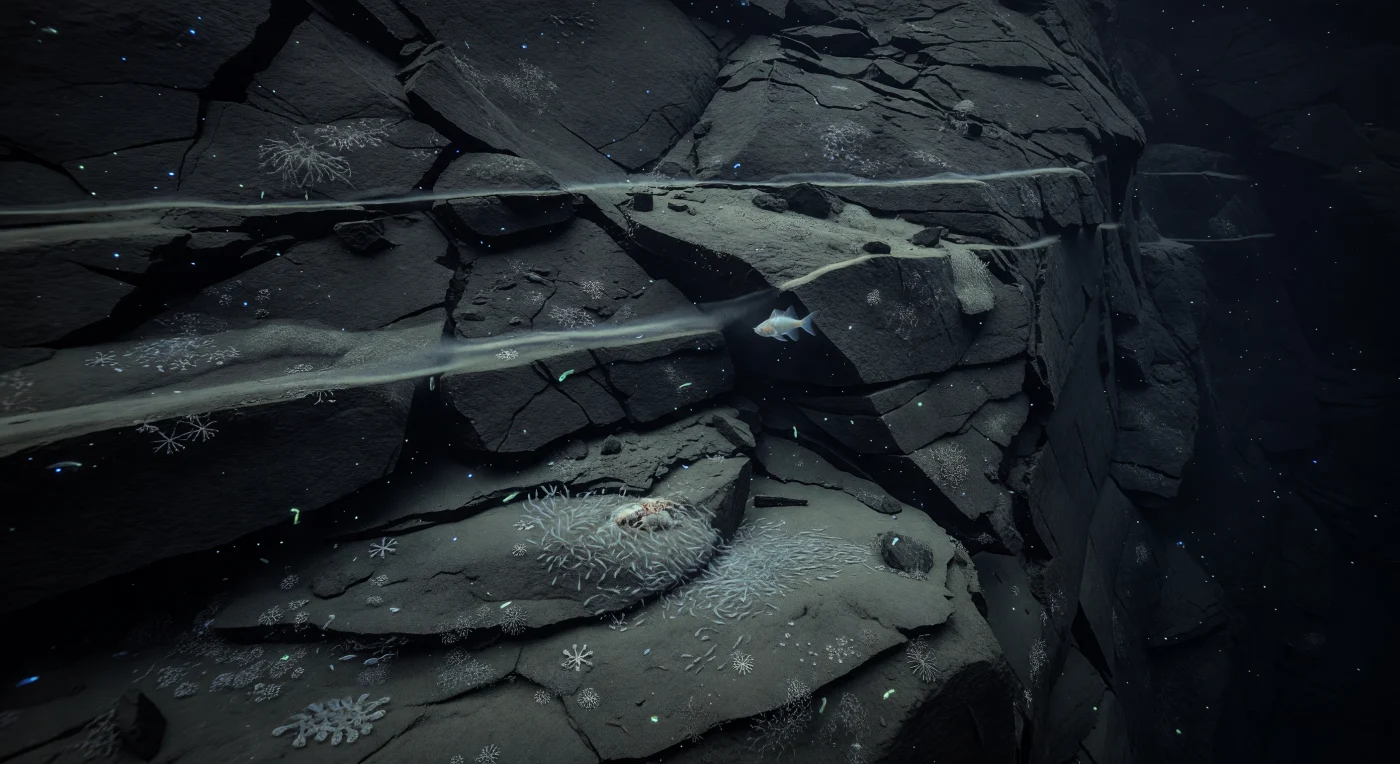
The near-vertical fault scarp descends into absolute darkness, its matte black basalt fractured by tectonic oversteepening into ravined gullies and narrow benches where thin ribbons of gray mud cling to each horizontal surface and pale xenophyophore colonies spread their delicate agglutinated lattices across sediment pockets like fragile mineral lace — all of it shaped under pressures approaching 80 to 100 megapascals, cold and stable at barely one to two degrees Celsius, in water that has not seen sunlight for millennia. No photon from the surface penetrates here; the only light that exists in this world is the light organisms make themselves, and across the ravines isolated cold blue pinpricks trace the paths of drifting crustaceans while faint cyan-green flashes from small pelagic invertebrates briefly outline ledge edges and the slow drift of marine snow descending through the clear, particulate-hazed water column. A ghost-pale hadal snailfish — gelatinous, neutrally buoyant, its skeleton reduced to the minimum that crushing pressure and carbonate-poor water permit — drifts just off the scarp face, one of the deepest vertebrates on Earth, its body a masterwork of piezophilic adaptation. On a sheltered sediment bench below, a small carcass has already been found by dense swarms of hadal amphipods, their translucent bodies forming a restless living mass against the gray silt, converting fallen organic matter into the currency of the trench food web with an efficiency that belies the apparent stillness of the surrounding wall. The scarp simply continues downward, disappearing into a black that is not metaphorical but total, a geometry of planetary tectonics rendered in cold rock and silence, existing entirely without witness.
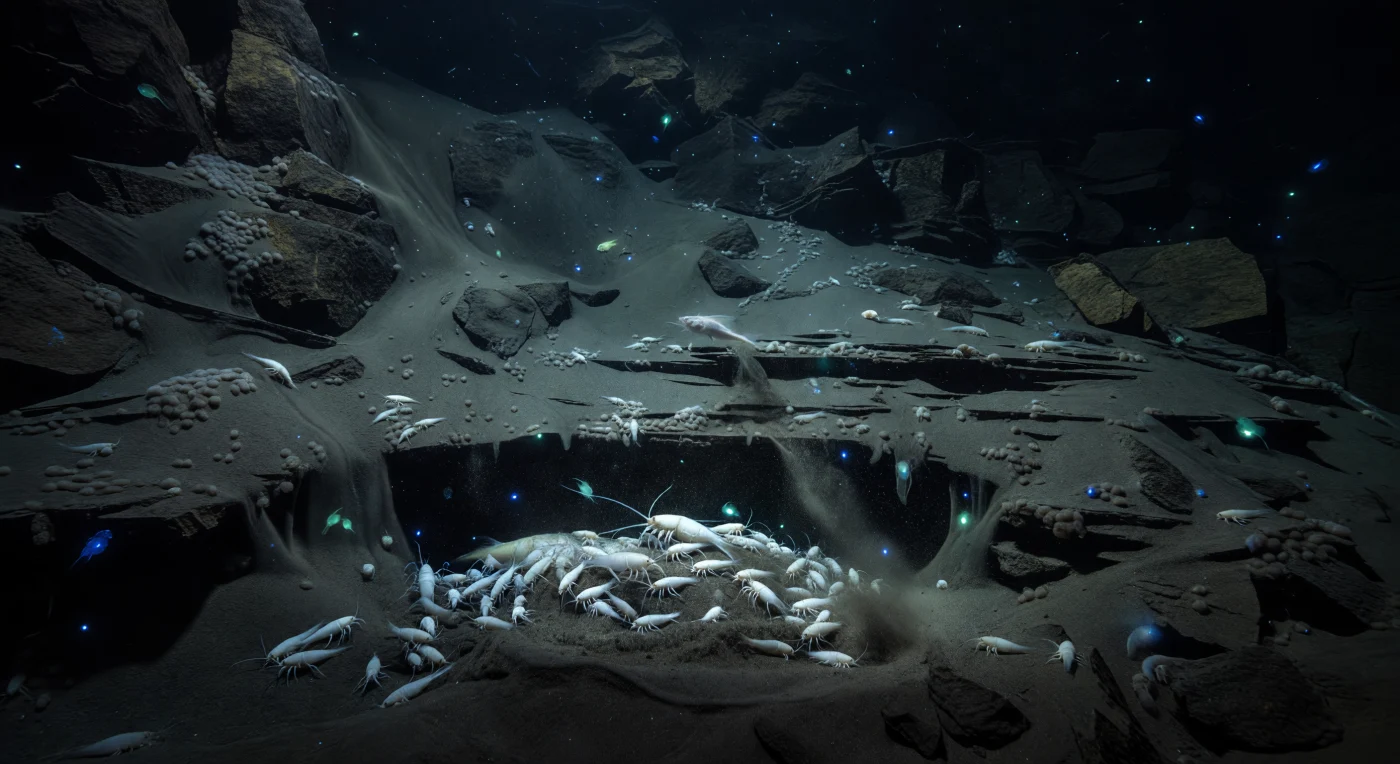
In a sheltered hollow gouged into the steep hadal shoulder at roughly 8,000 meters depth — where pressure approaches 80 megapascals and crushes the water into a medium denser and more alien than anything at the surface — a naturally fallen fish carcass has come to rest half-buried in soft gray silt, drawn down through kilometers of dark water by gravity alone, a rare packet of organic energy in a world defined by scarcity. Giant amphipods of the family Lysianassidae, ivory-pale and built by evolution to endure pressures that would collapse any unspecialized organism, swarm the carcass in dense, churning layers, their articulated legs and long antennae sharp against the disturbed cloud of fine sediment they raise as they feed — opportunistic scavengers that detect such falls through chemoreception across vast distances of black water and converge within hours. Intermittent cobalt and blue-green pulses from gelatinous zooplankton drifting through the water column above catch on the translucent carapaces of the amphipods and the slick, fault-scarred basalt of the trench wall, each bioluminescent flash a cold organic signal exchanged in total darkness between organisms that have never required sunlight, never needed a surface world. A hadal snailfish — Liparidae, among the deepest-ranging vertebrates known to science, their tissues biochemically stabilized against pressure by elevated concentrations of trimethylamine oxide — drifts at the periphery of the feeding mass, suspended weightlessly above the slope in water barely above freezing. Marine snow descends through the blackness in slow, constant fall, mingling with the nepheloid haze above the disturbed sediment, every particle a fragment of the sunlit world far above, transformed by the time it arrives here into something the trench has claimed entirely as its own.
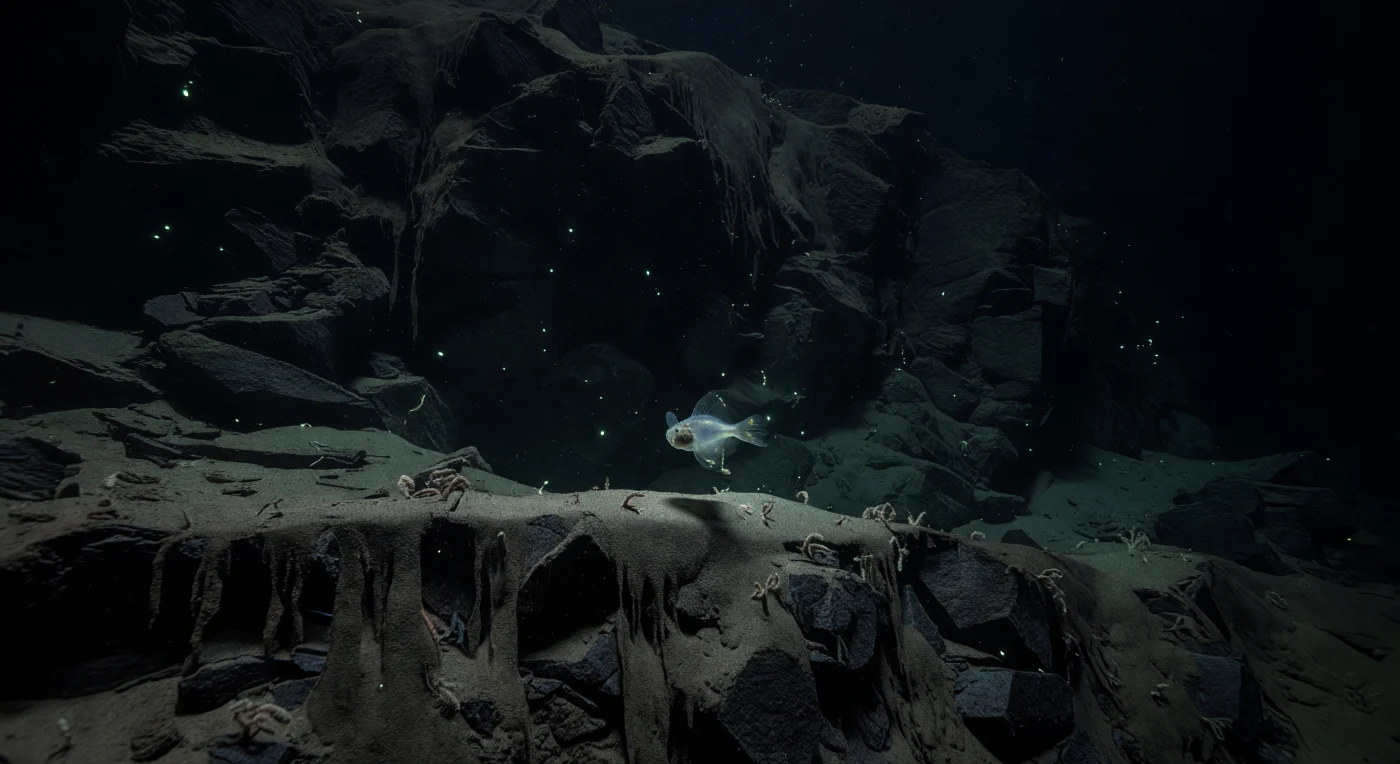
At around 7,500 to 8,500 metres depth on the steep flank of a major oceanic trench, pressures approaching 85 megapascals compress every molecule of water into a medium that no sunlight has ever reached, a permanently aphotic world where the only visible light emerges from life itself. Here, a lone hadal snailfish — likely a species of *Pseudoliparis* or a closely related liparid — hovers with effortless poise just above a narrow sediment bench cut into a plunging wall of fractured basalt and draped ravine mud, its gelatinous, translucent body an evolutionary answer to crushing pressure: reduced mineralisation, piezolyte-rich tissues, and a skeleton so delicate it would collapse at surface conditions. Sparse agglutinated xenophyophores — giant single-celled foraminifera that are among the largest individual cells on Earth — dot the pale silt of the bench, filter-feeding particles delivered by topographically steered currents and the slow rain of marine snow that drifts through the near-freezing water at roughly 1 to 2 degrees Celsius. Occasional cold cyan-green pulses of bioluminescence from drifting planktonic organisms sketch the cliff face behind the fish in brief, living light, catching the translucent margins of its broad pectoral fins before dissolving back into absolute darkness. This world is not waiting to be discovered; it has existed on its own terms, in perfect pressurised silence, for millions of years.
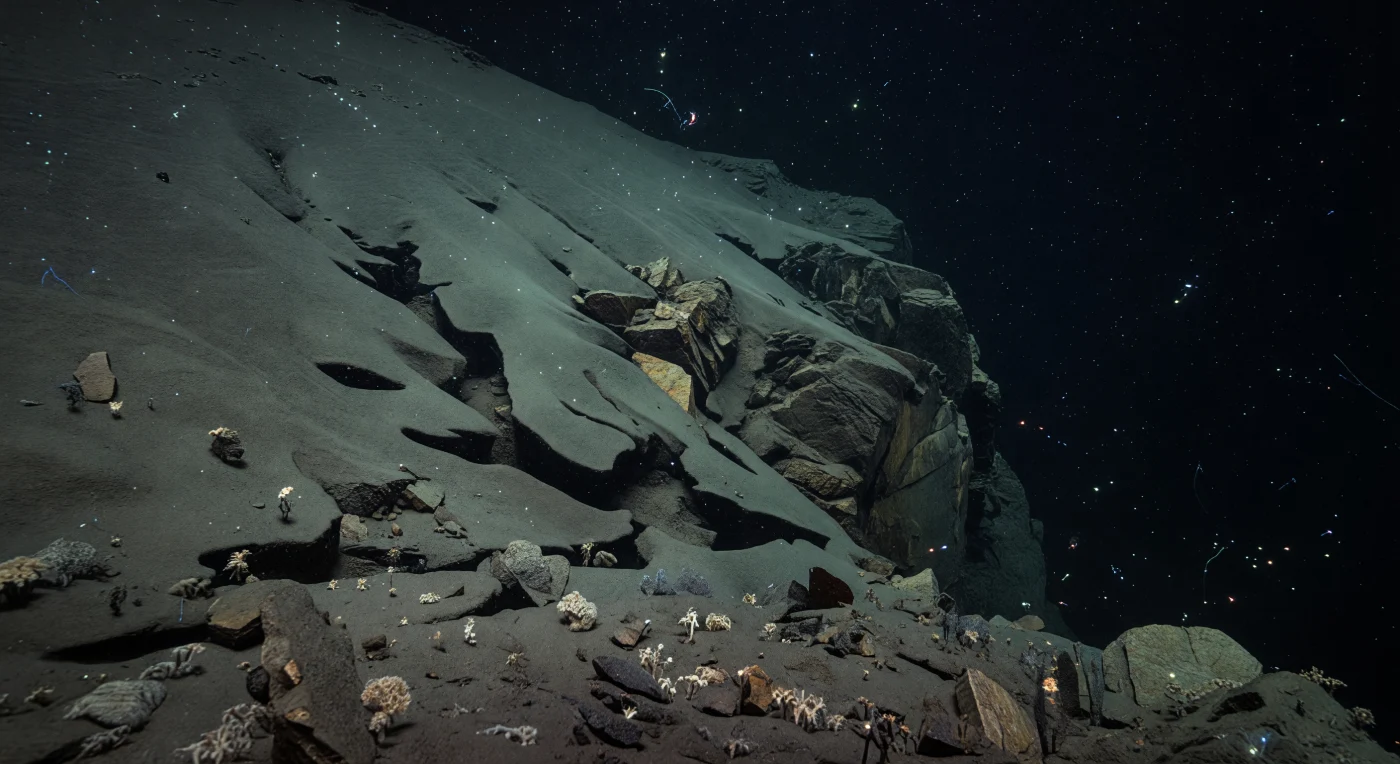
At the edge where the trench shoulder breaks into ravined gullies and plunges toward the hadal axis, cold gray sediment drapes over angular talus and exposed faulted rock under pressures approaching 85 megapascals — a crushing force that governs every biochemical process in the few organisms adapted to survive here. Across the pale agglutinated xenophyophores anchored to the cohesive clay, hair-fine threads of blue bioluminescent light arc slowly through the water column above the abyssal drop, left by pelagic bodies invisible in the permanent darkness — perhaps amphipods, small gelatinous zooplankton, or organisms as yet unnamed, drifting through a world of near-freezing, perpetually aphotic water at roughly 1–2°C. The ravined sediment drape itself records episodes of downslope gravity transport and topographically steered currents that funnel organic particles from the water column above into these gullies, concentrating the sparse energy that sustains life at the trench's upper hadal flanks. Scalloped erosion channels cut into the slope where benthic nepheloid layers sweep sediment away from exposed rock, leaving behind a landscape shaped as much by deep circulation and seismic stress as by simple accumulation. These trails of cold light trace passage through a silence that has known no witness — a place where darkness is not an absence but the fundamental condition of existence itself.
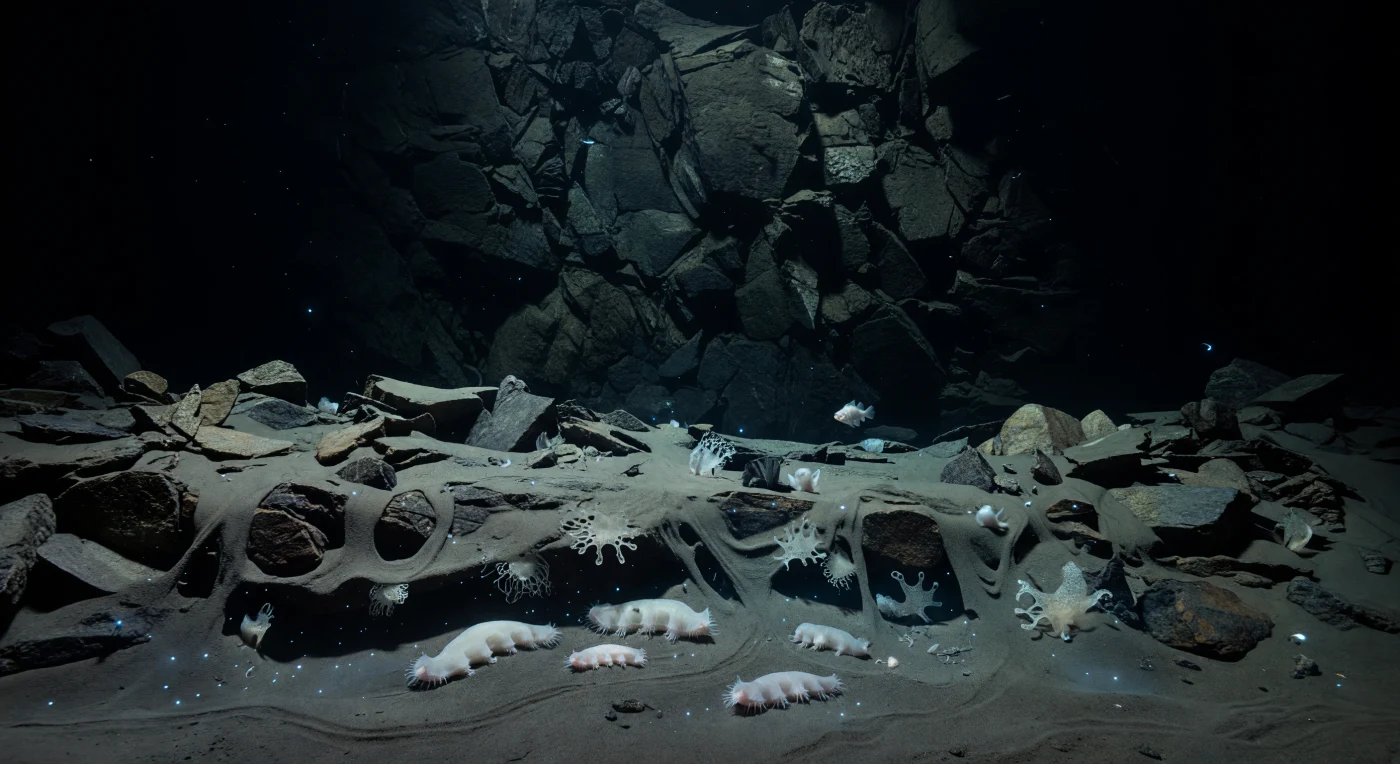
At depths where pressure exceeds 800 atmospheres and temperature hovers near 1–2°C, a near-vertical subduction-scar cliff of dark fractured basalt plunges into a talus bench of angular collapsed blocks, their surfaces slicked with mineral films and dusted by a thin nepheloid haze of slowly settling marine snow. In the sheltered mud pocket cradled between the fallen stones, pale hadal holothurians — translucent ivory, their low dorsal ridges faintly tinged with pink — inch forward on delicate tube feet, inscribing sinuous trails in the gray silt as they process sediment laden with bacterial mats and particulate organic carbon that has drifted down across kilometers of open water. Fragile xenophyophore tests cling to calmer patches of sediment nearby, their single-celled architecture scaled to a size only achievable under such stable, cold, high-pressure conditions, while a solitary hadal snailfish — a liparid adapted with pressure-tolerant enzyme systems and a gelatinous, low-density body — hovers ghost-like just beyond the bench, dwarfed by the ascending wall that vanishes into absolute blackness above. Intermittent cyan-blue bioluminescent flashes from drifting midwater organisms briefly cross the scene, catching the wet texture of broken rock and outlining the holothurians' soft ridges before fading back into darkness, the only light this world has ever known. Here, at the convergent margin of two tectonic plates, life persists in a primordial silence that owes nothing to any outside witness.
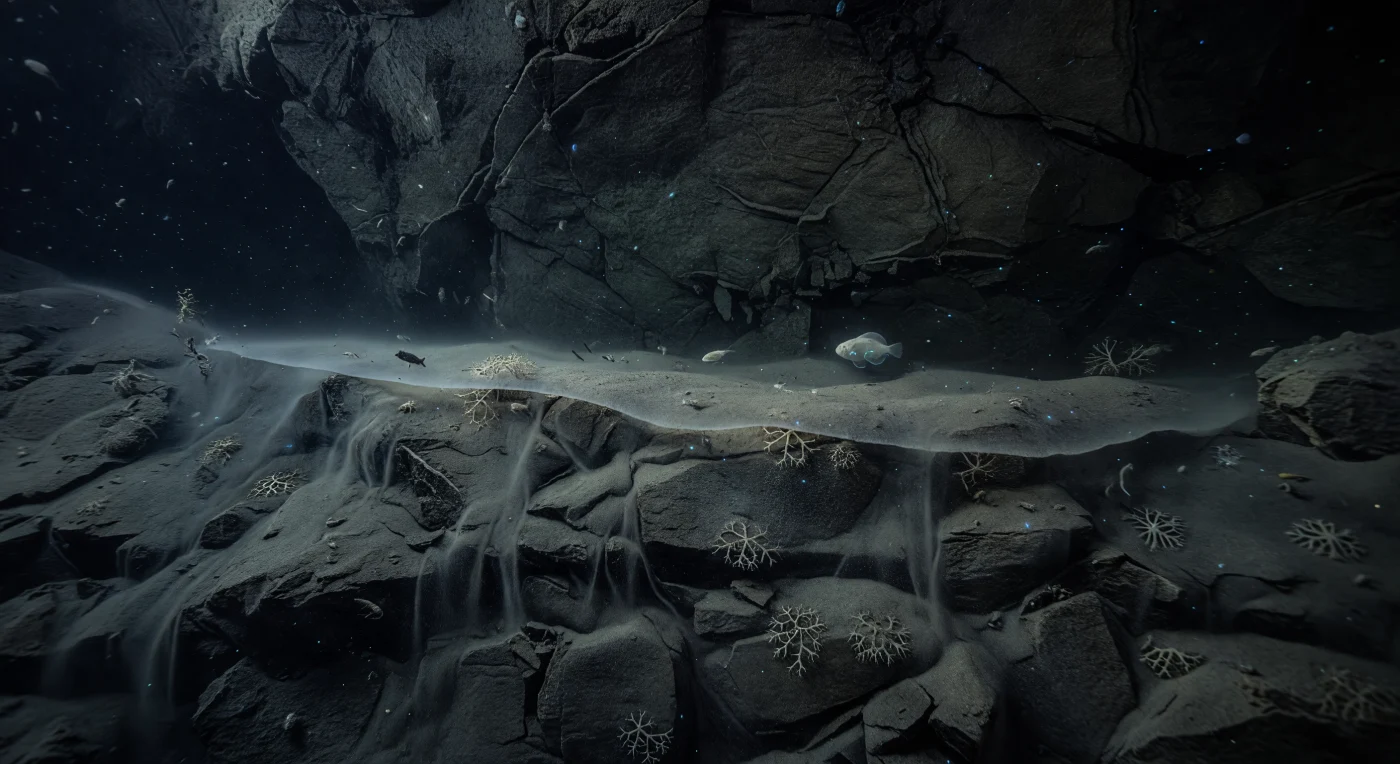
At roughly 7,500 to 8,500 metres beneath the surface, a narrow bench interrupts the near-vertical plunge of black basaltic rock, its sediment pockets draped in ravined gray clay and talus debris shed from the cliff above over geological timescales — a landscape shaped by gravity, pressure approaching 85 megapascals, and water barely warmer than 1–2°C. A contour-following current grazes the ledge and lifts fine silt into a thin nepheloid veil, a low horizontal haze in which clay particles and marine snow hang suspended in cold, motionless water, the entire drift illuminated by nothing but the sparest bioluminescent pinpricks — faint blue-green glimmers from drifting microorganisms that are just sufficient to resolve the ledge geometry in charcoal and cold steel-gray. Against the darker wall and across the silty bench, amphipods and munnopsid isopods move as dim translucent forms, their bodies half-dissolved into the particulate murk, while fragile agglutinated xenophyophores dot the softer sediment pockets like pale lacework — single-celled giants that thrive precisely because the shoulder current concentrates organic matter along the bench, making these steep topographic interruptions among the most biologically significant features of the hadal realm. Slightly farther from the cliff, a soft-bodied hadal snailfish hovers weightlessly in the black water column, its pale form ghostlike against absolute darkness — a vertebrate pressing existence to the very edge of what pressure, temperature, and enzyme chemistry permit, in a world that has never known sunlight and exists in complete, crushing, primordial silence.
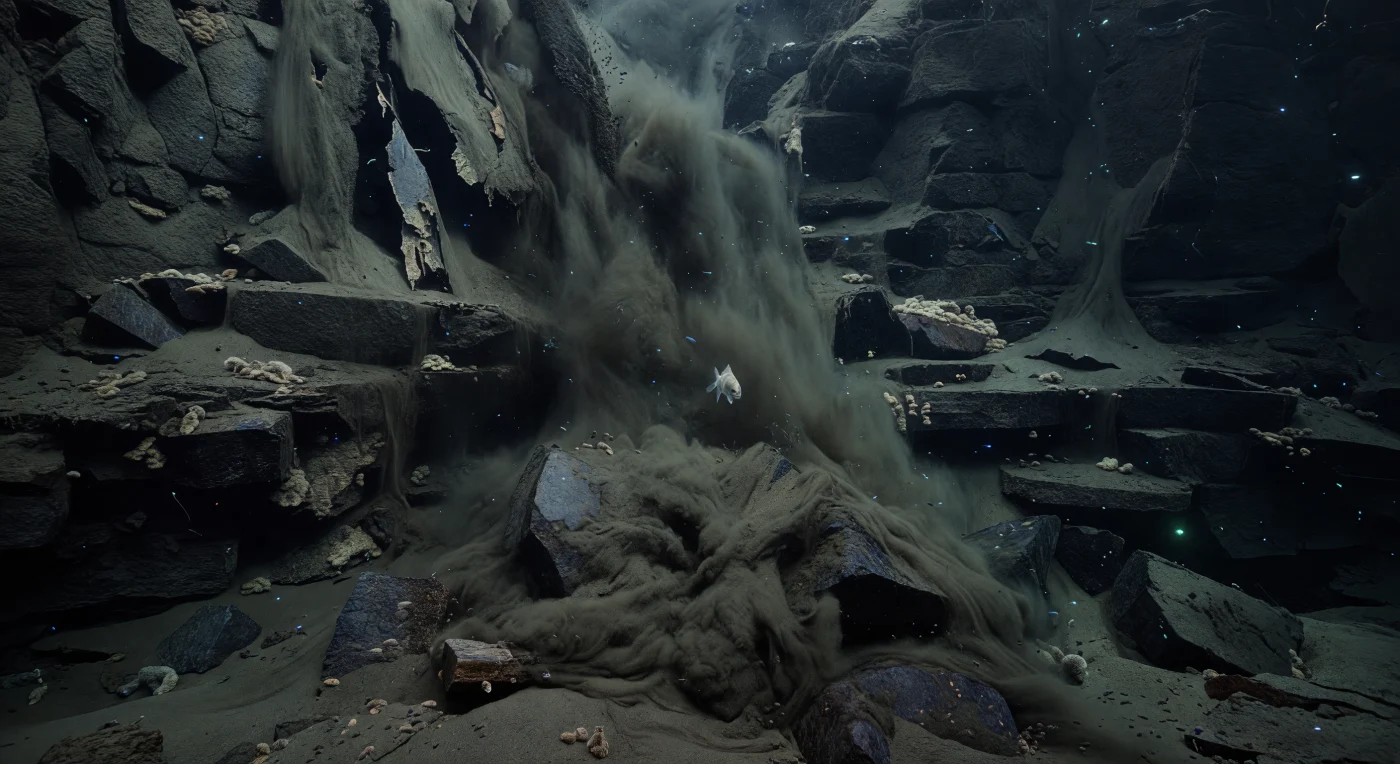
At roughly 8,000 to 9,000 metres beneath the surface, where pressure exceeds 80 megapascals and temperatures hover near 1–2°C, a fresh sediment slump tears loose from a fault scarp and pours down a steep chute in dense, graphite-colored billows, rolling over angular talus blocks and stripped bedrock benches with a slow, irresistible gravity that carries no sound through the near-freezing water. Torn sediment drapes peel from the ravined walls as the cohesive plume curls around boulders and lifts thin veils of silt into the permanent aphotic blackness — an entirely natural mass-wasting event of the kind that periodically redistributes organic matter and fine sediment toward the hadal axis, reshaping the benthic landscape and briefly burying whatever life clings to the lower scarps. Pale agglutinated xenophyophores — among the largest single-celled organisms on Earth, uniquely adapted to extreme pressure and particle-rich sediment — hold fast to sheltered ledges just beyond the advancing flow, while a ghost-pale hadal snailfish, the deepest-known vertebrate lineage, hovers above the disturbance in neutral suspension, its pressure-adapted enzymes functioning where no other fish can follow. Sparse cyan and blue-green bioluminescent pinpricks drift along the hadal wall — faint metabolic signals from organisms whose chemistry runs on geological time — and several are momentarily swallowed as the gray plume passes over them, extinguished and then silently reappearing as the silt cloud thins. Marine snow and a natural nepheloid haze mingle freely in the water column, delivering the only food this world receives, while the monumental scale of the plunging trench walls — charcoal rock fading into velvet blackness above and below — speaks to the immense, unhurried self-sufficiency of an ocean that has never needed a witness.
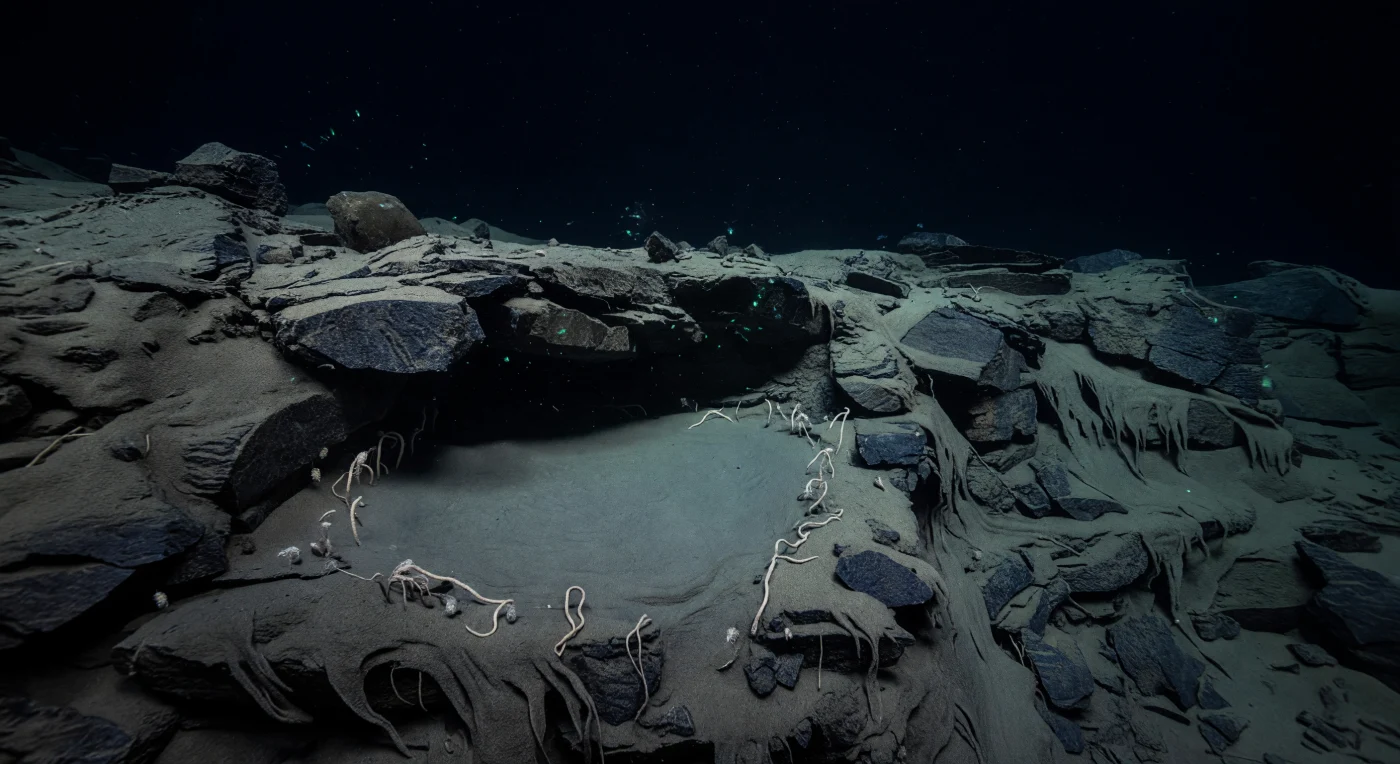
Beneath a fractured overhang of pressure-split basaltic slabs, a still pocket of ash-gray silt accumulates in one of the most extreme environments on Earth — a trench shoulder where hydrostatic pressure exceeds 600 atmospheres and temperatures hover near 1–2°C, rendering the water dense, near-freezing, and essentially motionless in its thermal character yet gently animated by topographically steered contour currents that carry a slow drift of marine snow and nepheloid particles suspended in the black water column. The underside of the overhang shelters a community of agglutinated foraminifera — organisms that construct delicate tubular tests from sediment grains cemented together, an architecture precisely adapted to the mechanical and chemical constraints of hadal pressure — alongside tiny haploid crustaceans, likely amphipods or isopods, pressed close to the substrate where accumulated organic detritus funneled down the steep ravined flanks provides the chemical energy that sustains life in permanent darkness. No photon of sunlight has reached this depth since the rock itself was formed; the only light that has ever moved through this water originates within the organisms themselves, and isolated emerald and blue-green bioluminescent blinks from small drifting bodies trace the rim of fractured stone and the faint scalloped surface of silt before receding into open black water where the wall plunges further still, unwitnessed and unchanged, a geology and biology that predate any awareness of their own existence.
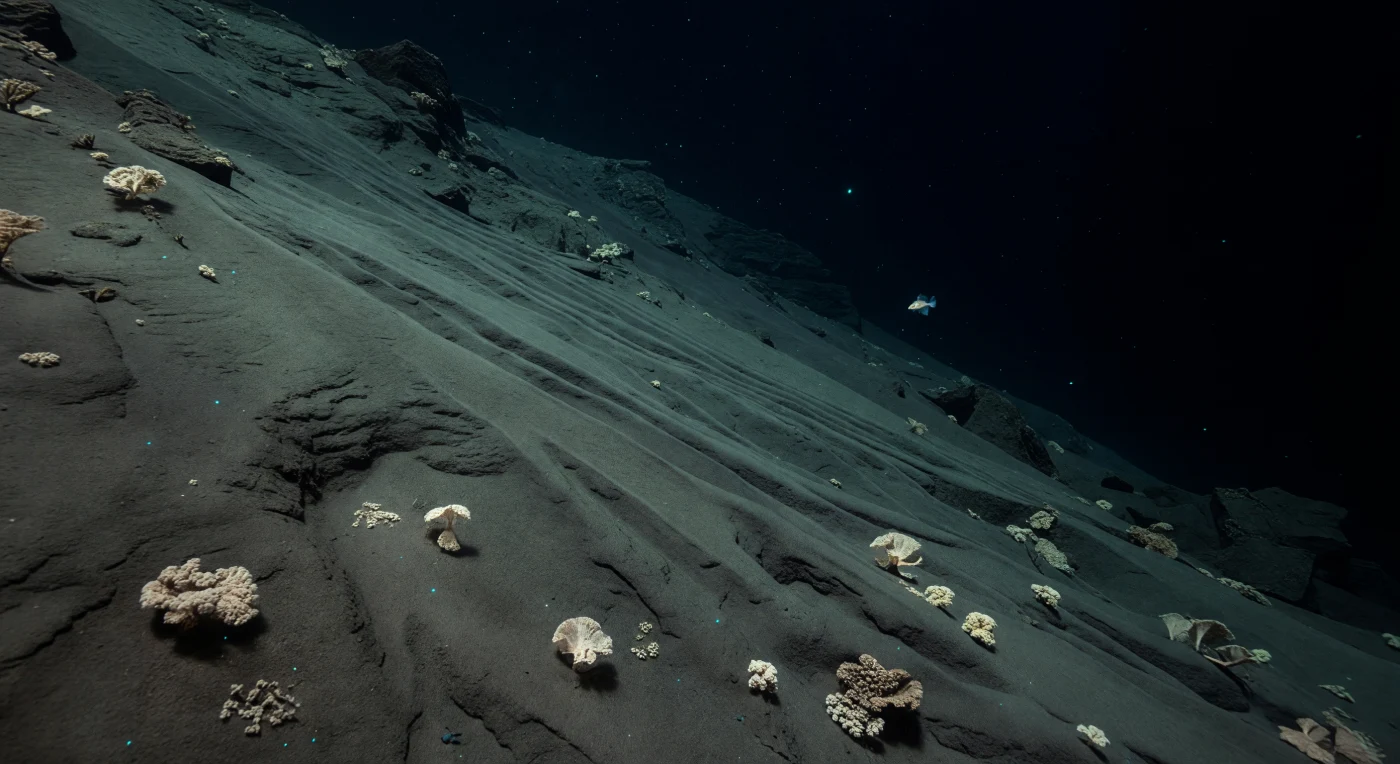
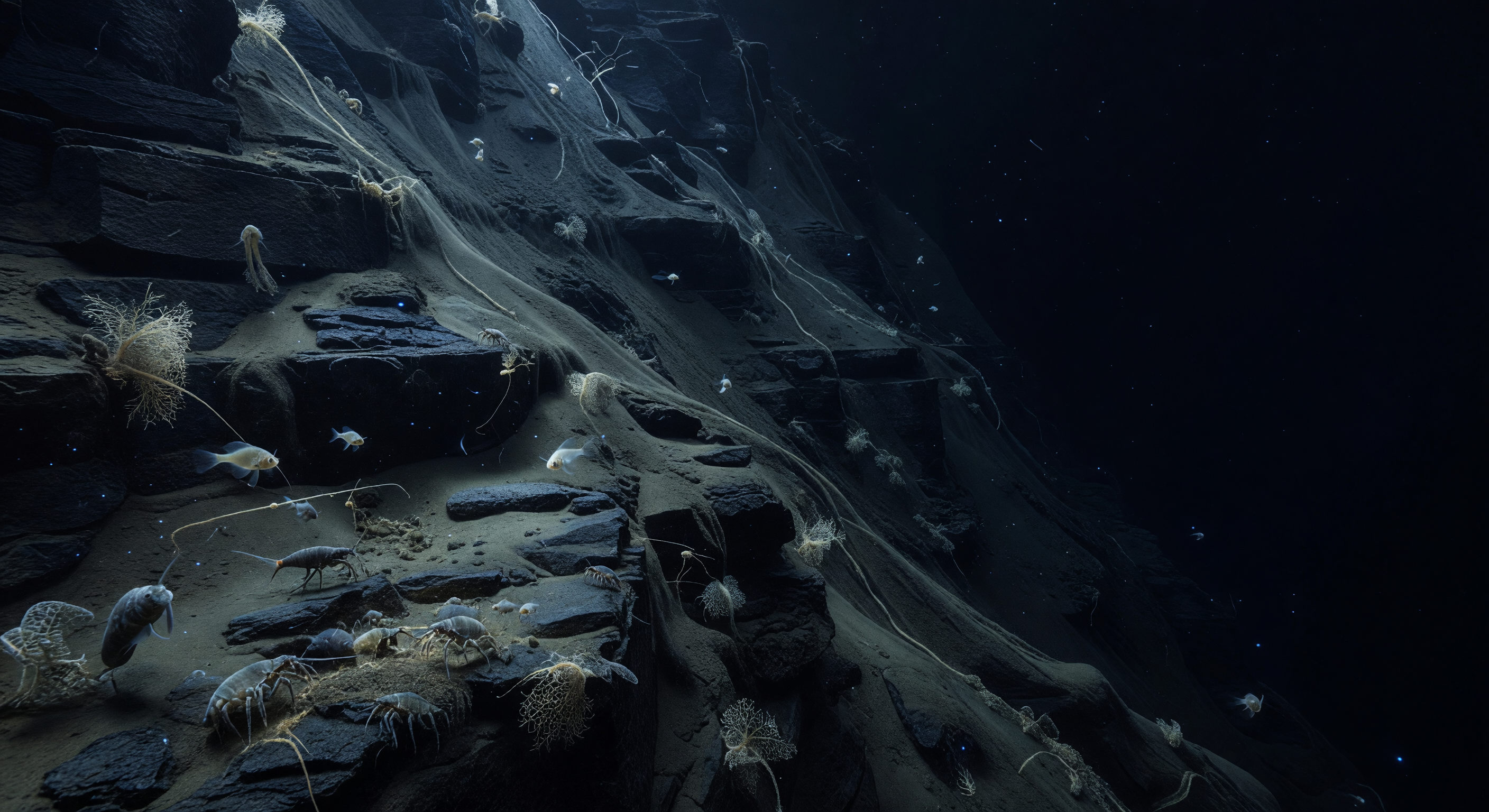
Along the vast inclined bench, sediment drapes of silty gray clay and compacted mud cascade in long erosion furrows down toward the trench axis — a descent so immense that the far edge simply dissolves into absolute blackness, lost well before any boundary can be resolved. At depths between eight and nine thousand meters, pressure exceeds eighty megapascals, cold enough to hold near one to two degrees Celsius, and the water mass here is ancient, stable, and nearly isothermal, shaped over millennia by the slow circulation of the deepest Pacific. Scattered across the sediment pockets like pale lacework anchored to the slope, xenophyophores — giant single-celled agglutinating protists unique to hadal environments — spread their fragile rosettes and fans, thriving precisely because of the concentrated organic matter that settles into these topographically complex furrows and slump scars. A single hadal snailfish, *Pseudoliparis* or close kin, hovers in translucent suspension against the vast bench, its gelatinous body and softly undulating fins an evolutionary answer to crushing pressure — the deepest vertebrates alive, descending further into the axis than any other fish lineage on Earth. Through the frigid water column, sparse marine snow drifts downward and a thin nepheloid haze slides low over the furrows, while a handful of faint blue-green bioluminescent motes pulse and fade freely in the darkness — the only light this world has ever known, belonging entirely to itself.