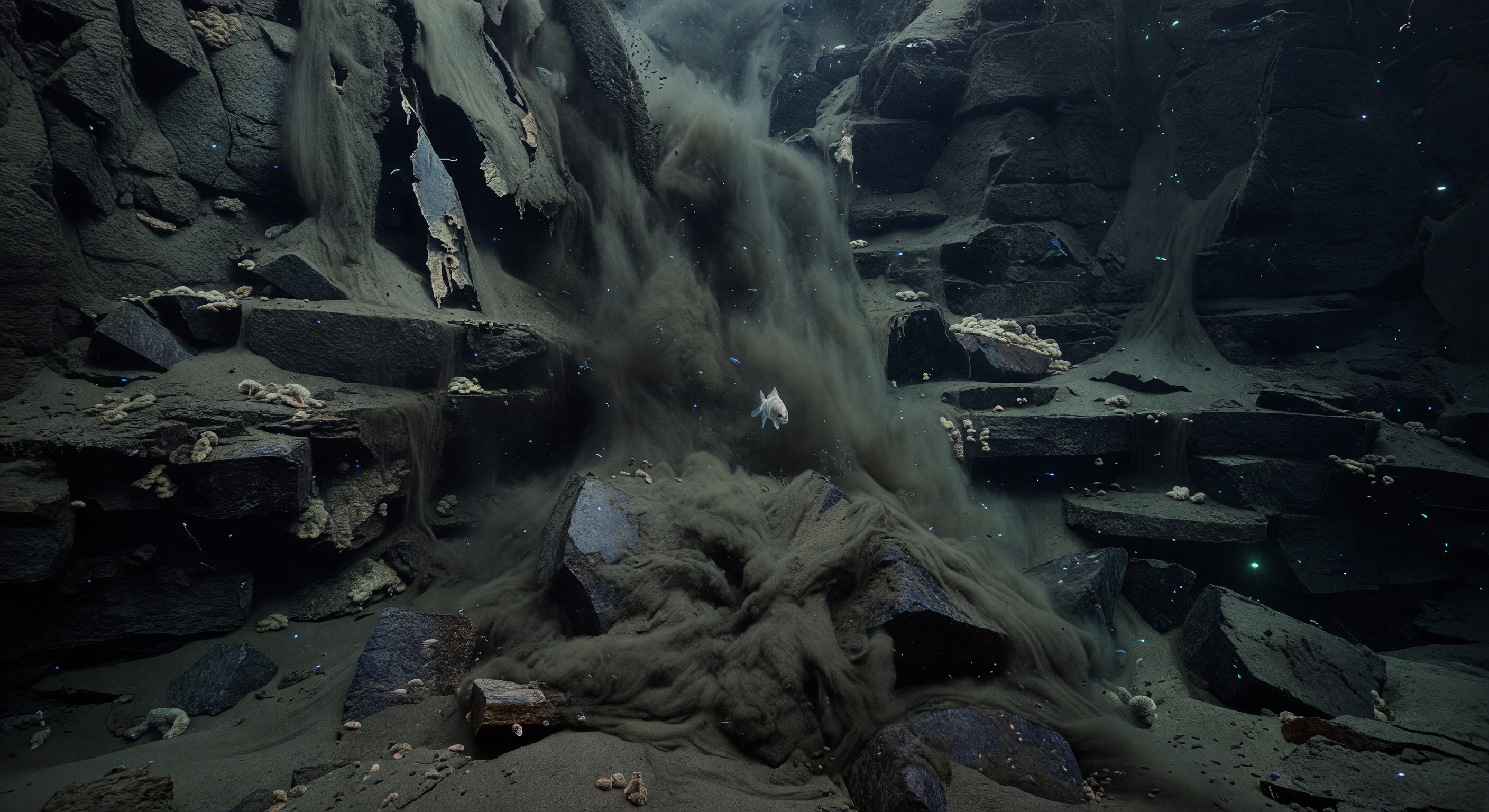
At roughly 8,000 to 9,000 metres beneath the surface, where pressure exceeds 80 megapascals and temperatures hover near 1–2°C, a fresh sediment slump tears loose from a fault scarp and pours down a steep chute in dense, graphite-colored billows, rolling over angular talus blocks and stripped bedrock benches with a slow, irresistible gravity that carries no sound through the near-freezing water. Torn sediment drapes peel from the ravined walls as the cohesive plume curls around boulders and lifts thin veils of silt into the permanent aphotic blackness — an entirely natural mass-wasting event of the kind that periodically redistributes organic matter and fine sediment toward the hadal axis, reshaping the benthic landscape and briefly burying whatever life clings to the lower scarps. Pale agglutinated xenophyophores — among the largest single-celled organisms on Earth, uniquely adapted to extreme pressure and particle-rich sediment — hold fast to sheltered ledges just beyond the advancing flow, while a ghost-pale hadal snailfish, the deepest-known vertebrate lineage, hovers above the disturbance in neutral suspension, its pressure-adapted enzymes functioning where no other fish can follow. Sparse cyan and blue-green bioluminescent pinpricks drift along the hadal wall — faint metabolic signals from organisms whose chemistry runs on geological time — and several are momentarily swallowed as the gray plume passes over them, extinguished and then silently reappearing as the silt cloud thins. Marine snow and a natural nepheloid haze mingle freely in the water column, delivering the only food this world receives, while the monumental scale of the plunging trench walls — charcoal rock fading into velvet blackness above and below — speaks to the immense, unhurried self-sufficiency of an ocean that has never needed a witness.
Trench shoulders