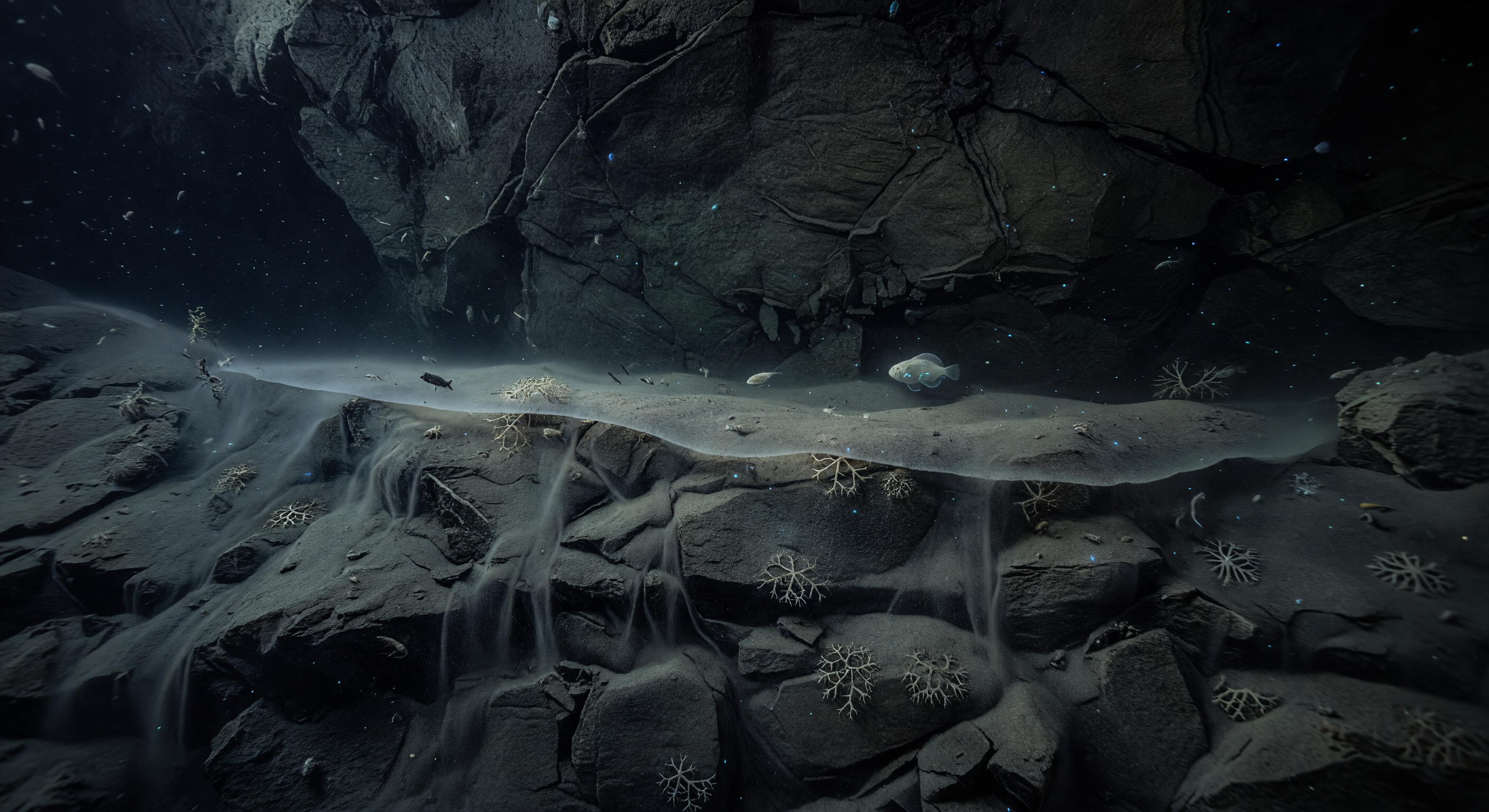
At roughly 7,500 to 8,500 metres beneath the surface, a narrow bench interrupts the near-vertical plunge of black basaltic rock, its sediment pockets draped in ravined gray clay and talus debris shed from the cliff above over geological timescales — a landscape shaped by gravity, pressure approaching 85 megapascals, and water barely warmer than 1–2°C. A contour-following current grazes the ledge and lifts fine silt into a thin nepheloid veil, a low horizontal haze in which clay particles and marine snow hang suspended in cold, motionless water, the entire drift illuminated by nothing but the sparest bioluminescent pinpricks — faint blue-green glimmers from drifting microorganisms that are just sufficient to resolve the ledge geometry in charcoal and cold steel-gray. Against the darker wall and across the silty bench, amphipods and munnopsid isopods move as dim translucent forms, their bodies half-dissolved into the particulate murk, while fragile agglutinated xenophyophores dot the softer sediment pockets like pale lacework — single-celled giants that thrive precisely because the shoulder current concentrates organic matter along the bench, making these steep topographic interruptions among the most biologically significant features of the hadal realm. Slightly farther from the cliff, a soft-bodied hadal snailfish hovers weightlessly in the black water column, its pale form ghostlike against absolute darkness — a vertebrate pressing existence to the very edge of what pressure, temperature, and enzyme chemistry permit, in a world that has never known sunlight and exists in complete, crushing, primordial silence.
Other languages
- Français: Voile Néphéloïde du Rebord
- Español: Deriva Nefeloide del Saliente
- Português: Névoa Nefeloide na Saliência
- Deutsch: Nepheloider Felsband Schleier
- العربية: انجراف الضباب الغائم
- हिन्दी: नेफेलॉइड कगार प्रवाह
- 日本語: ネフェロイド棚流れ
- 한국어: 네펠로이드 암반 흐름
- Italiano: Deriva Nefeloide del Bordo
- Nederlands: Nepheloïde Richel Drift