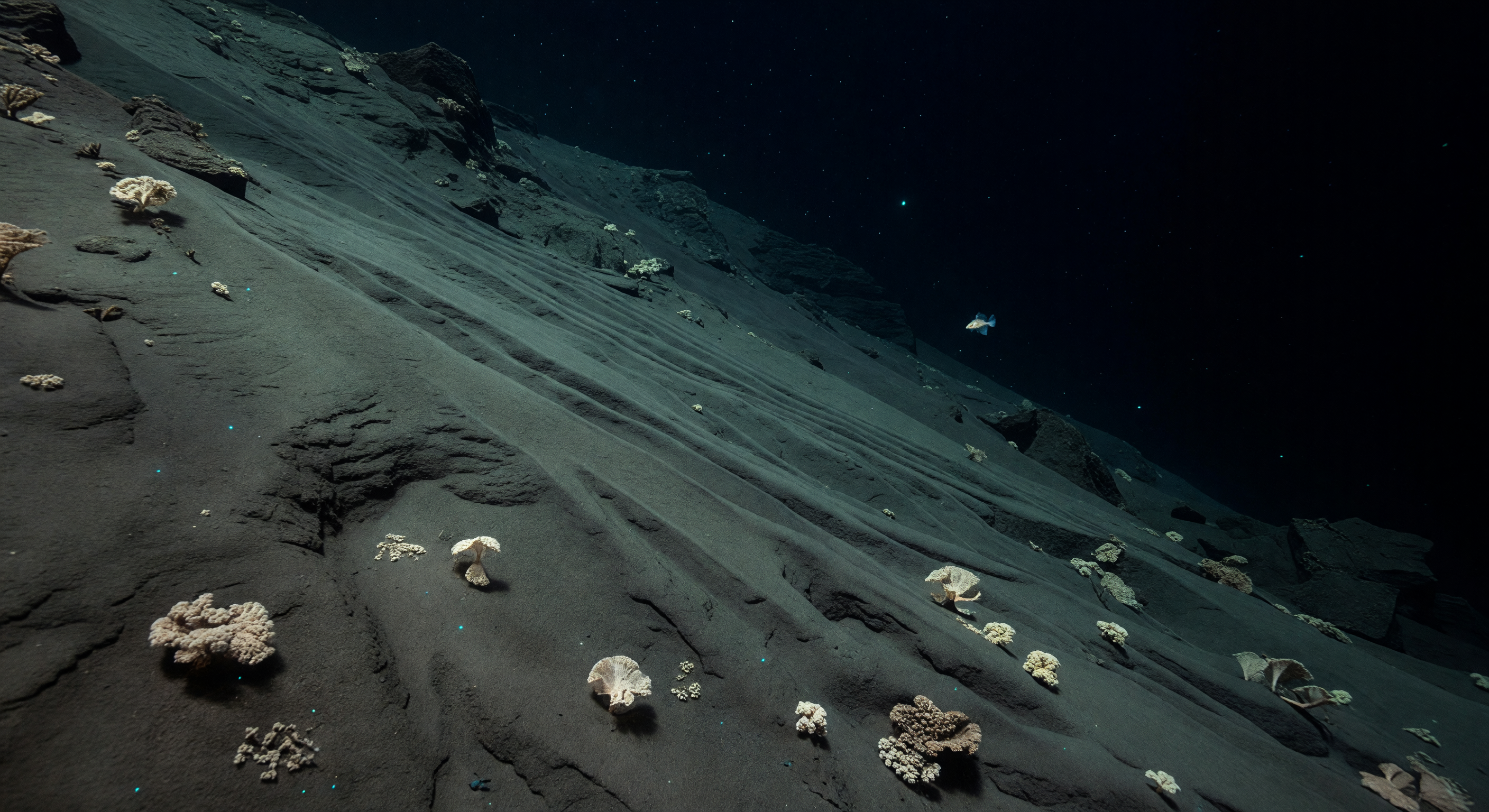
Along the vast inclined bench, sediment drapes of silty gray clay and compacted mud cascade in long erosion furrows down toward the trench axis — a descent so immense that the far edge simply dissolves into absolute blackness, lost well before any boundary can be resolved. At depths between eight and nine thousand meters, pressure exceeds eighty megapascals, cold enough to hold near one to two degrees Celsius, and the water mass here is ancient, stable, and nearly isothermal, shaped over millennia by the slow circulation of the deepest Pacific. Scattered across the sediment pockets like pale lacework anchored to the slope, xenophyophores — giant single-celled agglutinating protists unique to hadal environments — spread their fragile rosettes and fans, thriving precisely because of the concentrated organic matter that settles into these topographically complex furrows and slump scars. A single hadal snailfish, *Pseudoliparis* or close kin, hovers in translucent suspension against the vast bench, its gelatinous body and softly undulating fins an evolutionary answer to crushing pressure — the deepest vertebrates alive, descending further into the axis than any other fish lineage on Earth. Through the frigid water column, sparse marine snow drifts downward and a thin nepheloid haze slides low over the furrows, while a handful of faint blue-green bioluminescent motes pulse and fade freely in the darkness — the only light this world has ever known, belonging entirely to itself.
Trench shoulders