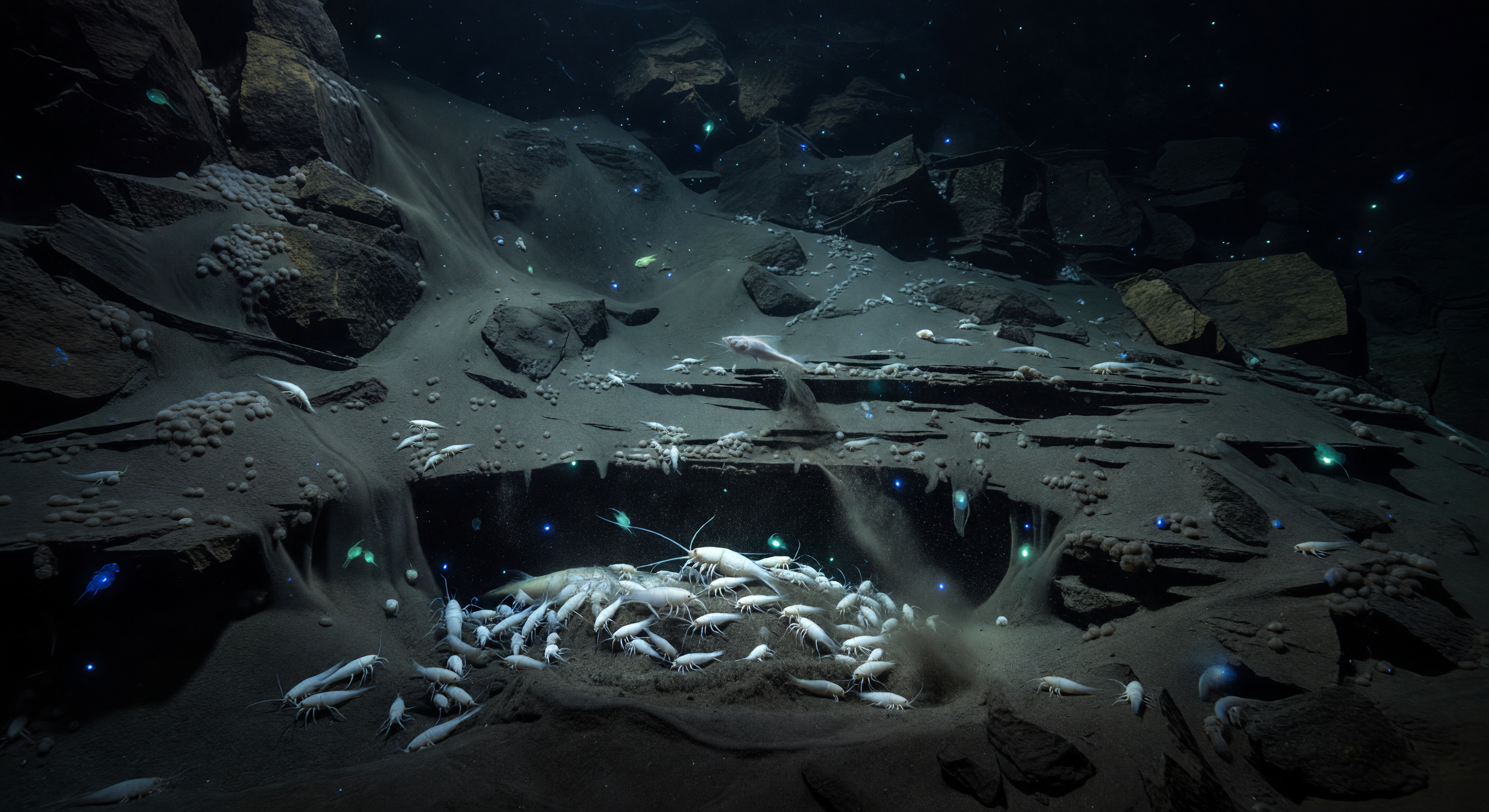
In a sheltered hollow gouged into the steep hadal shoulder at roughly 8,000 meters depth — where pressure approaches 80 megapascals and crushes the water into a medium denser and more alien than anything at the surface — a naturally fallen fish carcass has come to rest half-buried in soft gray silt, drawn down through kilometers of dark water by gravity alone, a rare packet of organic energy in a world defined by scarcity. Giant amphipods of the family Lysianassidae, ivory-pale and built by evolution to endure pressures that would collapse any unspecialized organism, swarm the carcass in dense, churning layers, their articulated legs and long antennae sharp against the disturbed cloud of fine sediment they raise as they feed — opportunistic scavengers that detect such falls through chemoreception across vast distances of black water and converge within hours. Intermittent cobalt and blue-green pulses from gelatinous zooplankton drifting through the water column above catch on the translucent carapaces of the amphipods and the slick, fault-scarred basalt of the trench wall, each bioluminescent flash a cold organic signal exchanged in total darkness between organisms that have never required sunlight, never needed a surface world. A hadal snailfish — Liparidae, among the deepest-ranging vertebrates known to science, their tissues biochemically stabilized against pressure by elevated concentrations of trimethylamine oxide — drifts at the periphery of the feeding mass, suspended weightlessly above the slope in water barely above freezing. Marine snow descends through the blackness in slow, constant fall, mingling with the nepheloid haze above the disturbed sediment, every particle a fragment of the sunlit world far above, transformed by the time it arrives here into something the trench has claimed entirely as its own.
Trench shoulders