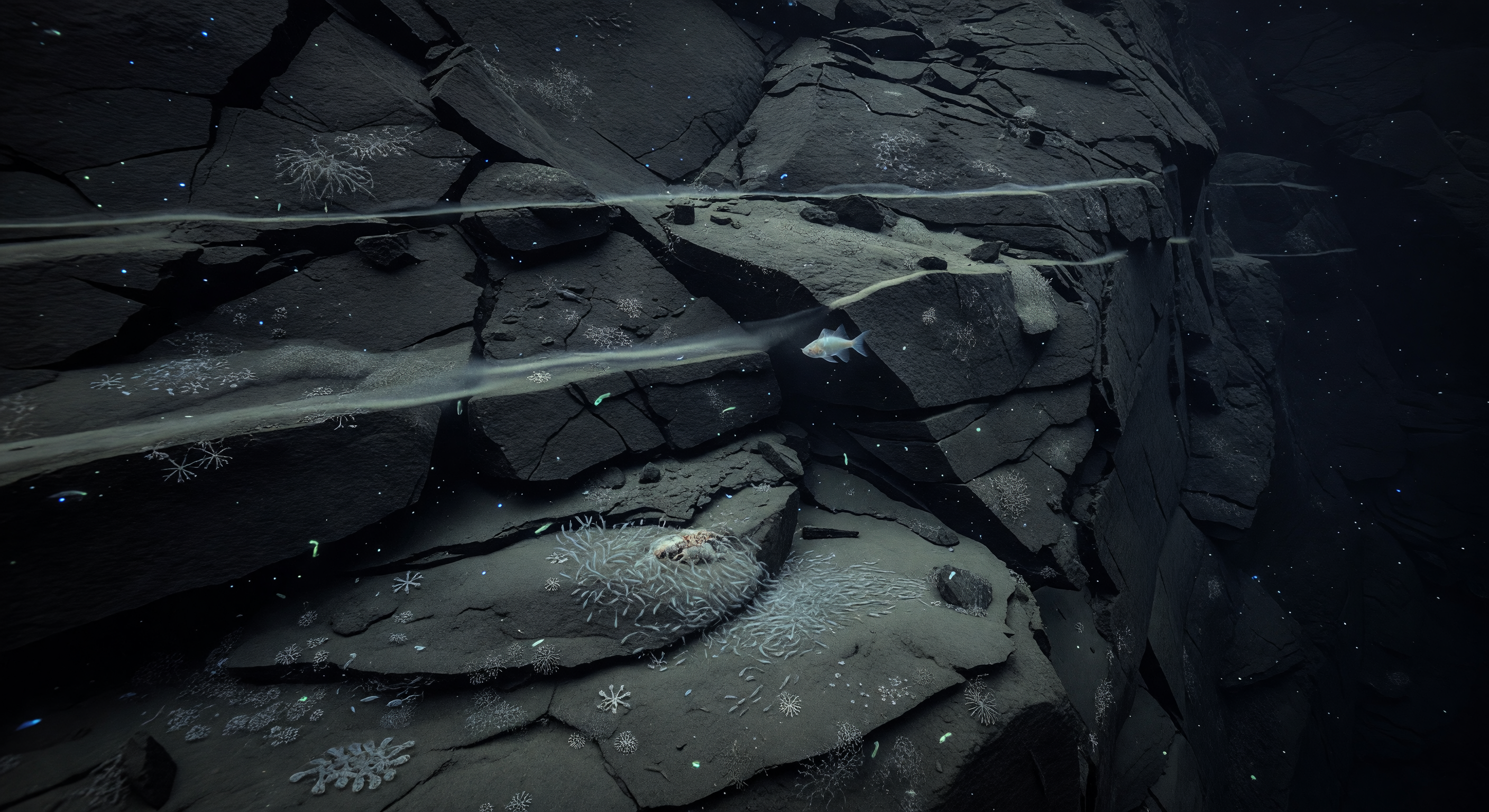
The near-vertical fault scarp descends into absolute darkness, its matte black basalt fractured by tectonic oversteepening into ravined gullies and narrow benches where thin ribbons of gray mud cling to each horizontal surface and pale xenophyophore colonies spread their delicate agglutinated lattices across sediment pockets like fragile mineral lace — all of it shaped under pressures approaching 80 to 100 megapascals, cold and stable at barely one to two degrees Celsius, in water that has not seen sunlight for millennia. No photon from the surface penetrates here; the only light that exists in this world is the light organisms make themselves, and across the ravines isolated cold blue pinpricks trace the paths of drifting crustaceans while faint cyan-green flashes from small pelagic invertebrates briefly outline ledge edges and the slow drift of marine snow descending through the clear, particulate-hazed water column. A ghost-pale hadal snailfish — gelatinous, neutrally buoyant, its skeleton reduced to the minimum that crushing pressure and carbonate-poor water permit — drifts just off the scarp face, one of the deepest vertebrates on Earth, its body a masterwork of piezophilic adaptation. On a sheltered sediment bench below, a small carcass has already been found by dense swarms of hadal amphipods, their translucent bodies forming a restless living mass against the gray silt, converting fallen organic matter into the currency of the trench food web with an efficiency that belies the apparent stillness of the surrounding wall. The scarp simply continues downward, disappearing into a black that is not metaphorical but total, a geometry of planetary tectonics rendered in cold rock and silence, existing entirely without witness.
Other languages
- Français: Descente de l'Escarpement Noir
- Español: Descenso del Escarpe Negro
- Português: Descida do Escarpamento Negro
- Deutsch: Abstieg der Schwarzen Verwerfung
- العربية: هبوط الحافة السوداء
- हिन्दी: काली ढलान का अवतरण
- 日本語: 黒い断崖の降下
- 한국어: 검은 단애 하강
- Italiano: Discesa dello Scarpato Nero
- Nederlands: Afdaling van de Zwarte Steilrand