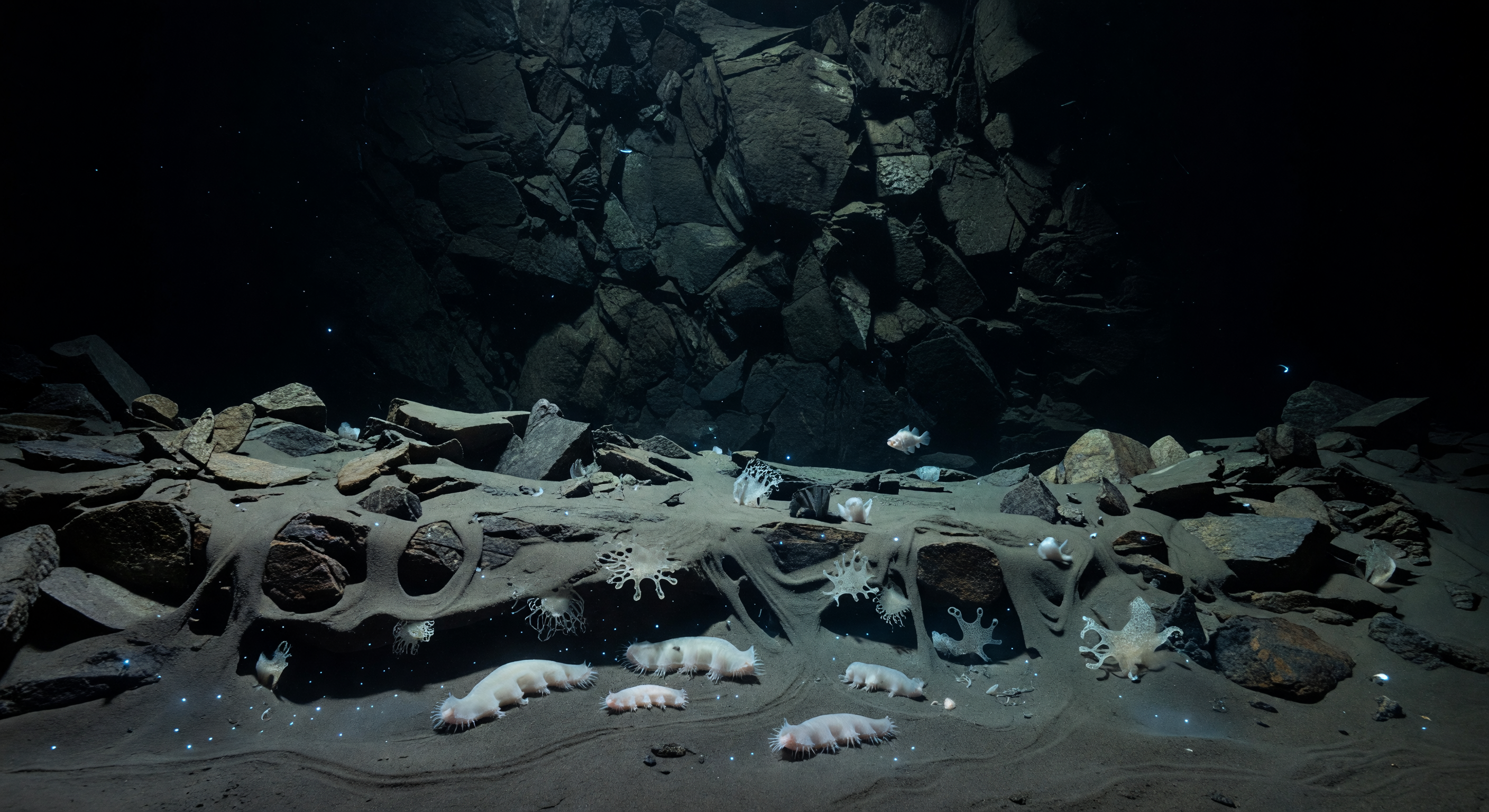
At depths where pressure exceeds 800 atmospheres and temperature hovers near 1–2°C, a near-vertical subduction-scar cliff of dark fractured basalt plunges into a talus bench of angular collapsed blocks, their surfaces slicked with mineral films and dusted by a thin nepheloid haze of slowly settling marine snow. In the sheltered mud pocket cradled between the fallen stones, pale hadal holothurians — translucent ivory, their low dorsal ridges faintly tinged with pink — inch forward on delicate tube feet, inscribing sinuous trails in the gray silt as they process sediment laden with bacterial mats and particulate organic carbon that has drifted down across kilometers of open water. Fragile xenophyophore tests cling to calmer patches of sediment nearby, their single-celled architecture scaled to a size only achievable under such stable, cold, high-pressure conditions, while a solitary hadal snailfish — a liparid adapted with pressure-tolerant enzyme systems and a gelatinous, low-density body — hovers ghost-like just beyond the bench, dwarfed by the ascending wall that vanishes into absolute blackness above. Intermittent cyan-blue bioluminescent flashes from drifting midwater organisms briefly cross the scene, catching the wet texture of broken rock and outlining the holothurians' soft ridges before fading back into darkness, the only light this world has ever known. Here, at the convergent margin of two tectonic plates, life persists in a primordial silence that owes nothing to any outside witness.
Trench shoulders