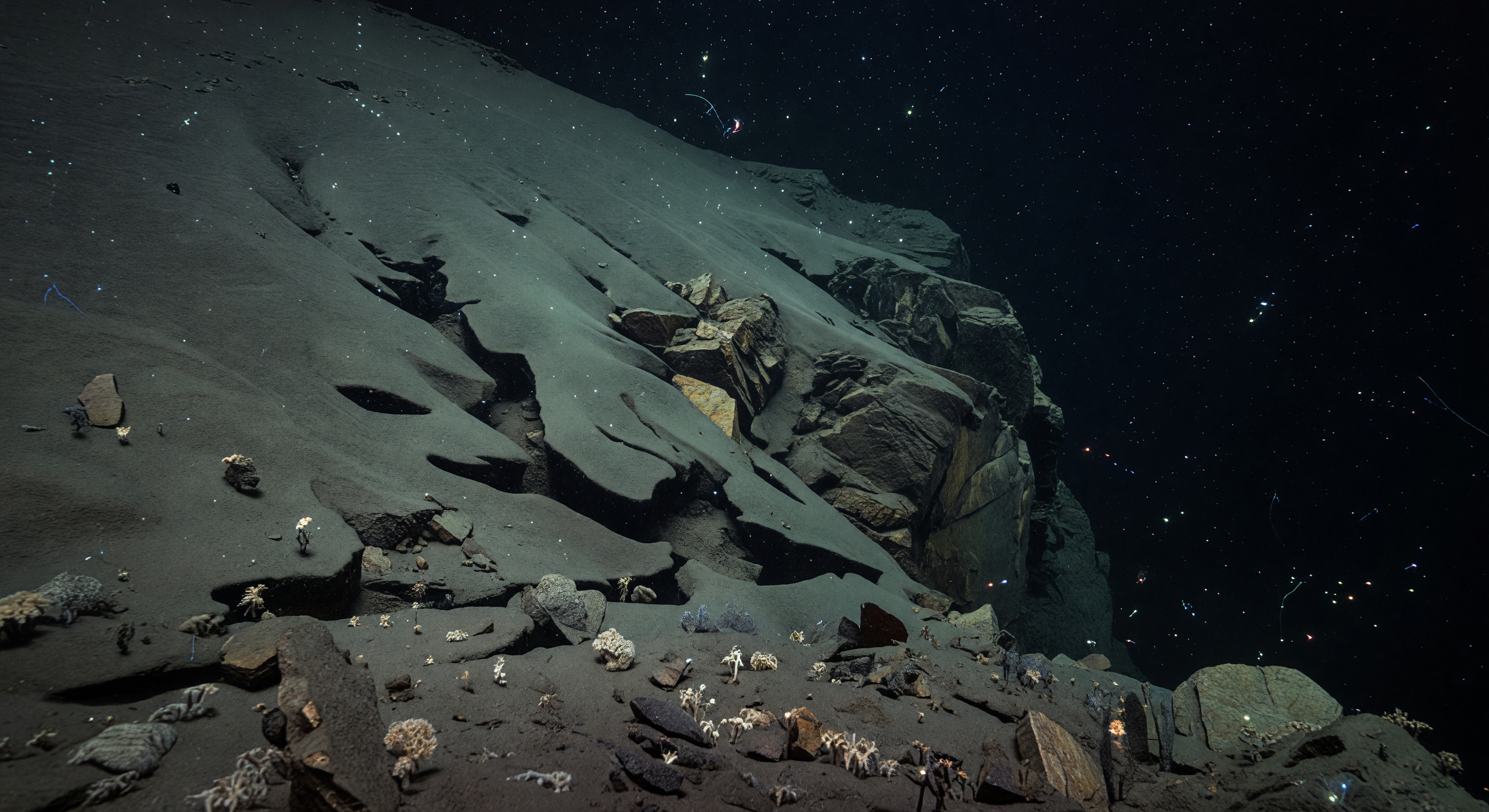
At the edge where the trench shoulder breaks into ravined gullies and plunges toward the hadal axis, cold gray sediment drapes over angular talus and exposed faulted rock under pressures approaching 85 megapascals — a crushing force that governs every biochemical process in the few organisms adapted to survive here. Across the pale agglutinated xenophyophores anchored to the cohesive clay, hair-fine threads of blue bioluminescent light arc slowly through the water column above the abyssal drop, left by pelagic bodies invisible in the permanent darkness — perhaps amphipods, small gelatinous zooplankton, or organisms as yet unnamed, drifting through a world of near-freezing, perpetually aphotic water at roughly 1–2°C. The ravined sediment drape itself records episodes of downslope gravity transport and topographically steered currents that funnel organic particles from the water column above into these gullies, concentrating the sparse energy that sustains life at the trench's upper hadal flanks. Scalloped erosion channels cut into the slope where benthic nepheloid layers sweep sediment away from exposed rock, leaving behind a landscape shaped as much by deep circulation and seismic stress as by simple accumulation. These trails of cold light trace passage through a silence that has known no witness — a place where darkness is not an absence but the fundamental condition of existence itself.
Trench shoulders