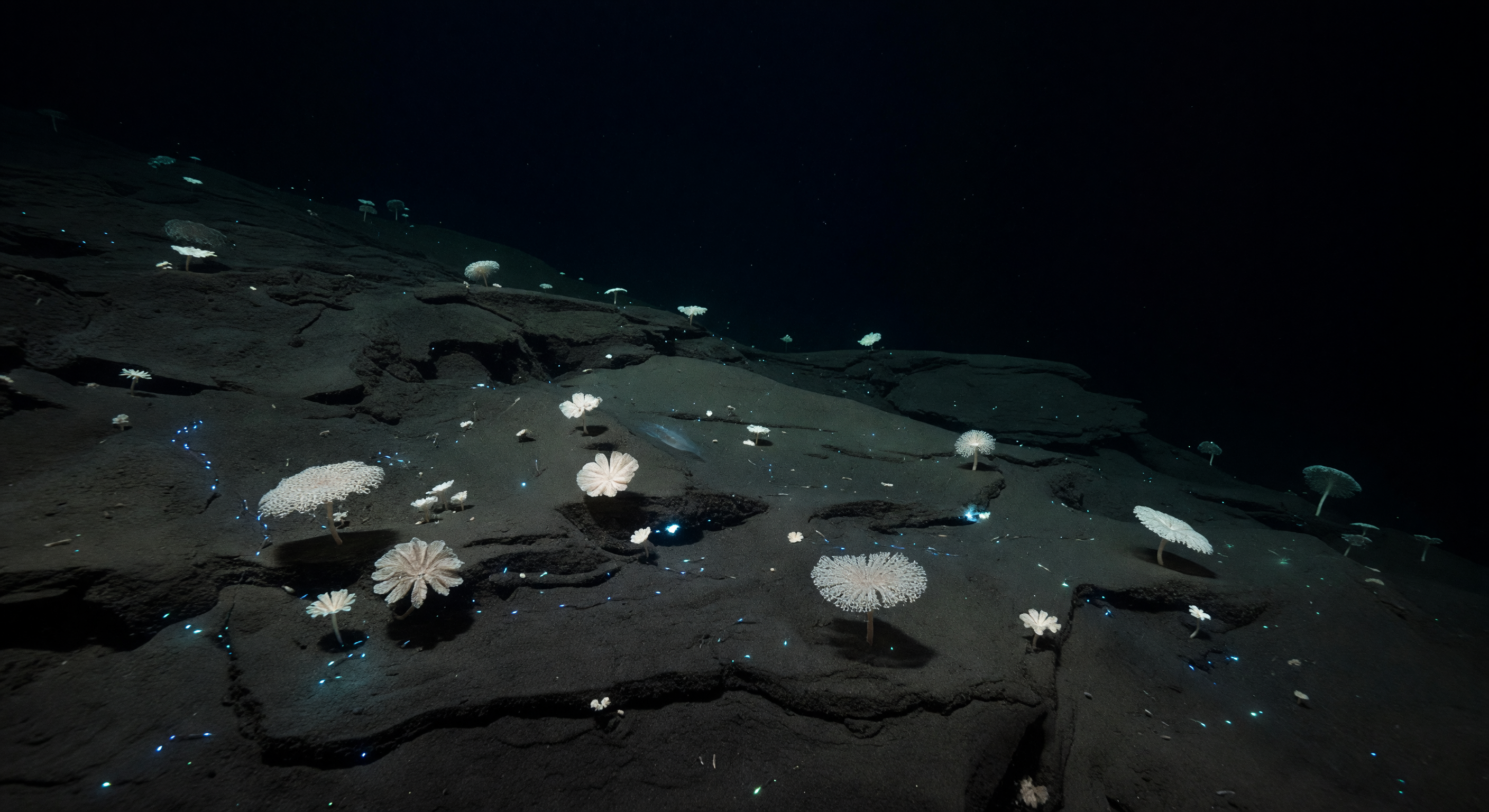
At roughly 7,500 to 8,500 metres below the surface, where pressure exceeds 800 atmospheres and water temperature hovers barely above freezing, a gently tilted terrace of graphite-dark mud extends across the trench shoulder in absolute aphotic silence. Scattered across this sediment drape, large xenophyophores — among the most enormous single-celled organisms on Earth — rise as pale, agglutinated rosettes and lacy disks, their chalk-ivory tests built grain by grain from particles scavenged from the seafloor, each structure a living archive of the marine snow that drifts perpetually downward from the sunlit world six miles above. No light from the surface has reached this place for geological ages; what briefly renders these forms legible are faint bioluminescent sparks — cool cyan and blue-green pinpricks produced by tiny animals moving low over the mud — tracing for a fleeting moment the delicate geometry of each xenophyophore before fading back into total blackness. A hadal snailfish drifts in the middle distance, its translucent, pressure-adapted body sustained by a biochemistry tuned to crushing depths that would destroy the cellular machinery of any shallow-water vertebrate, while amphipods cross the sediment between the xenophyophore colonies, scavenging in the thin benthic nepheloid haze. This terrace exists in primordial stillness, a living geology of soft bodies and agglutinated silica on dark ravined mud, utterly indifferent to any world above.
Other languages
- Français: Terrasse aux Xénophyophores Pâles
- Español: Terraza de Xenofiósforos Pálidos
- Português: Terraço de Xenofiósforos Pálidos
- Deutsch: Blasse Xenophyophoren Terrasse
- العربية: مصطبة الكائنات الشفافة الشاحبة
- हिन्दी: पीले ज़ेनोफ़ायोफ़ोर सोपान
- 日本語: 淡色有孔虫の段丘
- 한국어: 창백한 이형포자 테라스
- Italiano: Terrazza degli Xenofiosfori Pallidi
- Nederlands: Bleek Xenofyoforen Terras