Scientific confidence: High
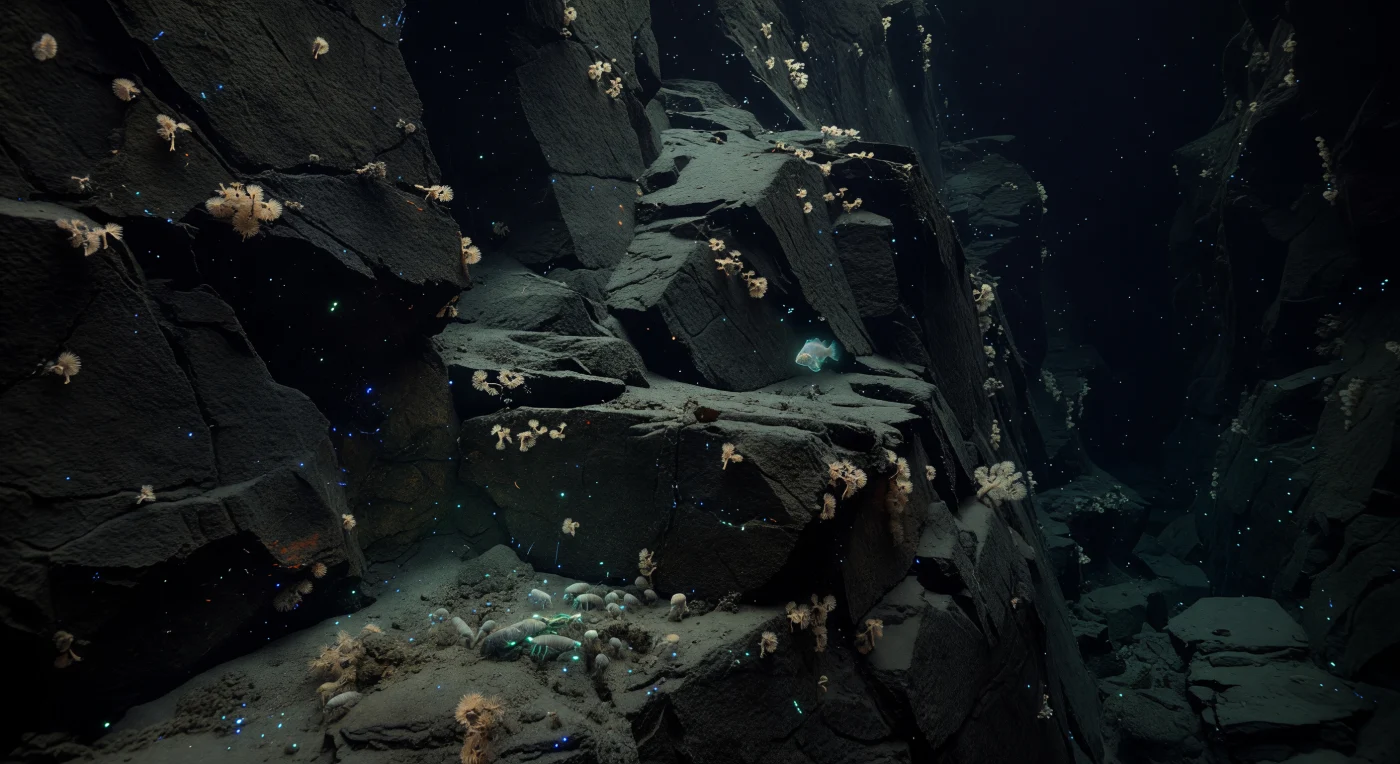
The near-vertical face of the Kermadec Trench wall descends without apparent end, a colossal tectonic wound where the Pacific Plate bends downward into the mantle at pressures approaching 1,000 atmospheres, cold water locked at barely 1–2 °C, every cubic centimeter of it bearing a crushing stillness that has persisted for millions of years. Fractured charcoal-black basalt and ash-gray sediment ledges stack upon one another in receding scarps, their surfaces veneered in organically enriched silt and punctuated by sparse xenophyophores — among the largest single-celled organisms on Earth — clinging to softer ledges in pale beige rosettes, filtering the slow fall of marine snow that drifts down from a sunlit surface world impossibly remote above. A ghost-pale hadal snailfish, gelatinized and pressure-adapted, holds position near a fractured ledge in the middle distance, its translucent body barely distinguished from the black water except where distant bioluminescent pinpricks — tiny flashes from drifting organisms scattered through the aphotic column — intermittently trace the contours of rock and sediment in cold blue-green light. Below, where organically enriched sediment collects against the base of the wall, a loose swarm of outsized amphipods works the soft substrate around a naturally sunken carcass, their pale segmented bodies catching faint cyan highlights, part of the hadal scavenging community that thrives precisely because this topographic funnel concentrates food falling from far above. The wall continues beyond all visibility into an ancient, witnessless dark, a world complete in itself, indifferent to observation, shaped entirely by pressure, tectonics, cold, and the slow chemistry of the deep.
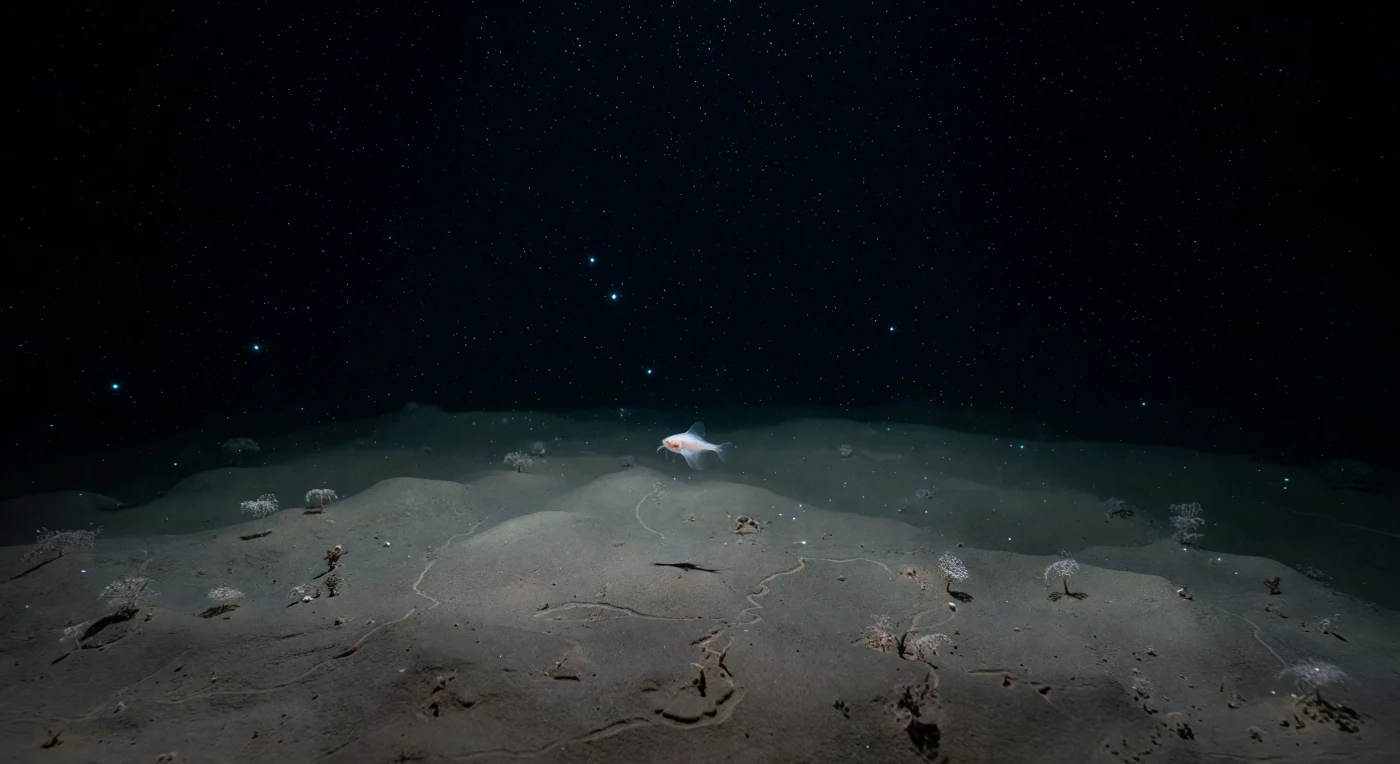
At roughly eight to ten thousand meters beneath the surface of the southwest Pacific, within the narrow axial floor of the Kermadec Trench, a solitary snailfish — *Notoliparis kermadecensis* or close kin — drifts in near-weightlessness above sediment that has accumulated over geological time as a slow rain of organic particles funneled downslope by the trench's own topography. The hydrostatic pressure here approaches eight hundred to one thousand atmospheres, enough to compress cellular membranes and denature unprotected proteins, yet this fish persists through biochemical adaptation: elevated concentrations of trimethylamine oxide stabilize its enzymes against pressure-induced deformation, while the reduction of mineralized bone renders its gelatinous body neutrally buoyant in water just above freezing, near one to two degrees Celsius. The sediment below it is soft, organically enriched relative to the surrounding abyssal plain, dimpled by feeding traces left by amphipods and deposit feeders, and studded at intervals with xenophyophores — giant single-celled foraminifera whose lace-like tests rise from the mud as among the largest individual cells known to exist on Earth. No sunlight has reached this depth in any geological era of life's history; what faint illumination exists comes only from the bioluminescent chemistry of organisms themselves, transient cyan sparks drifting through a suspension of marine snow that falls without destination through water that has not seen the sky for centuries. The trench exists entire and indifferent, its pressures absolute, its silences older than any record of it.
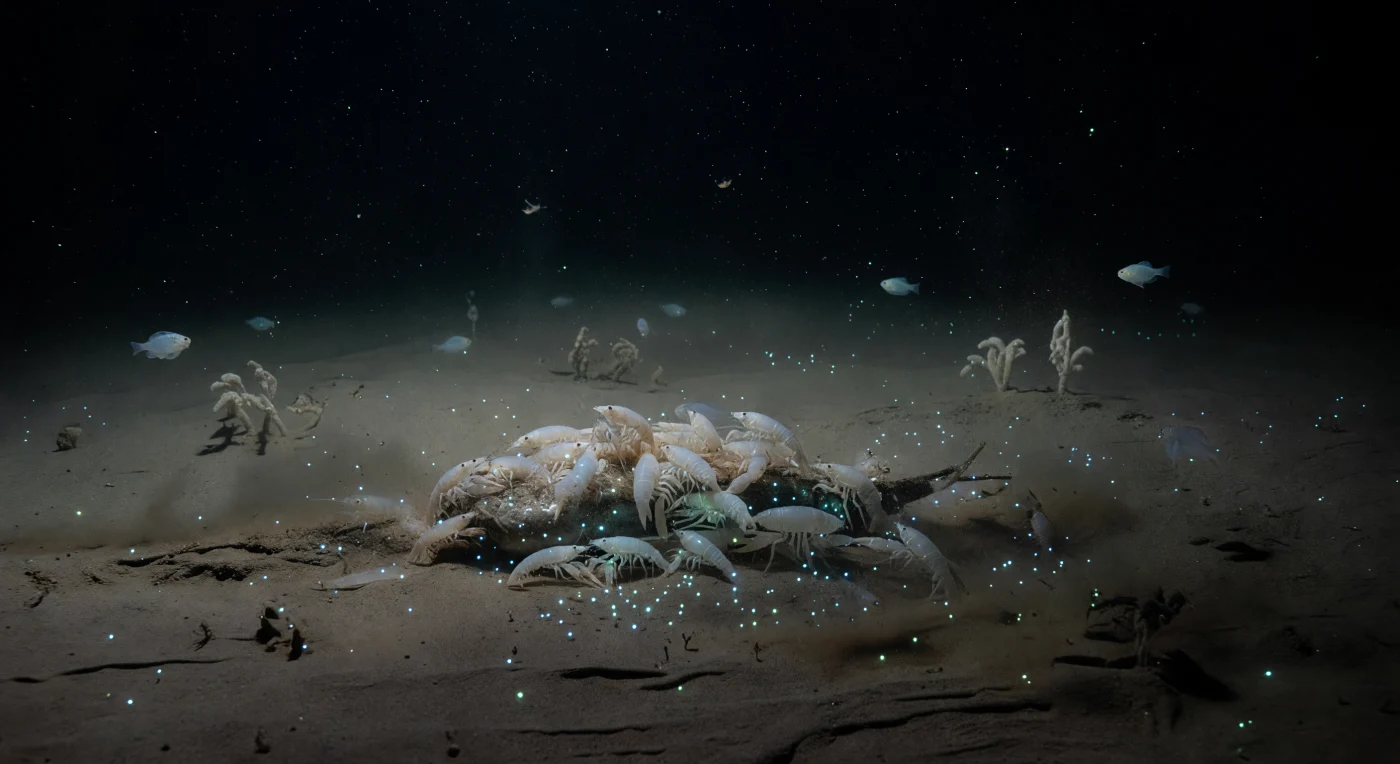
At roughly eight to ten kilometres beneath the surface of the southwest Pacific, where the Pacific Plate bends downward into the mantle and hydrostatic pressure exceeds 800 atmospheres, a carcass has come to rest on the soft taupe-gray sediment of the Kermadec Trench floor — and the hadal world has answered with extraordinary swiftness. Dense masses of *Hirondellea gigas*, giant pale amphipods whose translucent to milky-white bodies are exquisitely adapted to near-freezing water and crushing pressure through elevated concentrations of piezolytic compounds, move across the carcass in a frantic living mantle, their chitinous appendages stirring a low nepheloid cloud of fine silt that drifts outward and upward in the near-motionless water column. Scattered cyan and green bioluminescent pinpricks — produced within the swarm itself and by tiny organisms suspended in the darkness — catch on wet tissue, on individual grains of lifted sediment, and on the marine snow particles that descend constantly through this absolute aphotic void, the only light this world has ever known. In the quieter sediment beyond the carcass, the crinkled forms of xenophyophores — giant single-celled foraminifera that can reach tens of centimetres across — punctuate undisturbed patches of the trench floor, while a few translucent hadal snailfish, their skeletons reduced and their flesh gelatinous under evolutionary pressure, hover just above the bottom at the edge of the disturbance, their bodies barely resolved by the cold bioluminescent glow. This scene unfolds without witness, as it has across geological time: a closed, pressurized, primordial system cycling organic matter downward into the deepest crease of the ocean.
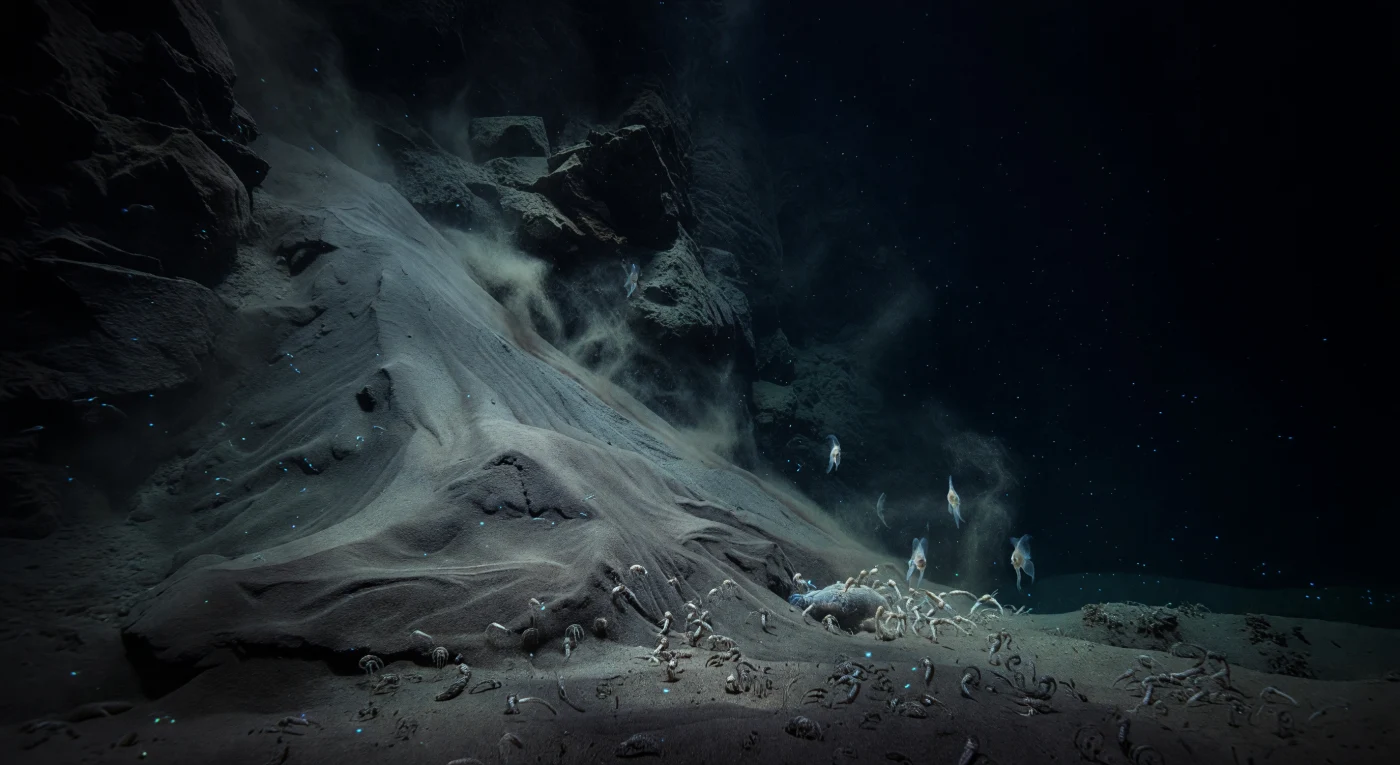
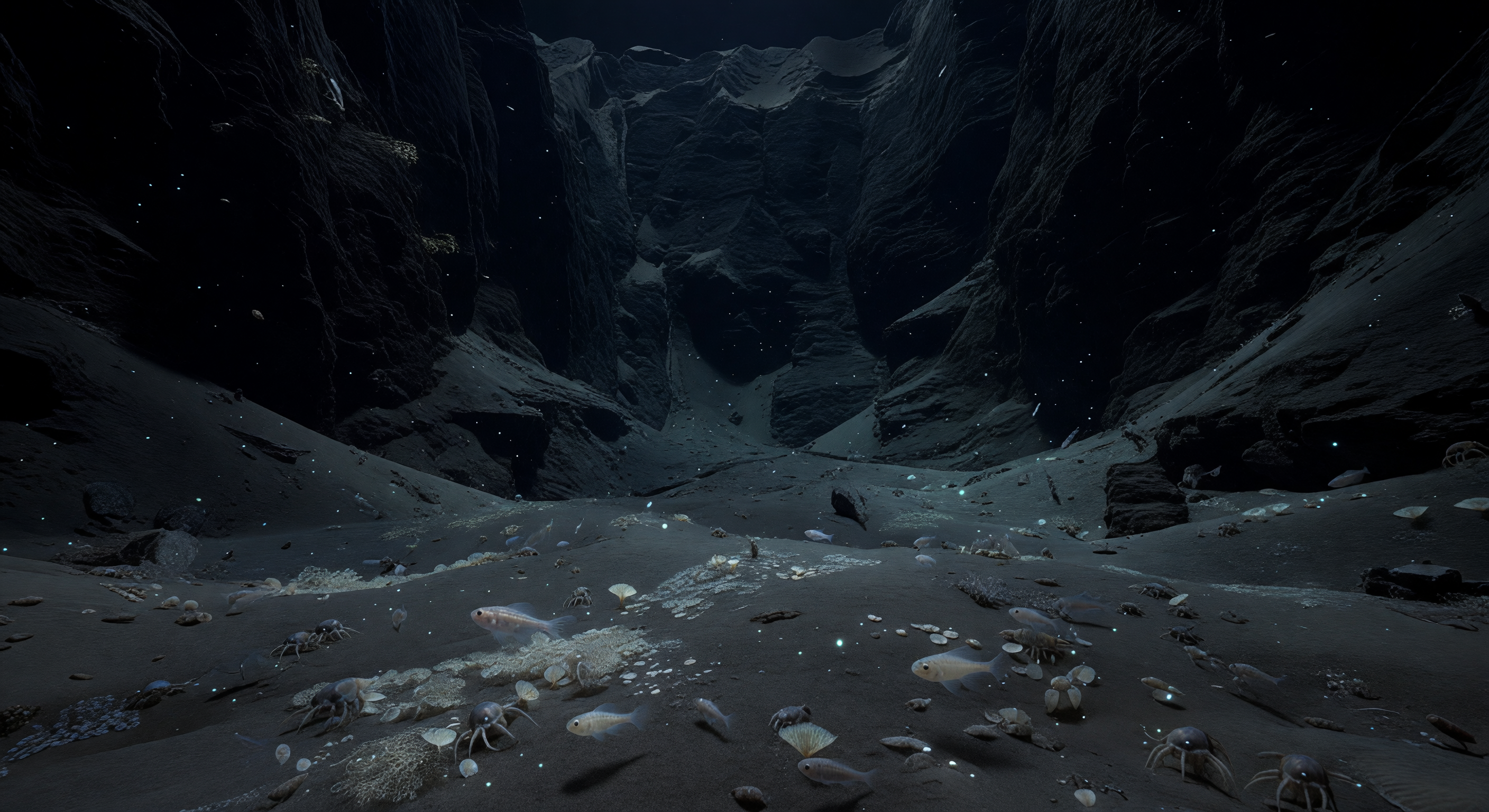
At the bottom of one of Earth's deepest trenches, a mass-wasting event has freshly rewritten the hadal floor: a broad tongue of collapsed sediment fans outward from the base of a towering trench wall, its surface folded into cool gray drapes and cohesive ridges interrupted by darker angular clasts freshly shed from the wall above, while veils of fine silt and clay still billow upward in slow, stratified suspension, dissolving into the surrounding black water at pressures approaching 900 atmospheres. The trench's steep topography acts as a long-term sediment funnel, concentrating organic-rich particles and phytodetrital aggregates along this axial zone, and the slump front has partially buried fields of fragile xenophyophores — giant single-celled organisms that colonize soft hadal sediments and serve as micro-habitat for meiofauna — leaving only their pale lobed tests protruding from the newly settled mud. Swarms of *Hirondellea gigas*, the giant amphipods endemic to hadal trenches, have already converged on a sunken carcass embedded in the deposit, their pale segmented bodies catching faint cyan glints of disturbed bioluminescence as they work through the organic windfall, while translucent snailfish — the deepest-living vertebrates known, their skeletons reduced and their tissues permeated with pressure-stabilizing TMAO — drift in near-weightless arcs just above the slump margin, barely distinguishable from the darkness. No sunlight has reached this place in geological memory; the only illumination is the cold, scattered glow of living chemistry — pinprick sparks from disturbed benthic organisms softly tracing the relief of fresh sediment — and the trench endures, tectonically alive and biologically inhabited, in absolute silence.
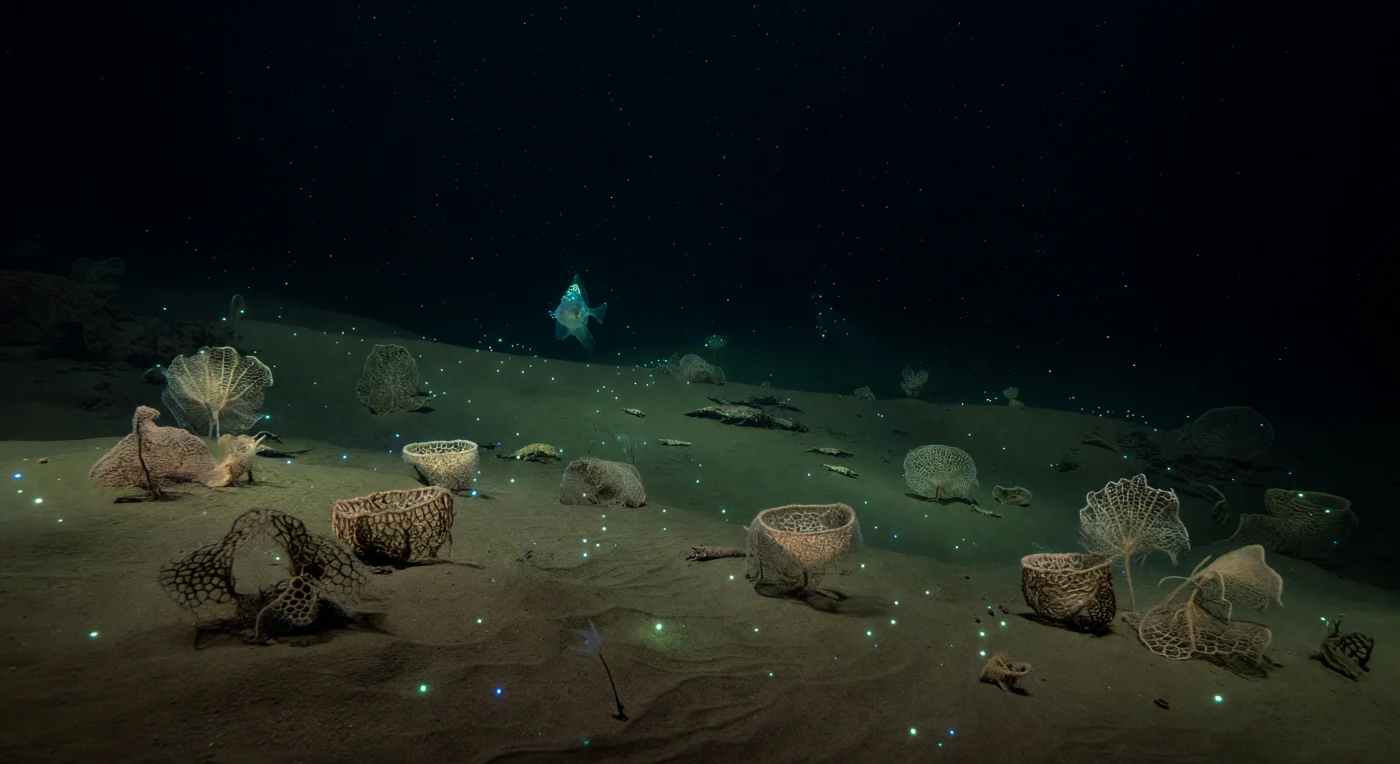
Along the lower flanks of the Kermadec Trench, at depths where hydrostatic pressure exceeds 800 atmospheres and temperatures hover near 1–2 °C, a gently sloping bench of olive-brown silt stretches into absolute darkness, its surface softened by centuries of accumulated marine snow and finely rippled by the weakest of bottom currents. Rising from this sediment in scattered, improbable gardens are xenophyophores — among the largest single-celled organisms on Earth — their reticulate fans and tangled lattice forms standing as pale tan filigree against the black water, some intact, others partly subsided into the mud they have colonized, all of them silently concentrating heavy metals and organic particles in a chemistry the hadal zone has refined over geological time. Faint cyan and green points of bioluminescence drift through the near-bottom nepheloid layer, briefly tracing the edges of xenophyophore fans and catching suspended particles in transit — the only illumination this world has ever known, produced entirely by the organisms passing through it. A ghost-pale hadal snailfish, its body gelatinous and pressure-adapted, its skeleton reduced to near transparency, glides just above the slope with unhurried lateral sweeps, its tissues stabilized against molecular collapse by elevated concentrations of piezolytic compounds, while farther along the bench, *Hirondellea gigas* amphipods move across darker patches of sunken organic detritus, dismantling what the water column above has slowly surrendered downward. This is the Kermadec hadal system as it has always been: a world of immense pressure, near-freezing stillness, and quiet biological purpose, existing entirely without witness.
At depths where hydrostatic pressure exceeds 800 atmospheres and water temperatures hover near 1–2 °C, the hadal interior of the Kermadec Trench exists in a state of absolute, sunless permanence — a narrow tectonically-sculpted corridor where the Pacific Plate's descent into the mantle has carved one of the deepest environments on Earth. Suspended throughout the water column, a perpetual drift of marine snow — disaggregated fecal pellets, fragmented phytodetrital flakes, and fine organic dust — descends through layered nepheloid veils, concentrated here by the trench's funnel geometry into a richer organic flux than the surrounding abyssal plains ever receive. Through this living sediment drift, microscopic bioluminescent organisms — gelatinous zooplankton, planktonic bacteria, and perhaps the faint metabolic pulses of unseen hadal fauna adapted through piezolytic biochemistry — leave thin, broken filaments of cold blue and cyan light that dissolve within centimeters, written and immediately erased in water so dark it registers as a gradient from blue-black to absolute nothing. Far below, barely distinguishable from the darkness itself, the trench floor accumulates organic-enriched sediment where Hirondellea gigas amphipods and translucent snailfish navigate a world defined entirely by pressure, chemical gradients, and the slow rain of matter from a sunlit ocean eleven kilometers overhead. This place does not wait — it simply continues, indifferent and immeasurable, as it has for millions of years of subduction.
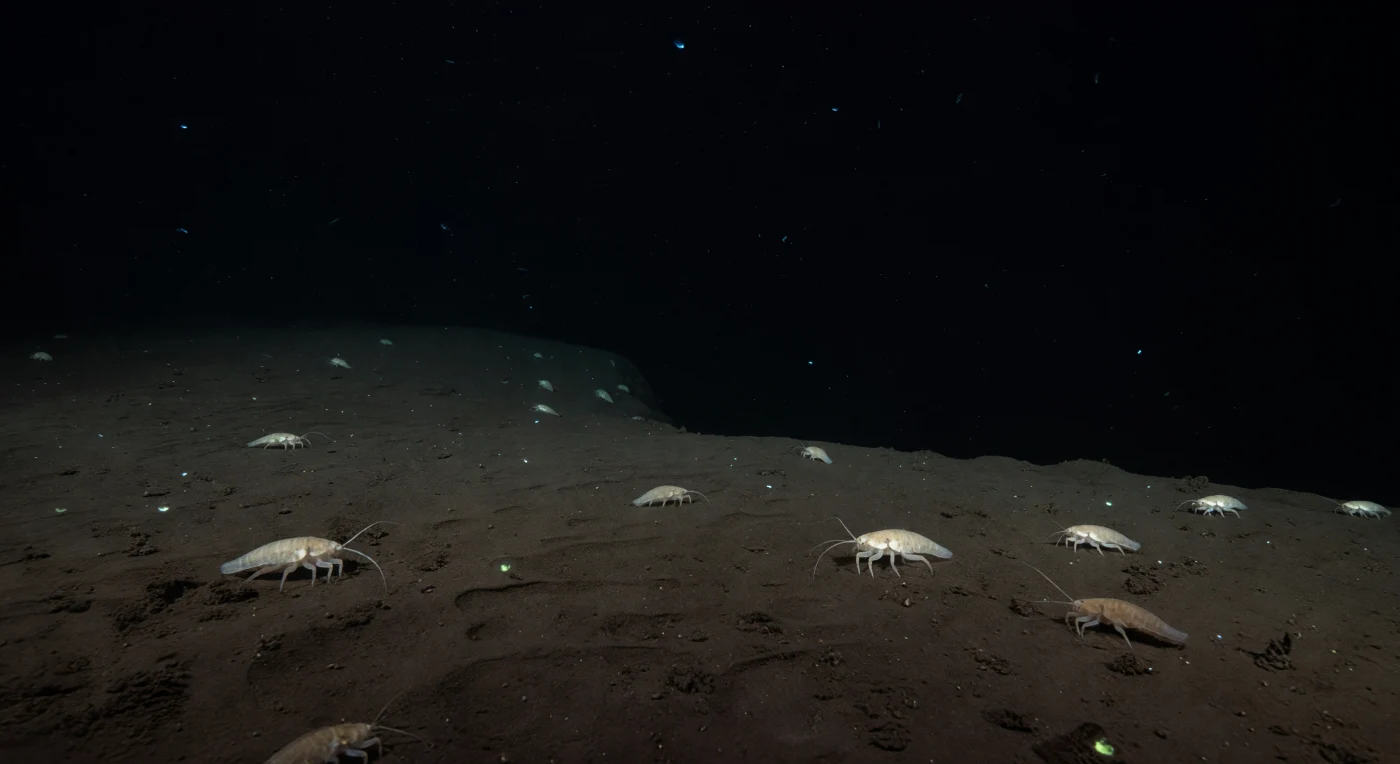
At depths approaching 9,000 meters beneath the southwest Pacific, the floor of the Kermadec Trench lies under roughly 900 atmospheres of hydrostatic pressure — a crushing force that has shaped every biochemical adaptation present in the sparse but specialized life found here. The sediment plain is a slow accumulation of millennia: fine clay particles, siliceous microfossil fragments, and a continuous drizzle of organic detrital aggregates that funnel down the trench's steep walls by a topographic effect, concentrating food energy along the axial floor in quantities exceeding those on the surrounding abyssal plains. Across this chocolate-gray expanse, several individuals of *Hirondellea gigas* — giant lysianassoid amphipods reaching several centimeters in length — move with purposeful, low-amplitude locomotion, their translucent cream exoskeletons revealing segmented musculature and pale visceral structures beneath, bodies biochemically stabilized against pressure collapse by elevated concentrations of trimethylamine N-oxide in their tissues. The water column above is near-freezing, close to 1–2 °C, and utterly devoid of solar photons — any faint photonic presence here originates entirely from the sparse bioluminescent chemistry of drifting mesopelagic organisms sinking far beyond their living depth, their dim cyan-blue emissions the only light this sediment has ever known. This is a world that has persisted in its silence across geological time, indifferent to the surface above, organized entirely by pressure, cold, gravity, and the slow rain of the dead.
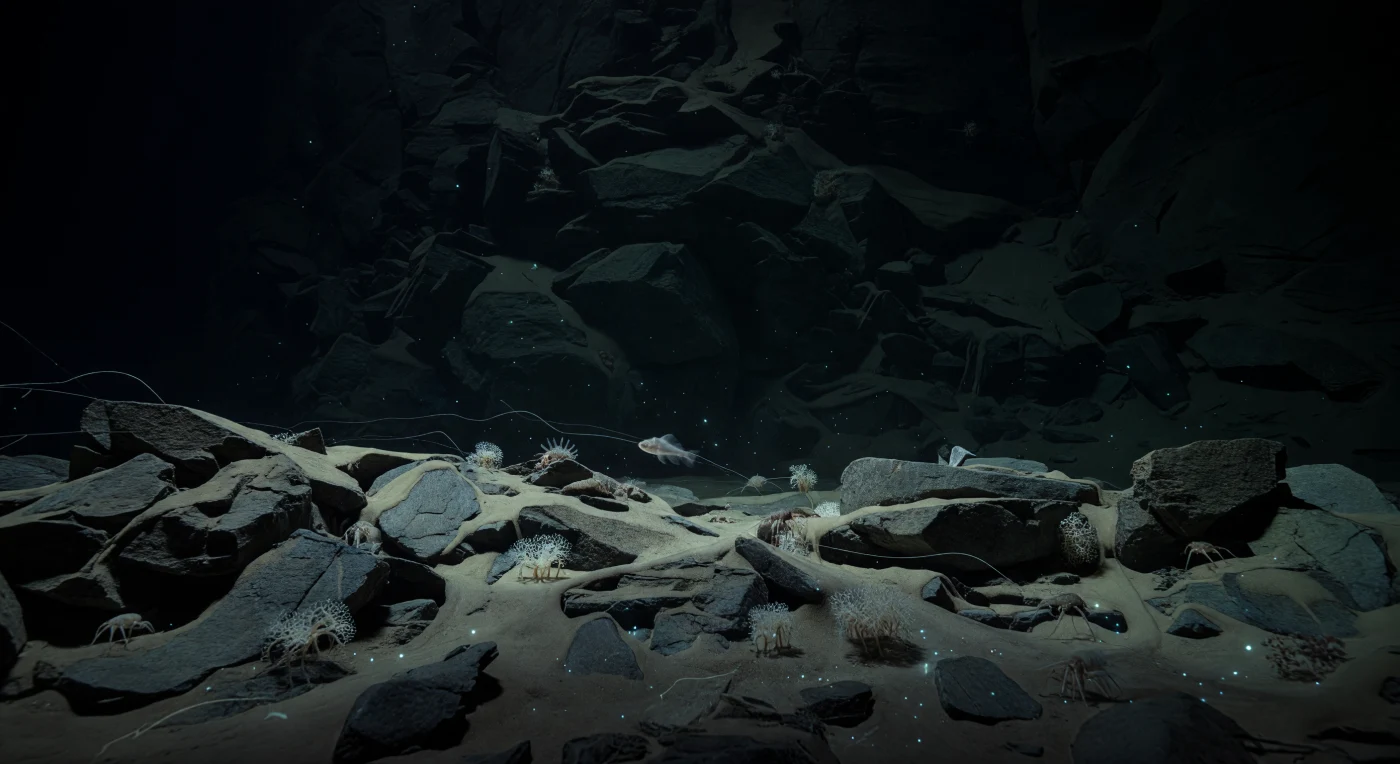
At the foot of the Kermadec Trench wall, angular slate-colored blocks and fractured rock shards form a rugged talus apron draped in fine organic-rich mud, where sediment tongues pool between stones at depths approaching ten thousand meters and pressures exceeding eight hundred atmospheres — a physical environment that crushes conventional biochemistry and demands extraordinary molecular adaptation from every organism present. Isolated xenophyophores, among the largest single-celled organisms on Earth, occupy sheltered pockets between the rubble, their pale reticulate forms partly embedded in the soft substrate, filtering the sparse organic particles that the trench's topographic geometry funnels relentlessly downslope. Thin threads of marine snow and resuspended particulate drift in weak bottom-guided currents across the apron, tracing the faint nepheloid haze that persists close to the sediment surface in this near-freezing, perfectly dark water. A translucent hadal snailfish — likely *Notoliparis* or a related liparid whose tissues are biochemically braced against collapse by piezolytes such as TMAO — drifts ghostlike above the talus, its pale body barely distinct from the surrounding blackness, while giant amphipods of the genus *Hirondellea* move purposefully among crevices where organic matter accumulates. Sparse cold points of cyan and blue-green bioluminescence from drifting microscopic organisms offer the only light this world has ever known, glinting faintly off wet rock surfaces as the trench wall rises into unseen darkness above — a tectonic scar in the lithosphere, utterly indifferent, ancient, and complete in itself.
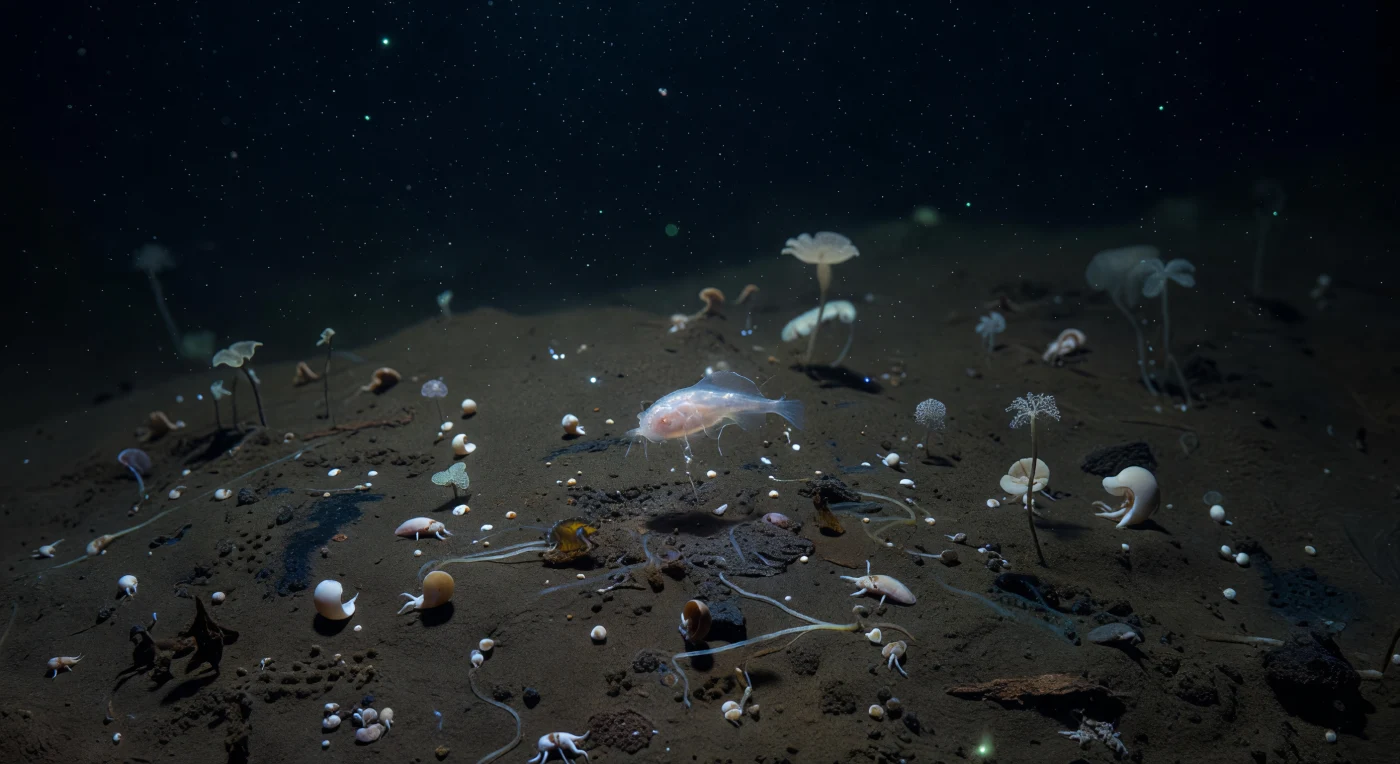
At the floor of one of Earth's deepest trenches, where the Pacific Plate buckles downward beneath crushing pressures approaching 1,000 atmospheres and temperatures hover near 1–2 °C, a hadal snailfish — *Notoliparis* or a close relative — drifts motionless above organic-enriched mud, its gelatinous, near-transparent body an evolutionary response to pressures that would destroy any rigid skeleton, its tissues saturated with piezolytes like trimethylamine oxide that stabilize proteins against collapse. Below it, the sediment surface tells a story of vertical flux compressed into horizontal space: the trench's steep topography acts as a gravitational funnel, concentrating phytodetrital aggregates, fecal pellets, and sunken organic matter far above the concentrations found on surrounding abyssal plains, nourishing dense communities of *Hirondellea gigas* amphipods that arc and pivot across the soft substrate like pale punctuation marks in permanent darkness. Fragile xenophyophores — giant single-celled foraminifera whose tests of agglutinated particles rise like pale lacework from the silt — anchor themselves on the softer slopes, their remarkable size itself an adaptation to the hadal realm's cold stability and slow metabolic tempo. Sparse bioluminescent points drift through the black water column above, cold blue-green sparks from bacteria and drifting invertebrates that represent the only light this sediment surface has ever known, while a thin nepheloid layer suspends fine particles just above the mud, the trench walls fading upward into absolute darkness — a world of immense pressure, slow time, and quiet biological intensity that has unfolded without witness across geological epochs.
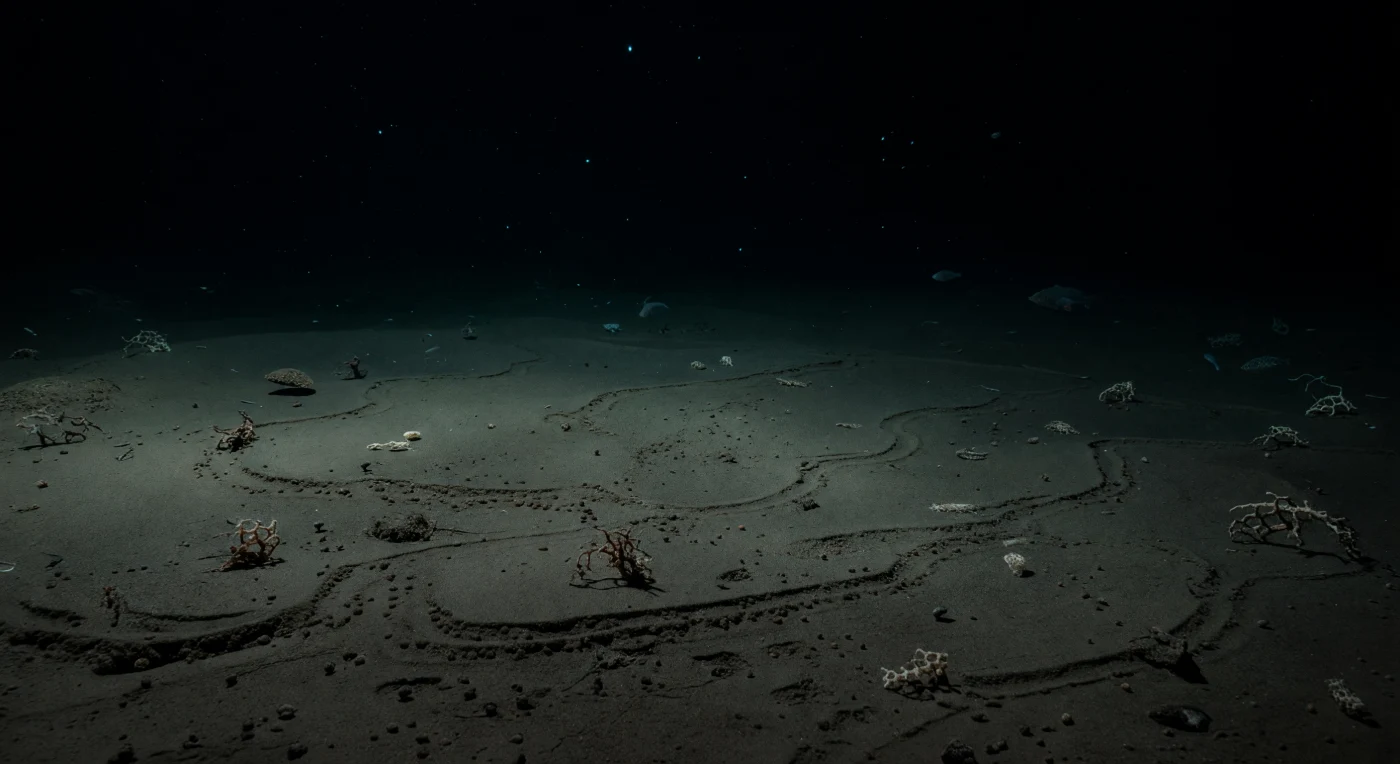
At roughly eight to ten thousand metres beneath the southwest Pacific surface, where the Pacific Plate bends into the mantle beneath the Kermadec subduction system, hydrostatic pressure exceeds eight hundred atmospheres and the water temperature hovers near one to two degrees Celsius — conditions that have shaped an ecology of extraordinary biochemical ingenuity. The sediment floor recorded here is not inert; it is a written archive of hadal life, its velvety silty surface inscribed with meandering foraging trails left by deposit-feeding invertebrates, punctured by tiny feeding pits, raised into low pelletized ridges by organisms processing organic-rich detritus, and scattered with the broken pale lattices of xenophyophore fragments — giant single-celled foraminifera whose delicate tests have collapsed under time and pressure into half-sunken ruins. The trench acts as a topographic funnel, concentrating phytodetrital marine snow and carcass fall from the abyssal plains above, producing sediment measurably enriched in organic carbon relative to surrounding seafloor and sustaining scavengers and deposit feeders at densities unusual for such depth. Rare cyan sparks suspended far above the bottom and cold-blue glimmers from drifting organisms provide the only light in this absolute darkness, enough to separate texture from surrounding blackness but no more, while ghostlike hadal snailfish — their tissues stabilized against pressure collapse by elevated concentrations of the piezolyte TMAO — drift through the farther gloom above a floor that corrugates faintly with the micro-relief of weak bottom currents and episodic sediment settling. This world proceeds in crushing stillness, wholly indifferent to observation, its ecology written only in mud.