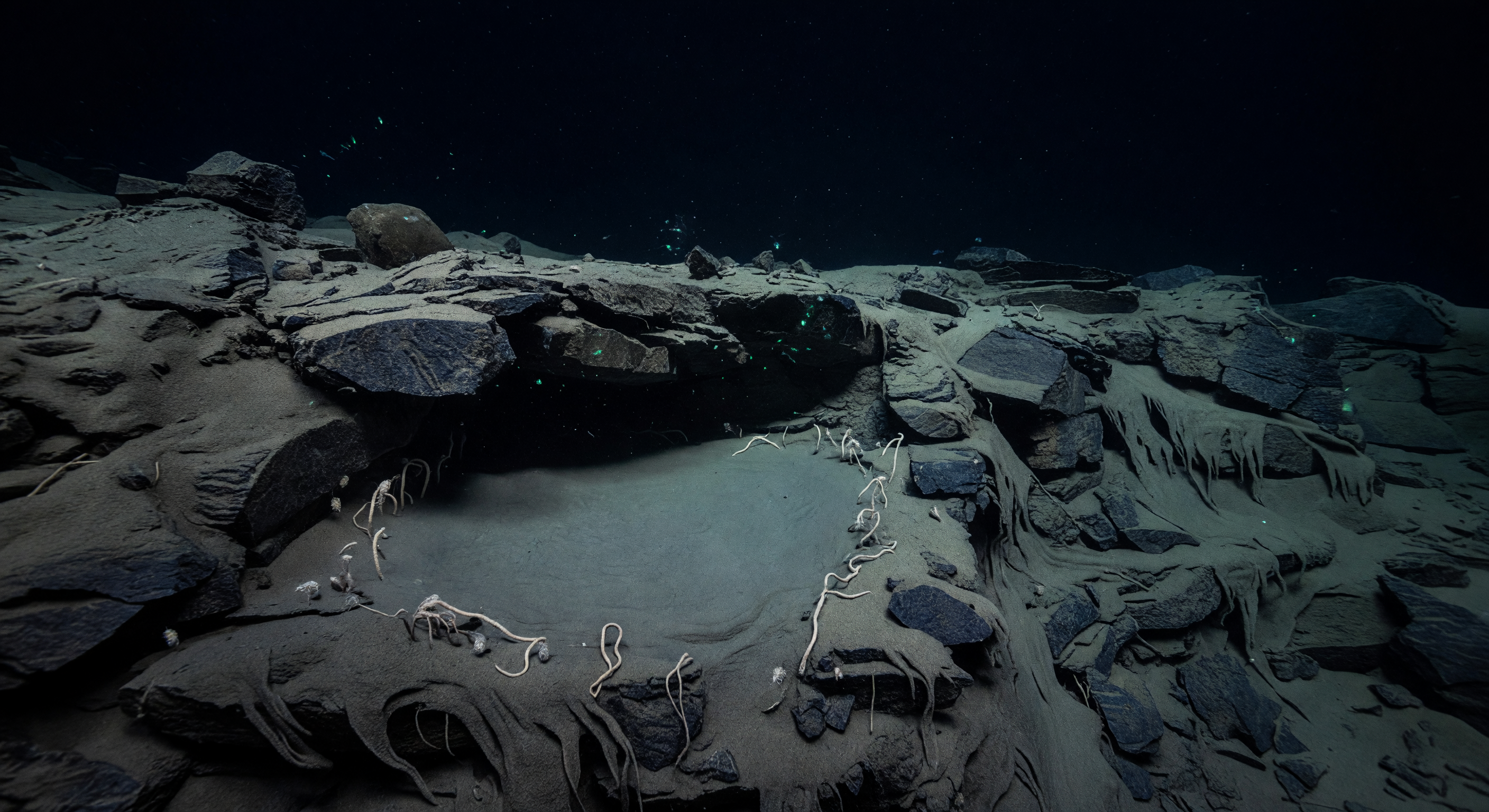
Beneath a fractured overhang of pressure-split basaltic slabs, a still pocket of ash-gray silt accumulates in one of the most extreme environments on Earth — a trench shoulder where hydrostatic pressure exceeds 600 atmospheres and temperatures hover near 1–2°C, rendering the water dense, near-freezing, and essentially motionless in its thermal character yet gently animated by topographically steered contour currents that carry a slow drift of marine snow and nepheloid particles suspended in the black water column. The underside of the overhang shelters a community of agglutinated foraminifera — organisms that construct delicate tubular tests from sediment grains cemented together, an architecture precisely adapted to the mechanical and chemical constraints of hadal pressure — alongside tiny haploid crustaceans, likely amphipods or isopods, pressed close to the substrate where accumulated organic detritus funneled down the steep ravined flanks provides the chemical energy that sustains life in permanent darkness. No photon of sunlight has reached this depth since the rock itself was formed; the only light that has ever moved through this water originates within the organisms themselves, and isolated emerald and blue-green bioluminescent blinks from small drifting bodies trace the rim of fractured stone and the faint scalloped surface of silt before receding into open black water where the wall plunges further still, unwitnessed and unchanged, a geology and biology that predate any awareness of their own existence.
Other languages
- Français: Poche sous surplomb fracturé
- Español: Nicho bajo saliente roto
- Português: Bolso sob saliência fraturada
- Deutsch: Höhle unter gebrochenem Überhang
- العربية: جيب تحت بروز متشقق
- हिन्दी: टूटे छज्जे की झलक
- 日本語: 割れた岩棚の窪み
- 한국어: 균열 암반 아래 틈
- Italiano: Tasca sotto aggetto spezzato
- Nederlands: Holte onder gebroken overhang