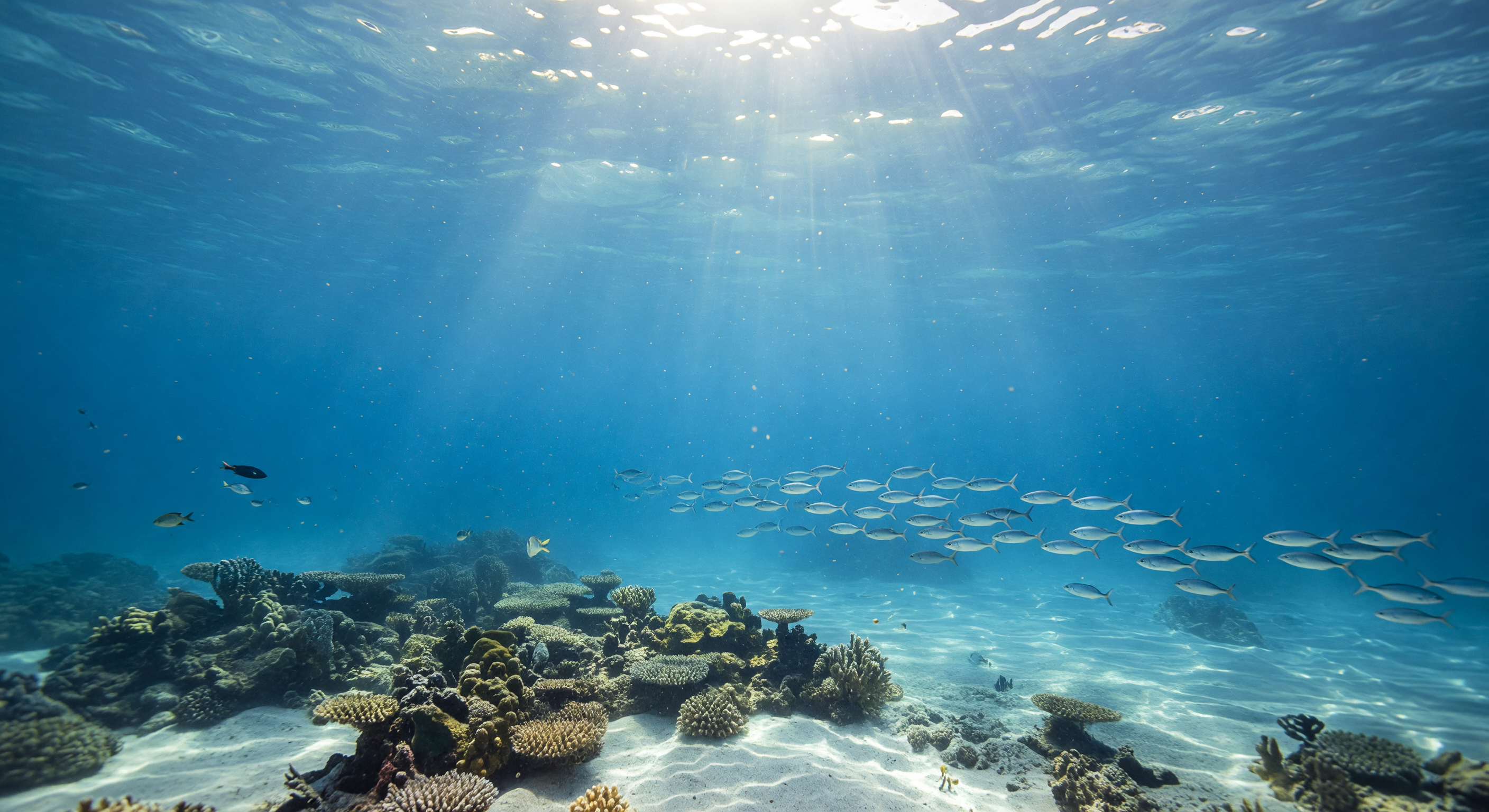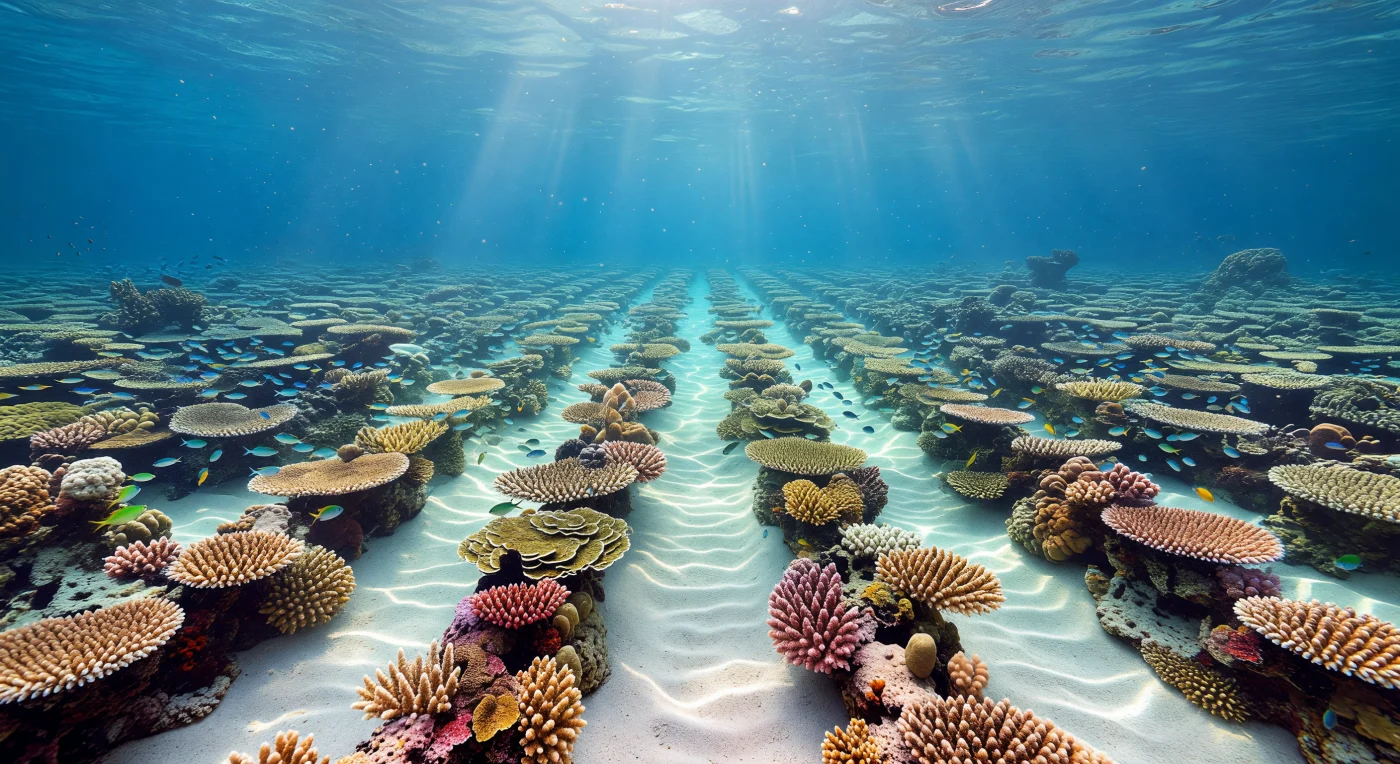
Sunlight pours through the surface film in great shifting curtains, bending into caustic lattices that race across coral ridges and pale sand channels, illuminating a geometry the reef has built over centuries through the patient calcification of countless coral polyps. Here, within the uppermost stratum of the ocean where photosynthesis drives all primary productivity, branching Acropora and broad plate corals compete fiercely for photons, their zooxanthellae converting sunlight into the calcium carbonate architecture that underpins entire ecosystems. Small chromis — Chromis viridis and their kin — hover in loose, nervous aggregations among the coral branches, each fish a flicker of blue-green iridescence as ambient light catches the interference layers of their scales, darting inward at the suggestion of a shadow before drifting out again. The sand channels between the spurs are swept clean by the gentle bottom currents that funnel seaward along the grooves, their rippled surfaces brightened by refracted light while fine suspended particles drift lazily through the water column, tracing the invisible choreography of slow, warm currents. This labyrinth exists in complete indifference to any witness — only the reef's own logic of growth, light, and predation shaping it, century after century, in the luminous silence of shallow tropical water.
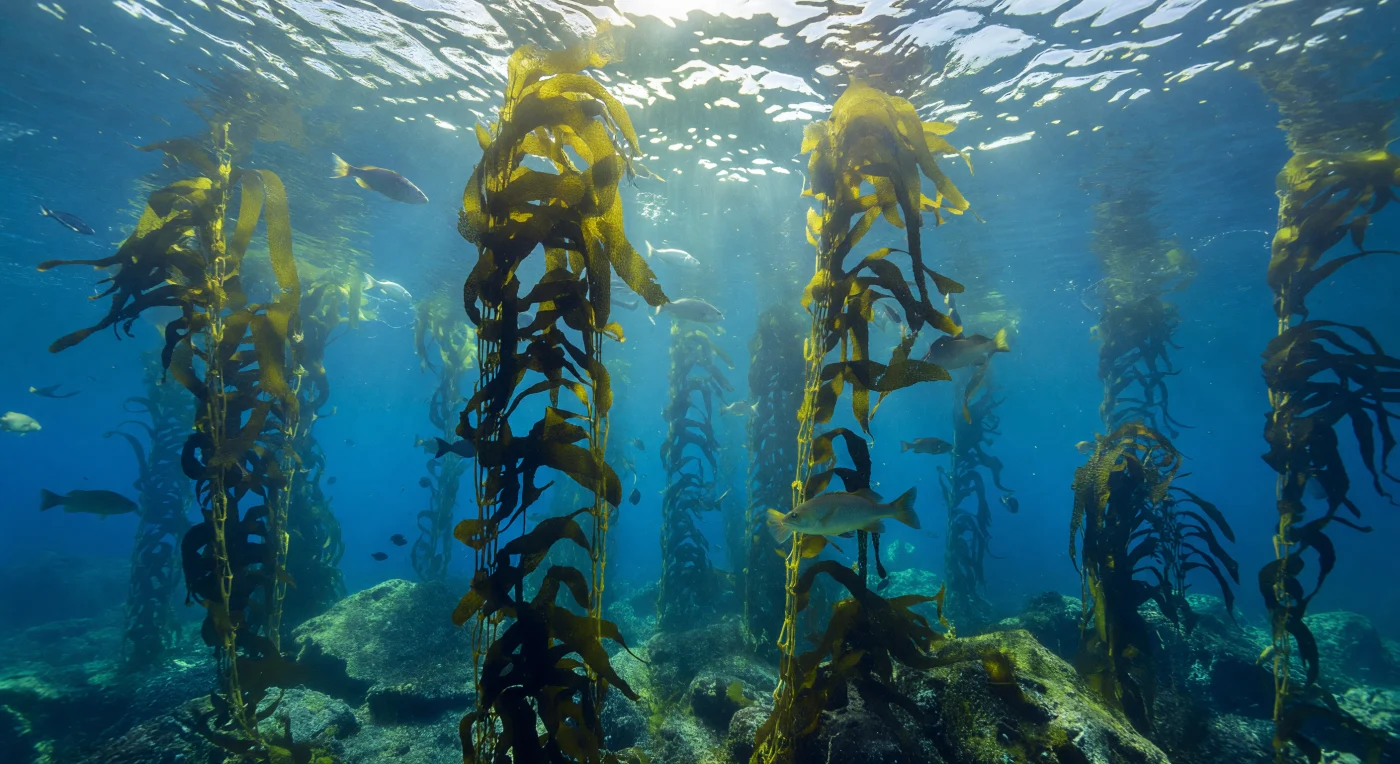
Sunlight here is not decoration but engine — it drives photosynthesis through every meter of the water column, sustaining a living architecture of giant kelp (*Macrocystis pyrifera*) whose stipes ascend twenty to thirty meters from anchoring holdfasts on the rocky substrate below, each one buoyed upward by gas-filled pneumatocysts that keep the fronds spread wide to harvest every available photon. The water itself is a working fluid: exchanging oxygen and carbon dioxide with the atmosphere above, suspending countless particles of phytoplankton, zooplankton, and marine snow that drift in slow gravitational fall, intercepting shafts of sunlight and scattering them into the blue-green luminosity that suffuses the entire column. Kelp bass (*Paralabrax clathratus*) move through the stipe corridors with the unhurried confidence of animals native to this structure, their scales catching caustic patterns refracted through the rippling surface a few body-lengths above; pressure here barely exceeds two atmospheres, and temperature, light, and dissolved gas are all close to atmospheric equilibrium. This forest produces its own microclimate — the dense canopy moderates surge, shades the understory, and sheds a continuous slow rain of organic detritus downward — making the kelp bed simultaneously a primary producer, a nursery, a hunting ground, and a conveyor belt of carbon toward darker water. It exists in perpetual, unremarkable abundance, indifferent to observation, exactly as it has for millions of years.
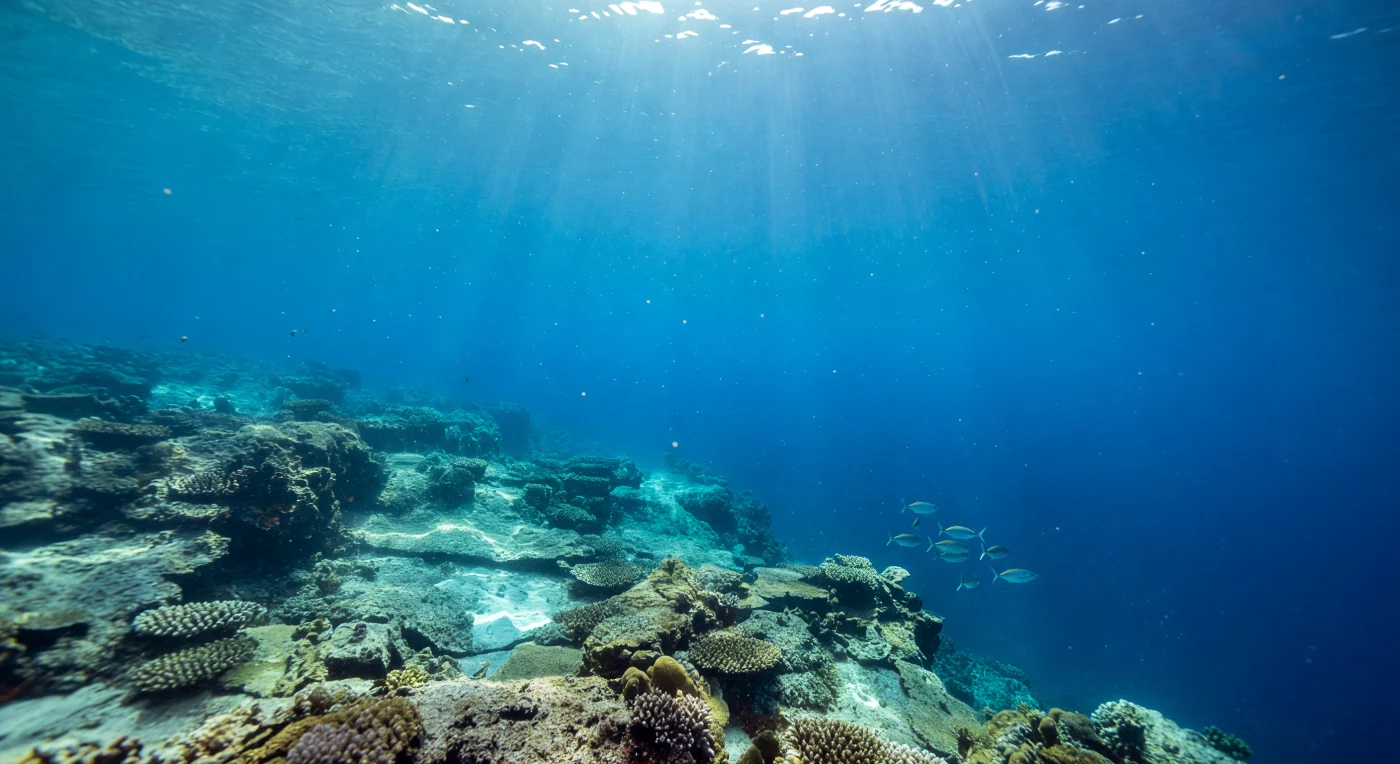
Sunlight penetrates these uppermost waters with extraordinary clarity, refracting into long cathedral shafts that slide and bend with each surface undulation, casting a shifting lattice of luminescence across rugged limestone ledges encrusted with hard corals, encrusting invertebrates, and the fine mineral textures shaped by current over geological time. This is the euphotic zone — the ocean's most productive stratum, where photosynthesis drives the base of nearly every marine food web, where warm tropical water exchanges gases and heat freely with the atmosphere above, and where pressure, though rising steadily toward eleven atmospheres at depth, remains within reach of the fastest and most agile of open-water predators. A loose patrol of jacks holds at the reef's outer edge, their flanks catching and scattering sunlight like signal mirrors, precisely positioned where the cobalt wall dissolves into open pelagic space — a boundary they exploit to ambush prey funnelled between reef structure and the vast water column. Countless suspended particles drift freely through the blue, each one a fragment of the ocean's living and dying — phytoplankton, zooplankton fragments, mineral grains — tracing invisible currents that connect this brilliant surface world downward into the deepening dark. The reef face itself descends into saturated ultramarine, its outcrops and crevices sheltering encrusting life that has colonised every available surface, a silent architecture built incrementally by organisms that have never needed a witness.
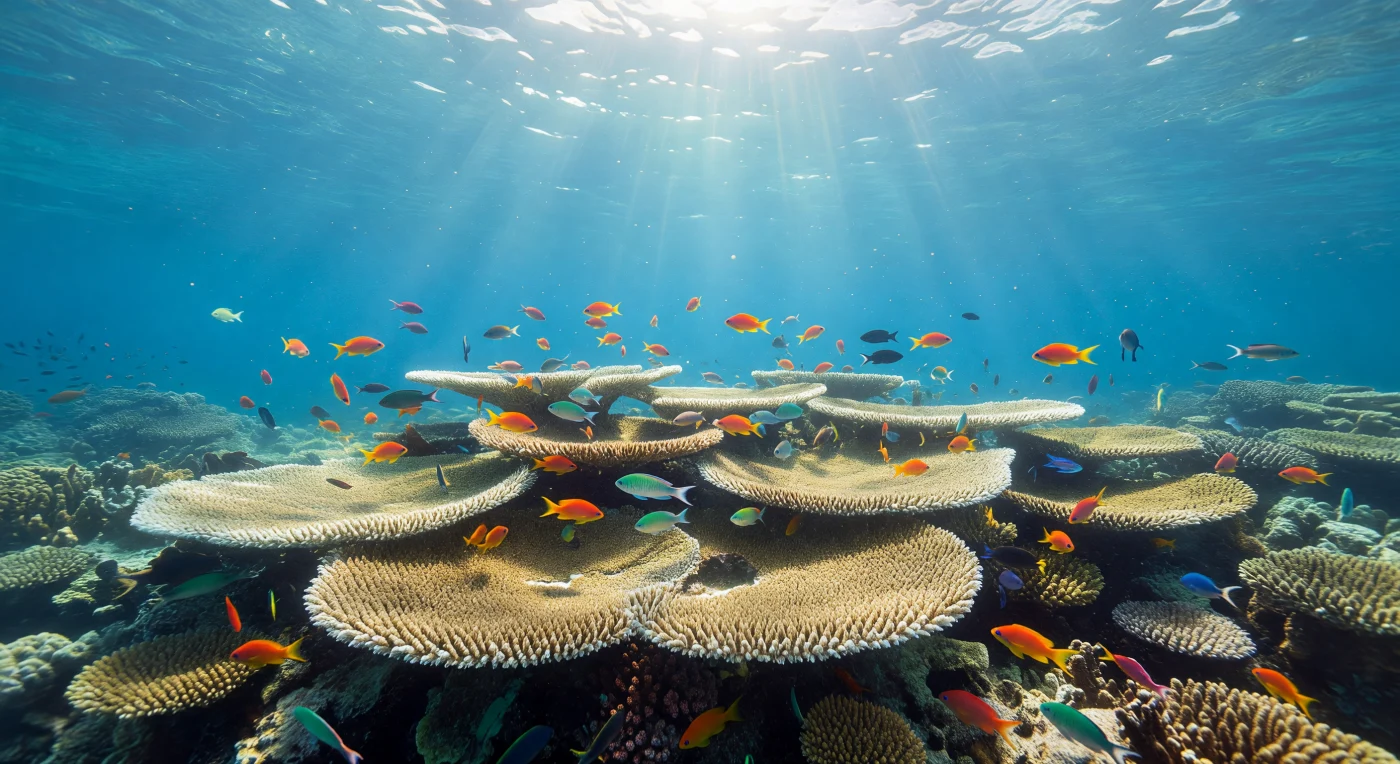
Here, where the Indo-Pacific sun still commands the water column with full authority, broad plates of *Acropora* coral stack outward from the reef wall in overlapping tiers, each horizontal disk a living architecture shaped over decades by the competition between upward growth, light-seeking geometry, and the slow abrasion of surge. Pressure remains gentle — barely two atmospheres at ten metres — and photosynthesis drives everything: the golden-tan surfaces of the coral tables host dense symbiotic zooxanthellae, while their undersides shelter cryptic invertebrates in perpetual cool shadow, lacework caustics rippling across the scene as the surface above bends and redistributes every ray of incoming light. Swarms of orange-pink anthias — *Pseudanthias squamipinnis* — hang in the open water column above the terrace, filter-feeding on the fine particulate snow drifting perpetually downward from the productive surface, while iridescent wrasses patrol the coral margins with the quick, unpredictable trajectories of fish tuned to a reef full of crevices and rivals. The water itself, warm and exceptionally clear, stretches away into an open cobalt blue that dissolves all distant form into soft pelagic haze — a reminder that this sunlit balcony is simultaneously a reef and an edge, a threshold between the intimate architecture of coral and the vast, featureless epipelagic ocean beyond. This world needs no witness: it has sustained itself, in precisely this form, for millions of years.
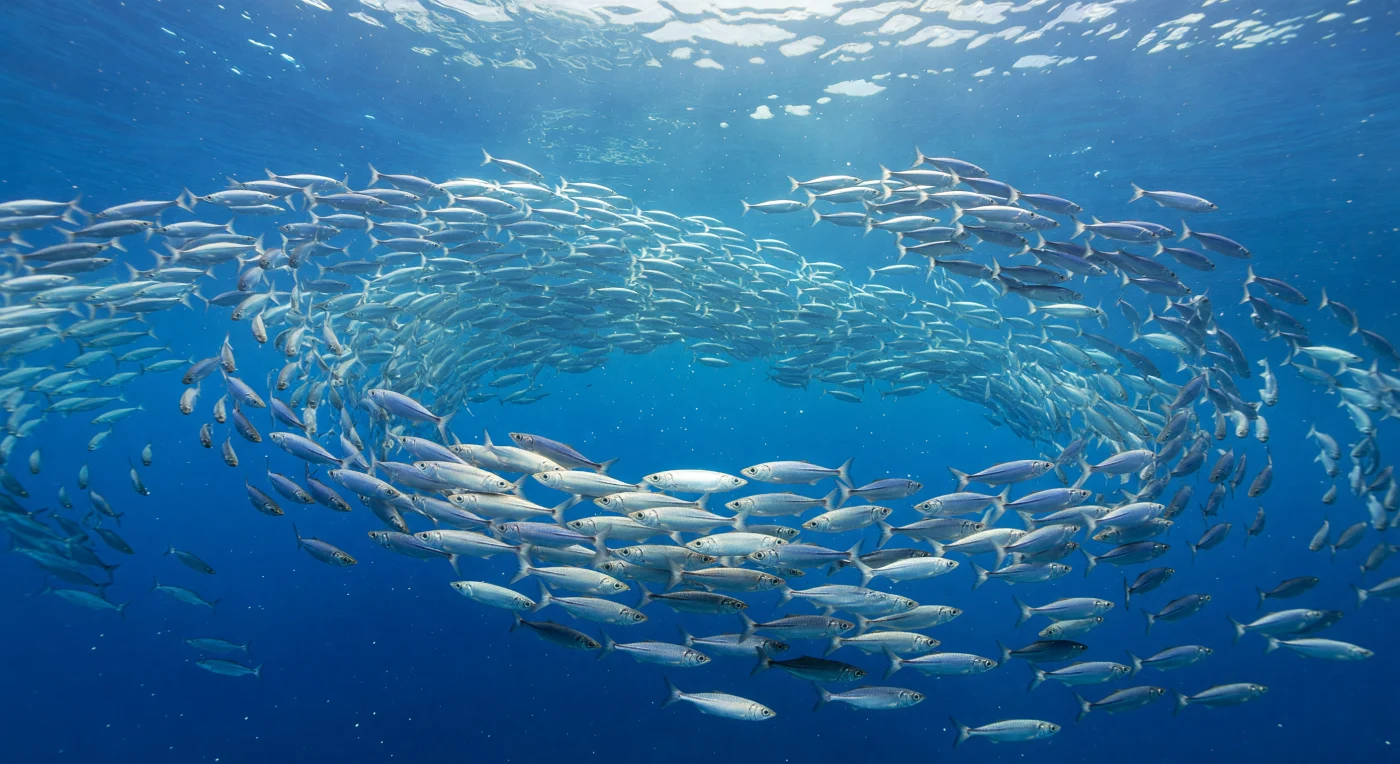
In the sunlit upper ocean, where pressure barely doubles even at depth and sunlight still reaches far enough to fuel the base of all marine life, a vast shoal of European pilchards — *Sardina pilchardus* or their Pacific kin — wheels through open water in one of the sea's most spectacular collective behaviors. Thousands upon thousands of individuals compress into sweeping arcs and then open into darker corridors of cobalt, the whole formation bending like a living vortex governed by hydrodynamic pressure waves and split-second lateral-line sensing rather than any leader or signal. Each synchronized turn presents a broadside of reflective guanine-crystal scales to the sun, converting the shoal momentarily into a shimmering mosaic of silver and white-gold against deep sapphire — a behavior known as the flash expansion, thought to confuse predators by overwhelming their ability to isolate a single target. Fine marine snow and suspended phytoplankton drift freely through the water column, catching fragments of light between the bodies, while god rays descend from the wind-rippled surface overhead, fanning outward through the euphotic zone where net photosynthesis still exceeds respiration and the entire pelagic food web begins. This is the ocean's most productive layer — a place of relentless biological momentum, radiant, indifferent, and complete without witness.
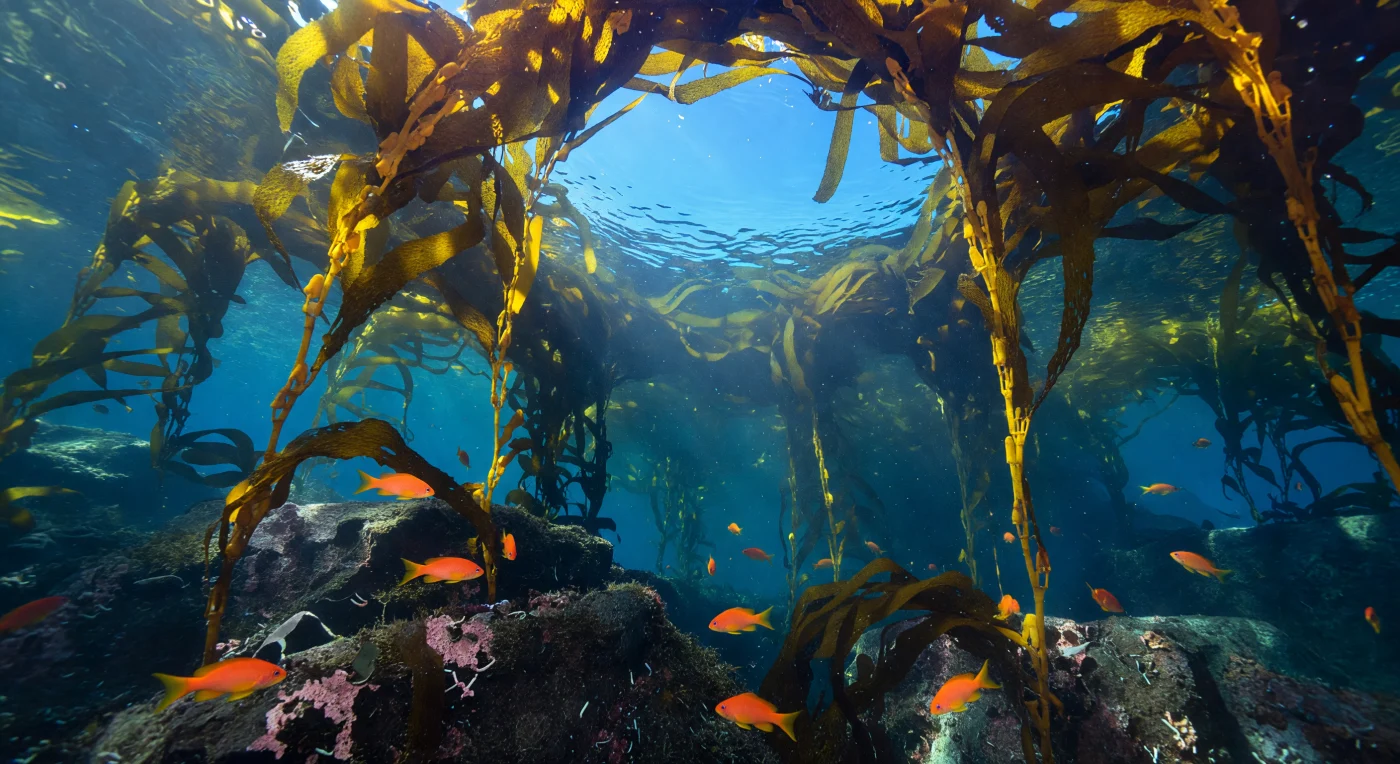
In the shadowed understory of a temperate kelp forest, tall stipes of *Macrocystis pyrifera* rise from basalt ledges encrusted with pink coralline algae, their gas-filled pneumatocysts buoying a dense canopy overhead where photosynthesis runs at full intensity in water just meters deep. A single luminous oval break in that canopy opens onto blazing cobalt and turquoise above, pure unfiltered solar radiation refracting through the surface and sending wavering caustic patterns across rock, blade, and water column — the signature of shallow epipelagic light where pressure barely exceeds two atmospheres and every photon still carries enough energy to drive primary production. Against this cool shadowed understory, brilliant orange garibaldi (*Hypsypops rubicundus*) — the largest of the Pacific damselfishes and fierce territorial guardians of these reef ledges — hover motionless between the kelp stems, their carotenoid pigmentation evolved not for camouflage but for conspicuous communication in a world still rich with color and light. Fine plankton and suspended particulate drift through the water column, glittering softly in ambient sunlight, each particle a fragment of the immense biological productivity that makes this zone the ocean's engine — a place of oxygen, abundance, and ancient rhythms that proceed entirely without witness.
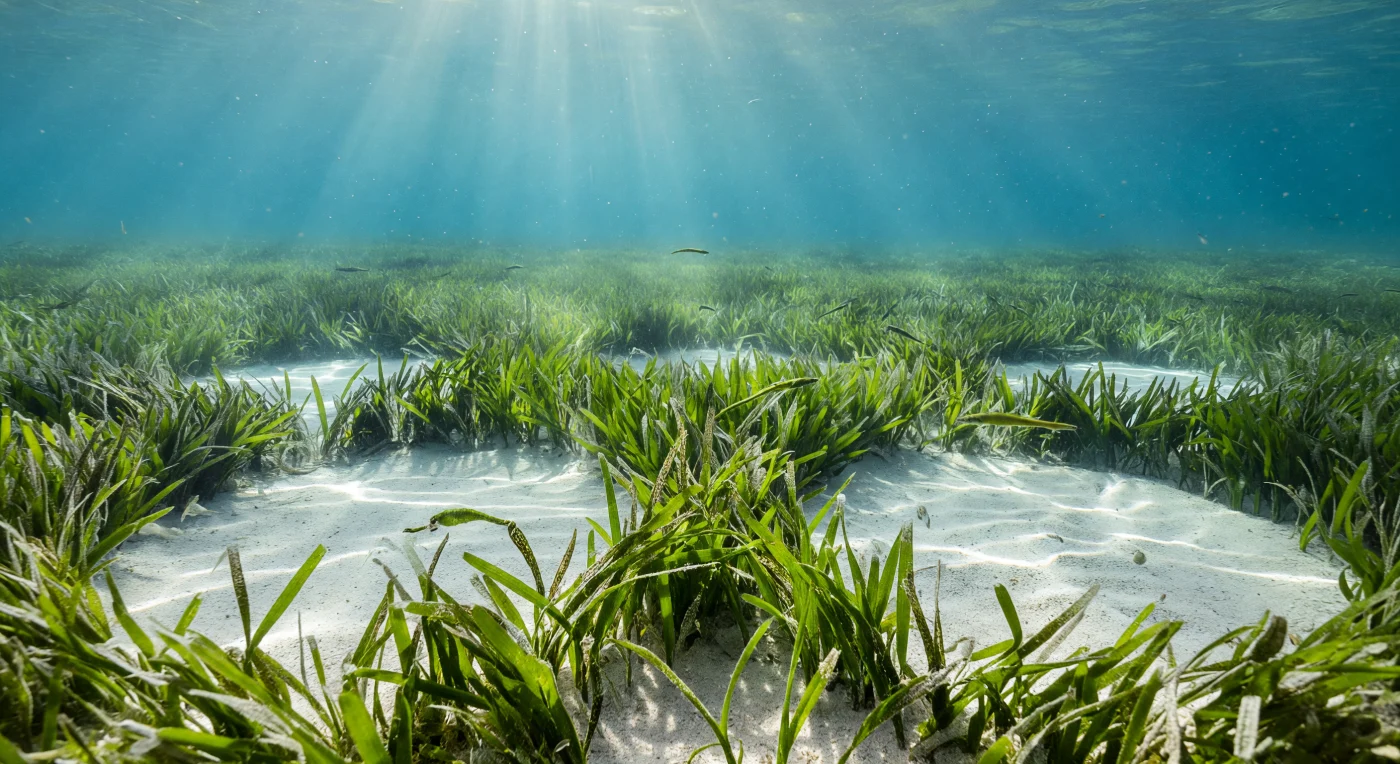
In the shallows where sunlight reaches the seafloor without attenuation, a broad plain of shoal-grass — most likely *Halodule wrightii* — extends across pale carbonate sediment, its narrow ribbon-like blades colonized by a thin film of epiphytic algae and diatoms that give each leaf a slightly roughened texture. The circular sand patches interrupting the meadow are characteristic of bioturbation and hydrodynamic scour, where gentle reversing currents prevent seagrass from establishing rhizome networks, leaving exposed windows of fine biogenic sand rippled by orbital wave motion. Within this mosaic, syngnathid pipefish — relatives of seahorses — hold station vertically among the blades using near-invisible pectoral fin oscillations, their cryptic coloration and elongated bodies rendering them almost indistinguishable from the surrounding vegetation as dappled caustic light plays across everything in shifting lattices. Transparent caridean shrimp, their organs faintly visible through glass-like carapaces, drift above the sand openings at depths where full solar irradiance still penetrates, the water column here exchanging gases freely with the atmosphere above and sustaining the net photosynthesis that makes seagrass meadows among the most biologically productive and carbon-sequestering habitats on the planet. This is a world of extraordinary clarity and continuous solar energy, operating entirely on its own terms, indifferent to any outside witness.
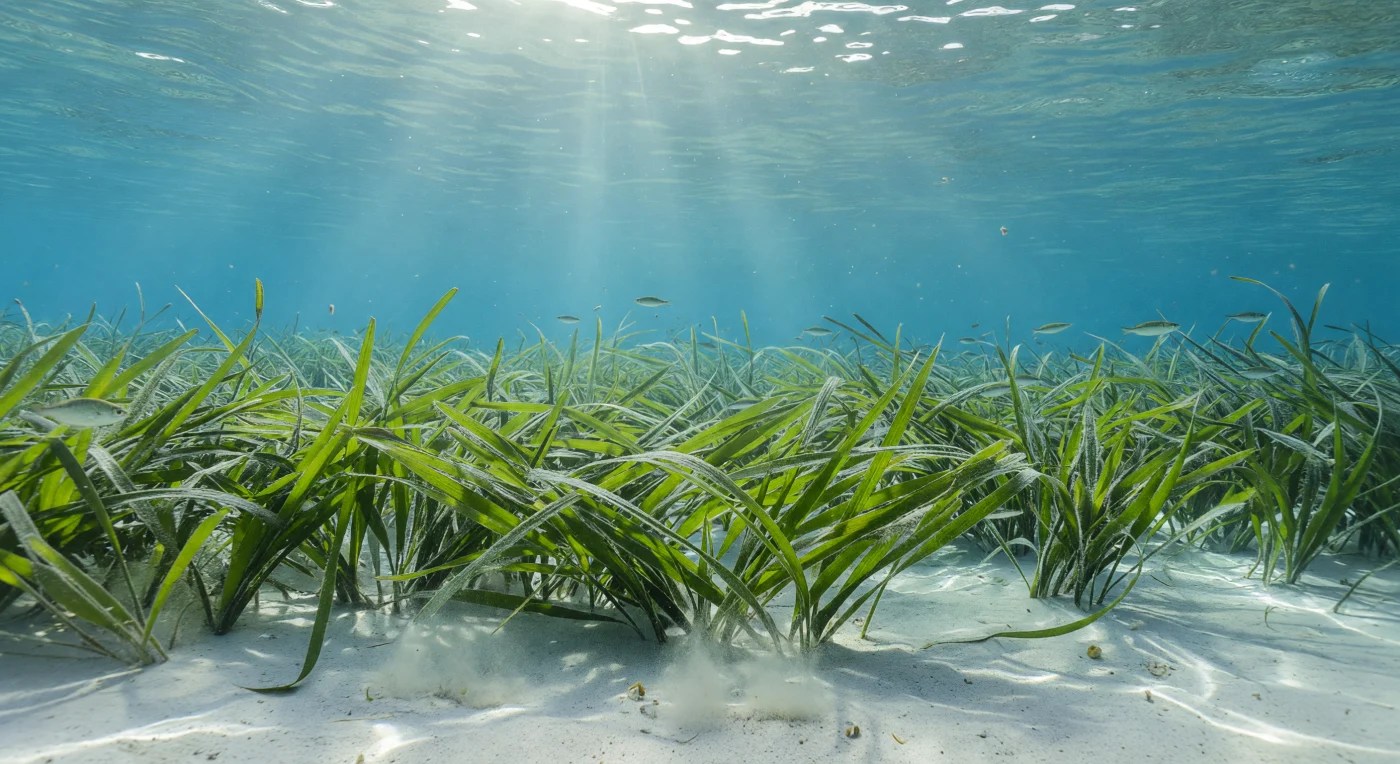
Sunlight pours through the rippled surface in broad, shifting curtains of gold and turquoise, refracting into crisp caustic ribbons that stripe the pale carbonate sediment and the swaying blades of turtle grass — *Thalassia testudinum* — whose ribbon-like leaves form a living lattice across the seafloor a few meters below the air-sea interface. This is the epipelagic realm at its shallowest and most luminous, where pressure is barely above one atmosphere, dissolved oxygen is saturated, and photosynthesis runs at full intensity, sustaining an entire trophic architecture built on light. The seagrass meadow itself is an ecosystem engineer: its root-and-rhizome matrix stabilizes the carbonate sediment, its blades host a dense film of epiphytic algae and microinvertebrates, and its canopy provides refuge for the loose aggregations of juvenile mojarras and translucent grunt fry drifting just above the tips, their silvery flanks catching and scattering the ambient light. Near the bottom, micro-disturbances lift fine detritus — fragments of shell, decomposing leaf material, foraminifera tests — into slow-spiraling suspension, tracing the subtle tidal current that bends the grass in long synchronized waves. The scene exists entirely on its own terms: a shallow tropical coastal habitat running its ancient, intricate metabolism in full sunlight, indifferent and complete.
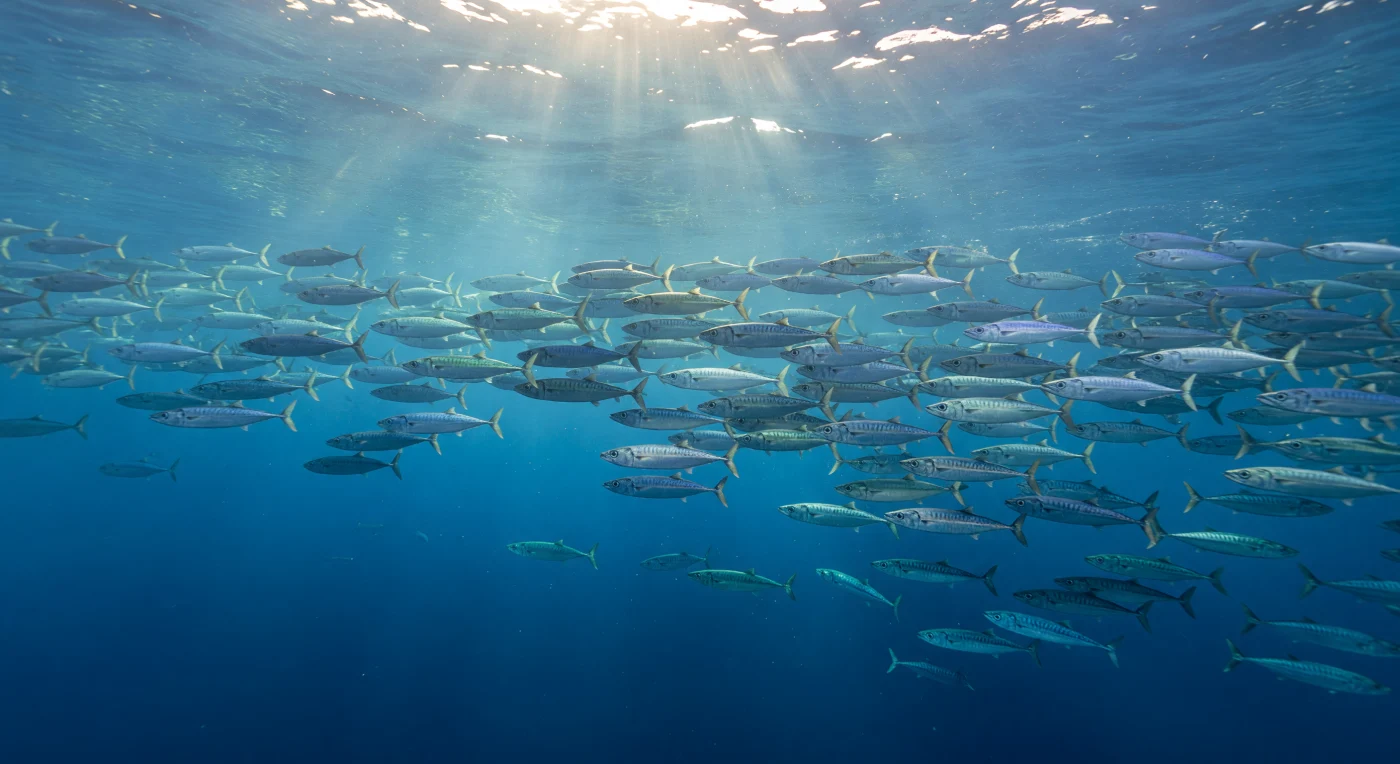
Along the continental shelf edge, where the seafloor abruptly surrenders to open water and the bottom drops away into deepening cobalt, thousands of Atlantic mackerel (*Scomber scombrus*) move as a single coherent body through the epipelagic zone — that upper stratum of the ocean, from the surface to roughly 200 metres, where sunlight still drives photosynthesis and life concentrates in extraordinary density. Oblique rays fan downward from above, refracting through clear, particle-laden seawater rich with drifting phytoplankton, zooplankton, and organic marine snow, each mote softly illuminated by ambient solar energy alone, scattering light into shifting caustic lattices across the water column. The mackerel school functions as both predator and prey here, a living hydrodynamic structure whose synchronized turns flash each silver flank like a turning mirror — a collective anti-predator strategy that exploits confusion and the blinding chrome of thousands of reflecting scales simultaneously. At this shelf break, cold nutrient-rich water from depth periodically upwells against the continental margin, fueling the planktonic productivity that draws these fish into dense aggregations, linking the chemistry of the deep ocean to the brilliant, sunlit corridor above. Without any witness and without interruption, the school streams onward through water that is simultaneously luminous and immense — a world of pressure, pulse, and silver light that has operated on these terms for tens of millions of years.
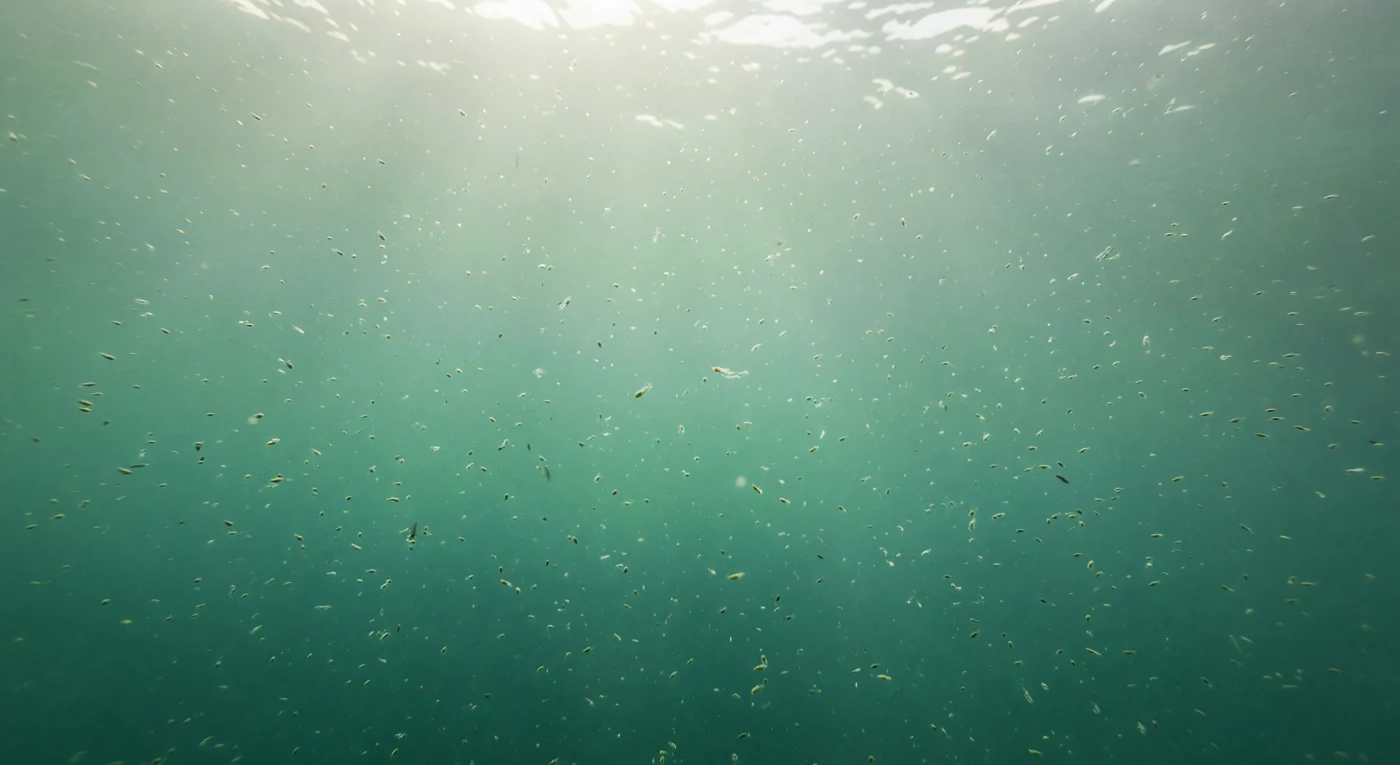
At the very surface of the sea, where ocean and atmosphere breathe together, a dense bloom of phytoplankton transforms sunlight into something diffuse and alive — the water itself becomes luminous, tinted jade and blue-green, as billions of microscopic algal cells scatter every photon passing through. This is the euphotic zone, the ocean's solar engine, where net photosynthesis drives one of Earth's great biogeochemical cycles: phytoplankton fix dissolved carbon dioxide, release oxygen, and form the base of a food web that cascades through countless trophic levels. Pressure here remains close to that of the atmosphere above — just a few atmospheres even at depth — and the water column churns gently with thermal mixing and wind-driven turbulence, suspending copepods, transparent nauplii larvae, organic aggregates, and drifting marine snow in a living particulate soup that filters and softens the light as it descends. In productive coastal seas like this, the euphotic layer compresses to as little as twenty or thirty meters before turbidity swallows the last usable photons, concentrating all photosynthetic activity into a bright, fertile, crowded upper stratum. This world of green water and drifting life exists in perpetual, unseen motion — a system older than any witness, sustaining the ocean from the very first centimeters below its surface.
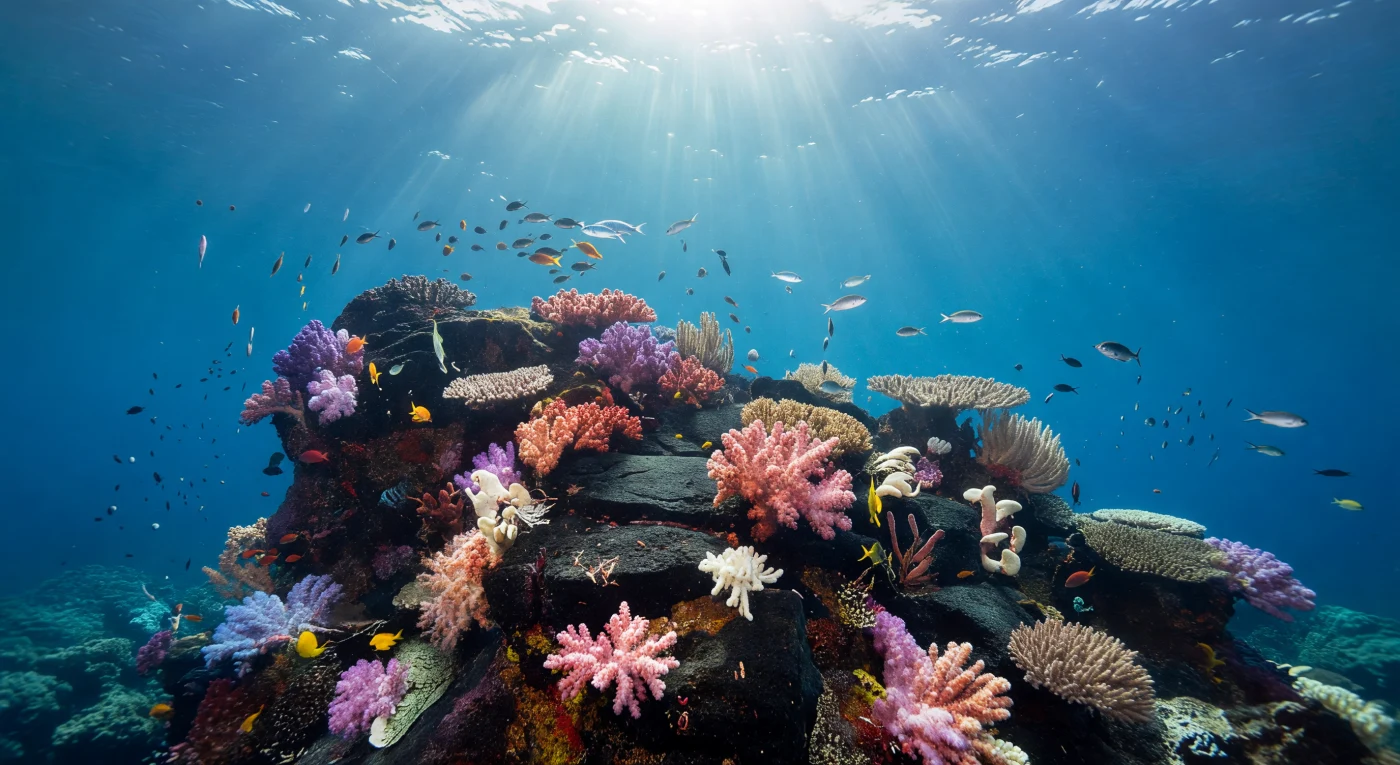
Where the volcanic pinnacle's flank rises into open water, broad shafts of sunlight descend from the surface in long, shifting columns, scattering across dark basalt and setting the water column alive with rippling caustics and the golden glint of suspended plankton. At twenty to thirty meters, pressure already reaches three to four atmospheres, yet this remains the ocean's most productive layer — the euphotic zone where solar energy drives photosynthesis and fuels the entire food web above and far below. Gorgonian fans and soft corals anchor themselves to every ledge and crevice along the upcurrent face, their polyps fully extended in the persistent flow, capturing zooplankton carried upward as the seamount deflects the passing current — a phenomenon known as topographic upwelling that concentrates nutrients and prey into a narrow, richly inhabited column of water. Above the reef structure, dense aggregations of anthias and chromis hold station facing the current, their scales catching brief solar flares, while deeper in the blue distance the pinnacle dissolves into open pelagic space, vast and unlit. Here the ocean exists entirely on its own terms — governed by light, flow, and the slow arithmetic of predator and prey — indifferent, continuous, and complete.
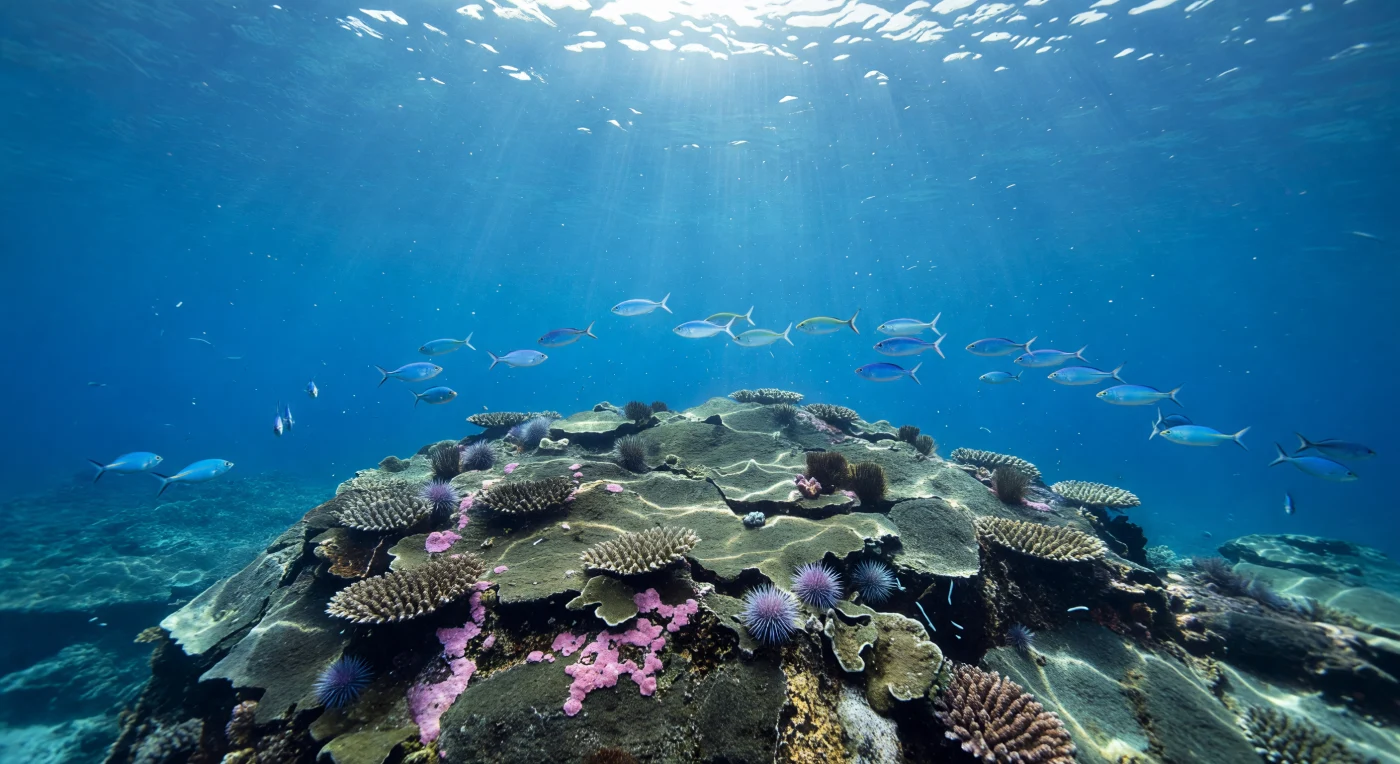
Sunlight pours down through the shallow water column in broad, shifting curtains, fracturing across the dark basalt of a seamount summit into shimmering caustic lattices that dance over pink coralline algae and the spines of lodged sea urchins. This is the epipelagic zone, where photosynthesis drives the ocean's primary productivity and pressure remains low enough — barely two atmospheres at ten metres — for complex, light-dependent communities to flourish directly on volcanic rock thrust up from the deep seafloor. The summit acts as an oasis in open water, concentrating nutrients in upwellings deflected by the ridge and attracting a loose, circling school of fusiliers whose silver-blue flanks catch and scatter the sunlight with each banking turn. Beyond the crest, the water column opens into saturated cobalt, colour deepening as suspended plankton and fine particulates drift freely in the current, each cell and fragment a living thread in the ocean's great photosynthetic engine. This place exists in unbroken continuity — lit, pressured, swept by current, and utterly indifferent to any witness.
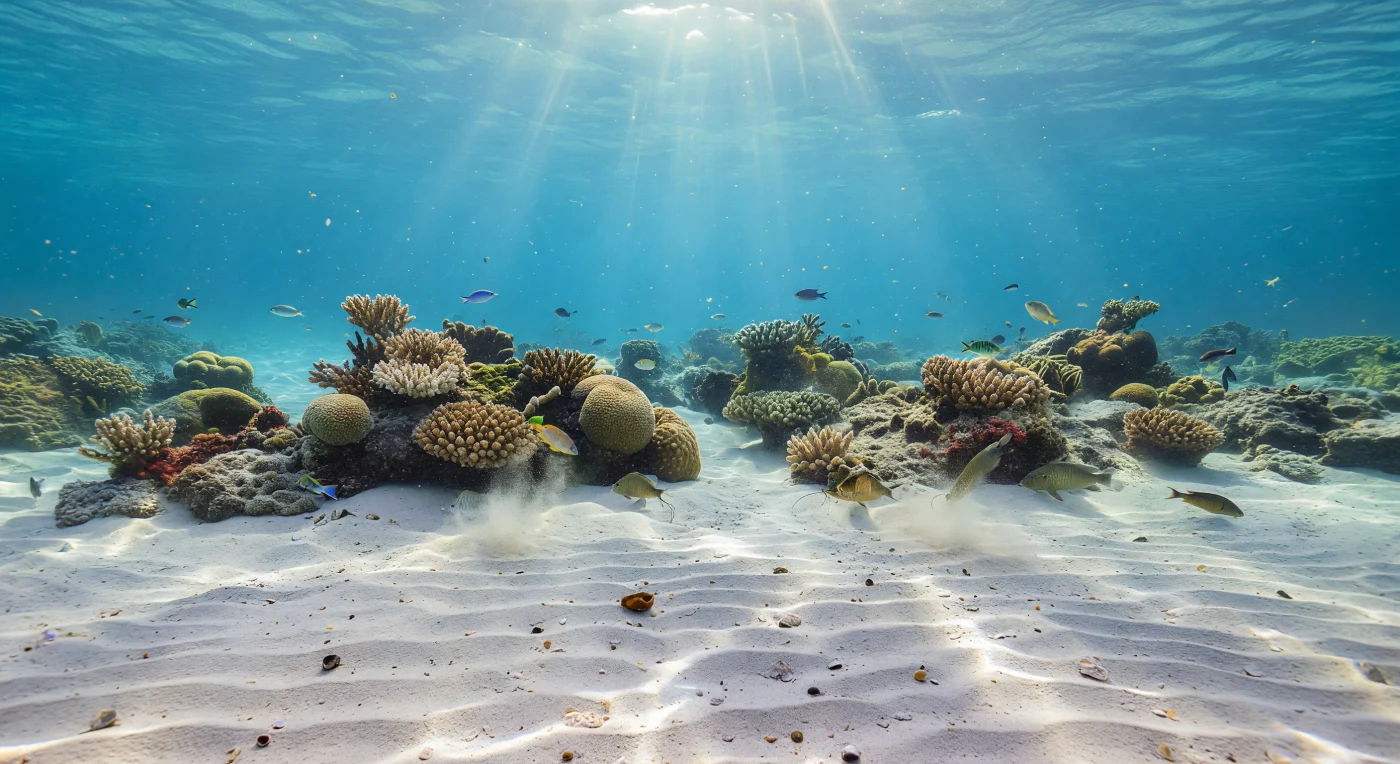
Where the white carbonate sand gives way to scattered coral bommies, tropical sunlight fractures into a shifting lattice of caustics that rolls continuously across ripple crests and hard-coral surfaces, penetrating to perhaps 30 metres in water this clear before the blue finally swallows it. Pressure here hovers between one and a few atmospheres — trivial by oceanic standards — yet the biological intensity is immense: the euphotic zone is operating at full power, with phytoplankton fixing carbon in the upper water column while goatfish work the sand-coral margin below, their chemosensory barbels probing ripple troughs and lifting pale sediment puffs that drift upward through suspended shell fragments and planktonic specks. The reef edge itself is an ecotone, a sharp transition between two productivity regimes — the structured, three-dimensional carbonate architecture of the bommies with their branching Acropora, encrusting coralline algae, and resident anthiids, and the open sandy flat where nutrient cycling depends on bioturbation and the restless redistribution of organics by current and forager alike. Beyond the last coral head the seafloor drops away into open pelagic blue, a reminder that this sunlit, warm, oxygen-rich surface layer — for all its familiarity — rests above an ocean that descends, largely dark and pressurised, for another four kilometres.
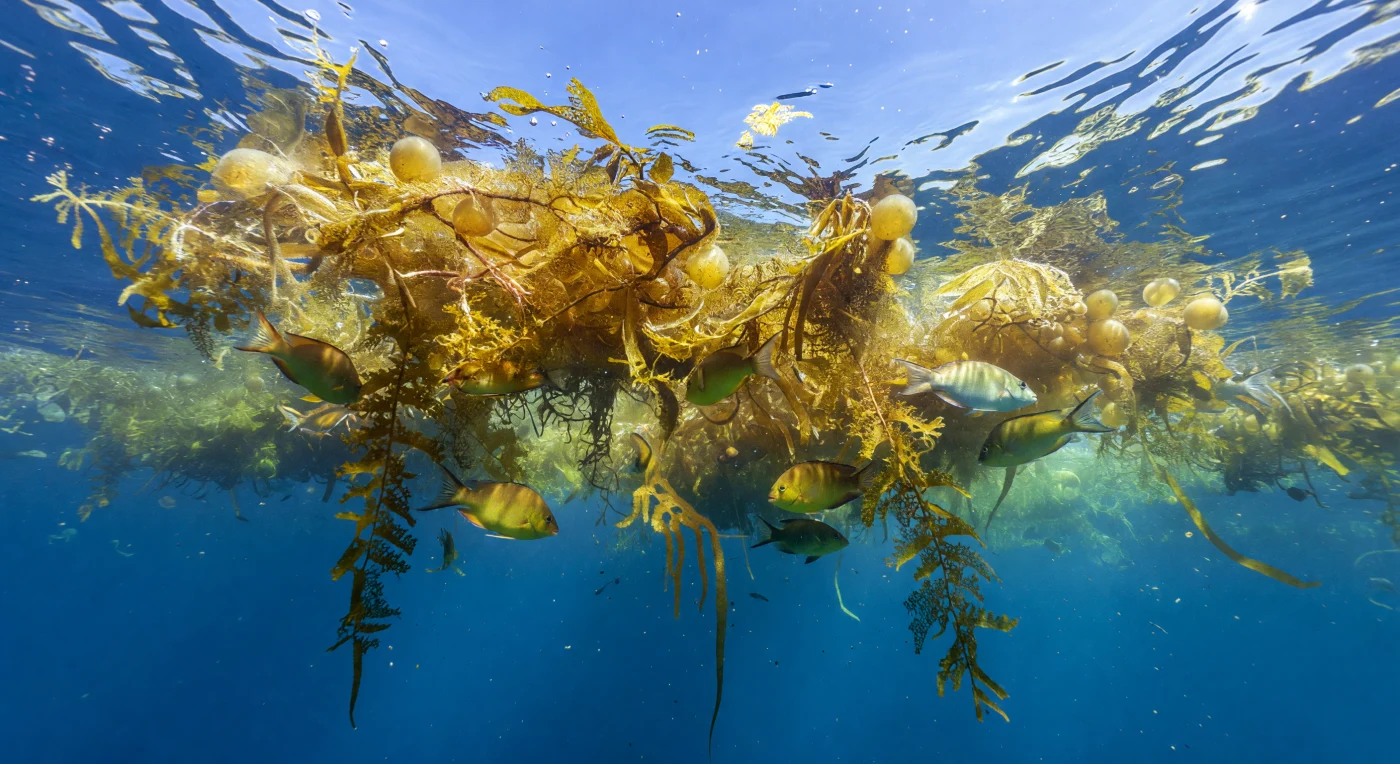
Beneath the drifting sargassum raft, natural sunlight fractures into shifting lacework — caustic patterns that ripple across amber fronds, rounded air bladders, and the open water column below, where the blue deepens from cobalt to a soft, velvety ultramarine. This is the epipelagic ocean at its most luminous: a layer of 0–200 metres where solar energy still penetrates with enough intensity to drive photosynthesis, warm the surface mixed layer, and sustain one of the most productive ecosystems on the planet. The sargassum itself is a floating biome, a pelagic habitat unanchored to any seafloor, carried by gyres and trade winds across thousands of kilometres of open Atlantic, its tangled fronds offering shade, structure, and concealment in an otherwise featureless expanse. Juvenile triggerfish and filefish — their bodies patterned in olive, honey, and translucent silver — hover among the hanging vegetation, finely camouflaged against predators rising from the blue depths below or scanning from above, exploiting a refuge that will drift with them through the first critical months of their lives. Fine particles of marine snow, plankton, and organic detritus drift slowly downward through the sunlit column, each fleck a node in the ocean's biological pump, carrying surface-fixed carbon toward the abyss in a process that quietly shapes the chemistry of the entire ocean.
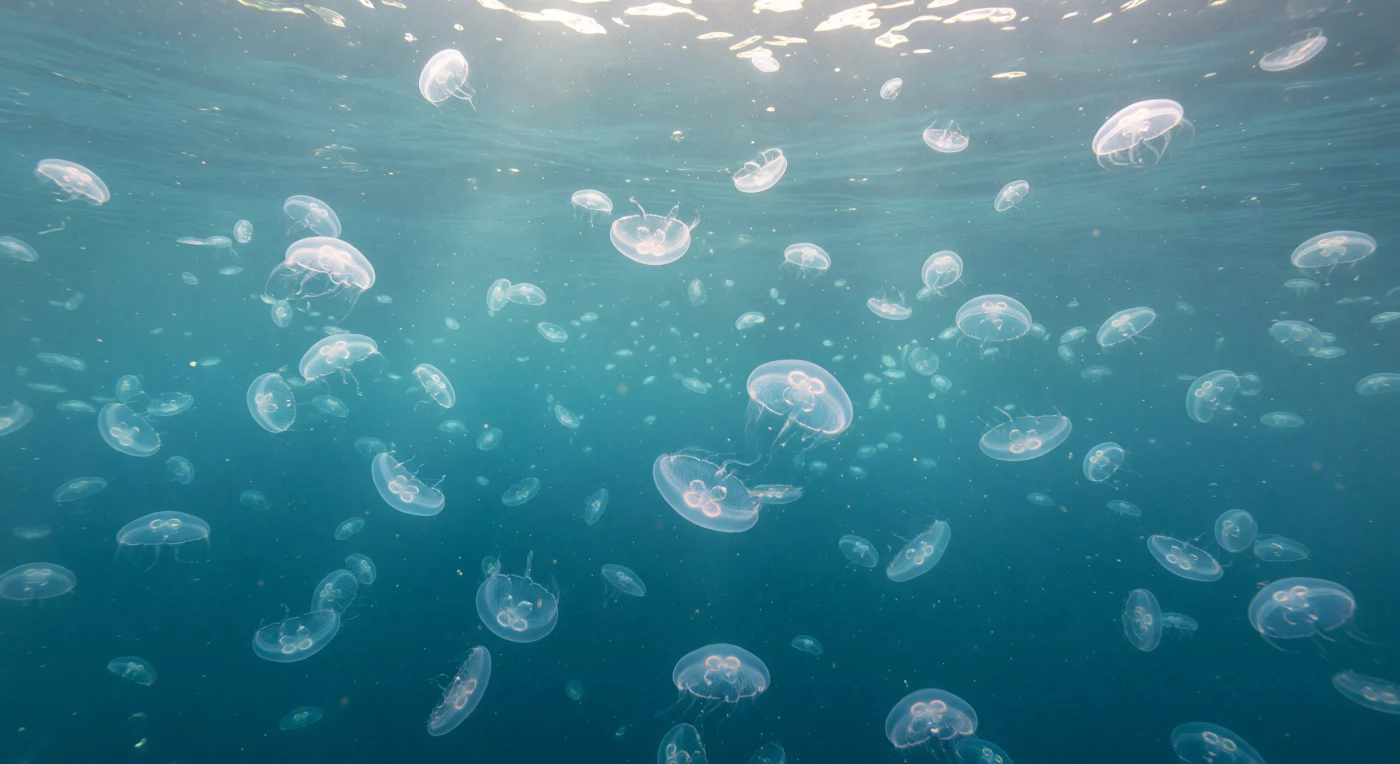
In the sunlit epipelagic, where pressure barely doubles from surface to depth and light still drives the engine of life, a bloom of ctenophores transforms the open water into a living chandelier of glass. These are not jellyfish but an ancient and wholly distinct phylum — Ctenophora — whose eight longitudinal rows of fused cilia, the combs that give them their name, scatter sunlight into fleeting spectral ribbons, a purely physical iridescence produced by diffraction rather than pigment or bioluminescence. Each body is composed of more than ninety-five percent seawater, virtually transparent, held together by a gelatinous mesoglea threaded with muscle and canal systems that pulse almost imperceptibly as the animals drift through water warmed by solar radiation and stirred by wind-driven mixing in the upper mixed layer. A bloom like this can arise within days when prey — copepods, fish larvae, other gelatinous plankton — reaches sufficient density, and a single square meter of productive sea may harbor hundreds of individuals, making ctenophores among the most numerically dominant predators in the world ocean despite their apparent fragility. Above, the surface ripples scatter sunlight into shifting caustic patterns that travel down through the water column, illuminating this quiet, weightless wilderness that has existed, utterly indifferent to observation, for hundreds of millions of years.
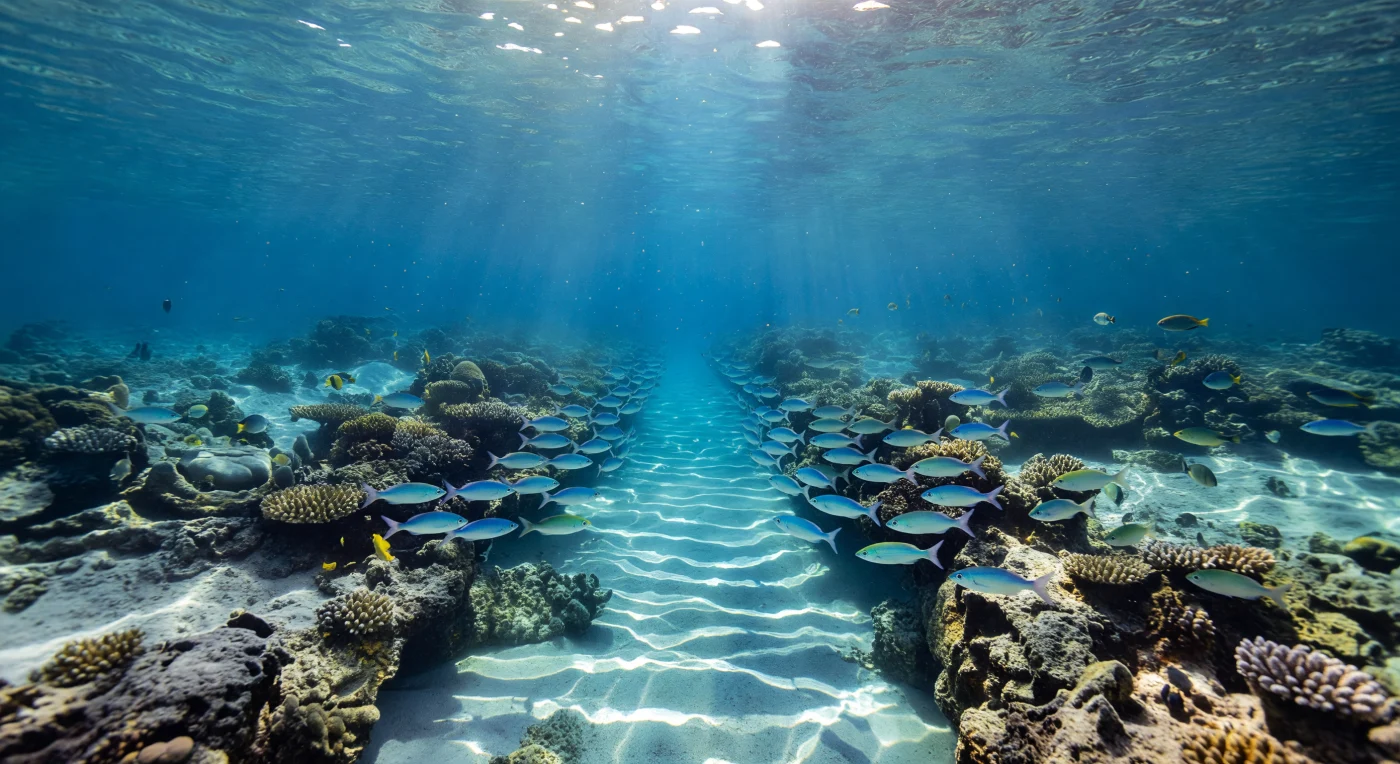
Sunlight floods the pass in shifting god rays, each beam fractured by the rippled surface above into a restless lattice of caustic light that races across branching coral heads and pale limestone ridges below. A dense school of fusiliers holds its station mid-water, bodies angled into the current with effortless precision, their silver-blue flanks and faint yellow stripes catching and releasing the tropical sun as one coherent, breathing geometry. At no greater depth than a few tens of metres, pressure remains close to that of the surface world, yet the reef pass itself is a place of genuine hydraulic force — tidal exchange funnelling nutrient-rich oceanic water across the barrier at speeds that suspend fine particulate and plankton as luminous drifting specks throughout the column. Hard corals encrust every available limestone surface, their calcium carbonate architecture shaped over centuries by the interplay of current, light, and biology, while scattered reef fish press into the shelter of outcrops as the flow accelerates through the throat of the channel. Beyond the pass, the column deepens from turquoise to cobalt, hinting at the open ocean that begins where the reef's sunlit geometry quietly gives way to blue.
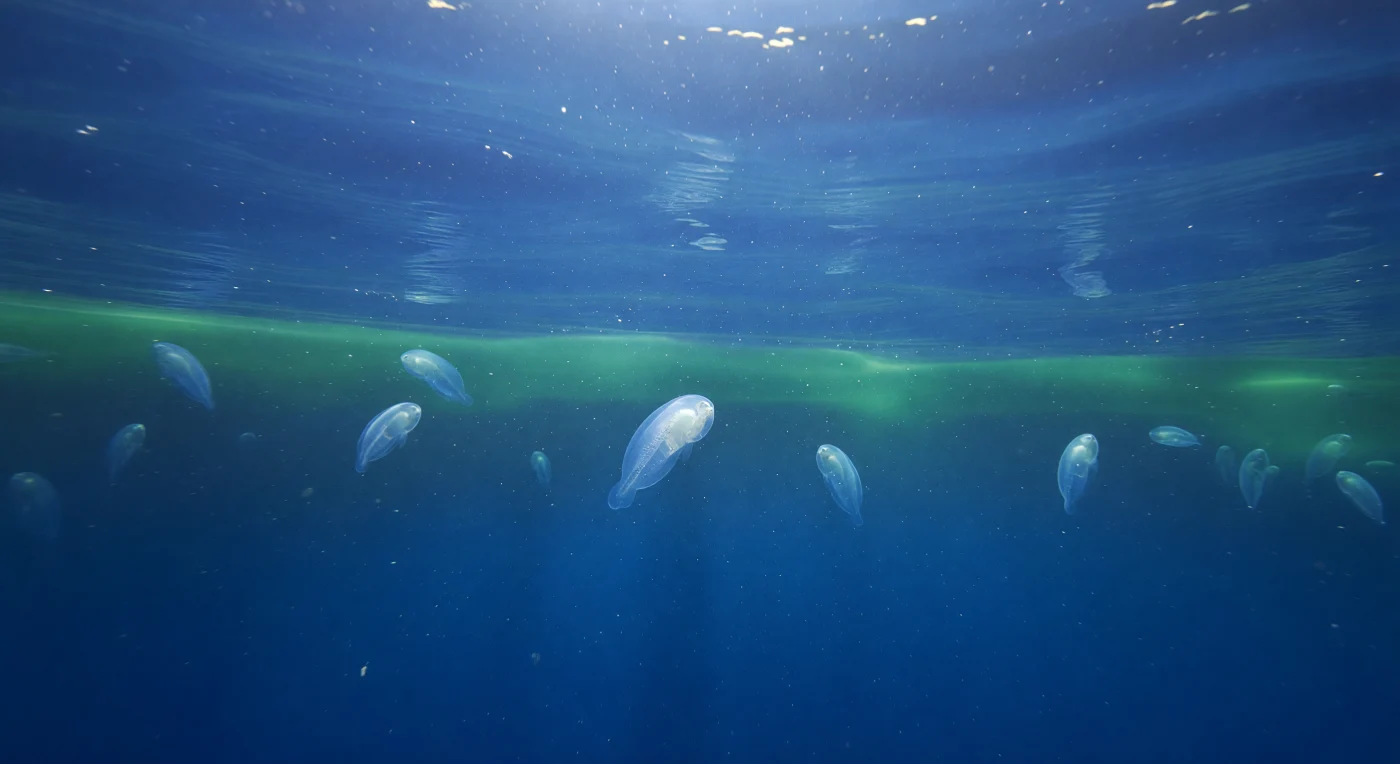
At roughly 120 to 150 meters depth in the open ocean, sunlight arrives as a pale, diffuse radiance — its reds and yellows long since absorbed — leaving only a cold sapphire glow that deepens to indigo below and still faintly illuminates the water column above. Here, at the base of the euphotic zone, phytoplankton gather in a phenomenon oceanographers call the deep chlorophyll maximum: a thin, horizontal band where microscopic photosynthetic cells — diatoms, coccolithophores, cyanobacteria — concentrate at the precise depth where remaining light and upward-diffusing nutrients briefly balance, forming a living emerald veil suspended in open water. Pressure here already exceeds eleven atmospheres, and the temperature has fallen through the thermocline into the quieter, colder water beneath, marking the boundary where the sun's biological influence essentially ends. Through this fragile green layer drift salps — solitary or colonial tunicate animals, barrel-shaped and wholly transparent, their circular muscle bands faintly visible through glass-clear tissue as they pulse slowly, filtering phytoplankton directly from the water with remarkable efficiency. Below the veil, the ocean grows darker and more immense, indifferent and self-contained, shaped entirely by physics, chemistry, and millions of years of biological negotiation with the fading light.
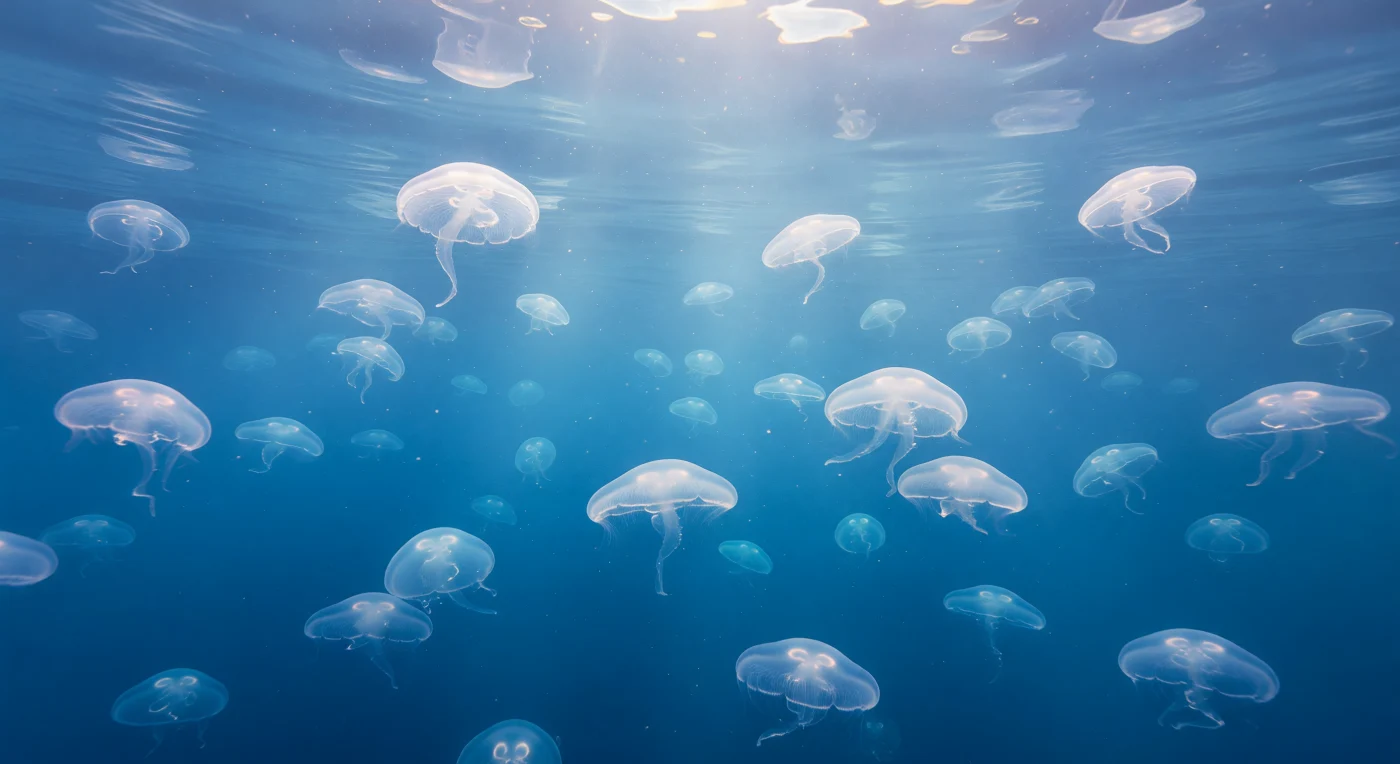
Beneath a mirror-bright surface that scatters sunlight into shifting veils of sapphire and turquoise, dozens of moon jellies — *Aurelia aurita* — pulse slowly through the upper water column, their translucent bells no thicker than wet silk, each one refracting the solar gradient into faint halos of milky white and pale violet. At these shallow depths, pressure barely exceeds a few atmospheres, oxygen is abundant, and the water teems with the microscopic phytoplankton and zooplankton that form the foundation of nearly all ocean life, drifting as invisible constellations through the luminous blue. The jellies are passive predators, trailing their fine oral arms and marginal tentacles through these particle-rich waters to capture copepods and fish larvae, their four-lobed gonads — rose-tinted rings at the bell's center — the only solid color in an otherwise ghostly anatomy. This is the epipelagic realm at its most serene: a living meadow sustained entirely by sunlight, shaped by gentle circular currents, and populated by creatures whose bodies are more than ninety percent water, evolved to exist in perfect suspension between surface and abyss. No seafloor anchors this world, no darkness defines it — only the endless blue column above and below, and the slow, rhythmic contraction of gelatinous bells that have pulsed through these waters for more than five hundred million years.