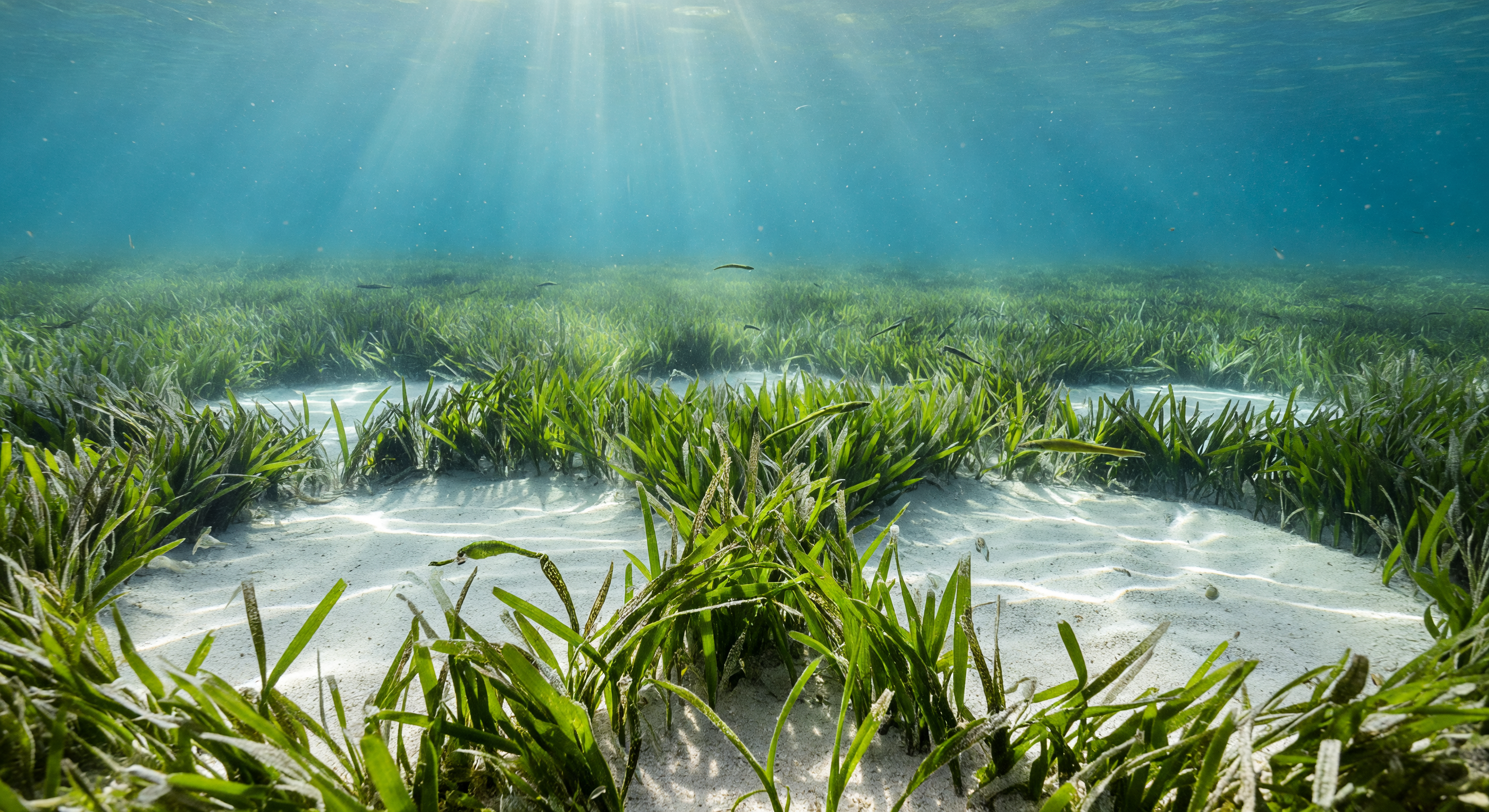
In the shallows where sunlight reaches the seafloor without attenuation, a broad plain of shoal-grass — most likely *Halodule wrightii* — extends across pale carbonate sediment, its narrow ribbon-like blades colonized by a thin film of epiphytic algae and diatoms that give each leaf a slightly roughened texture. The circular sand patches interrupting the meadow are characteristic of bioturbation and hydrodynamic scour, where gentle reversing currents prevent seagrass from establishing rhizome networks, leaving exposed windows of fine biogenic sand rippled by orbital wave motion. Within this mosaic, syngnathid pipefish — relatives of seahorses — hold station vertically among the blades using near-invisible pectoral fin oscillations, their cryptic coloration and elongated bodies rendering them almost indistinguishable from the surrounding vegetation as dappled caustic light plays across everything in shifting lattices. Transparent caridean shrimp, their organs faintly visible through glass-like carapaces, drift above the sand openings at depths where full solar irradiance still penetrates, the water column here exchanging gases freely with the atmosphere above and sustaining the net photosynthesis that makes seagrass meadows among the most biologically productive and carbon-sequestering habitats on the planet. This is a world of extraordinary clarity and continuous solar energy, operating entirely on its own terms, indifferent to any outside witness.
Sunlit surface waters