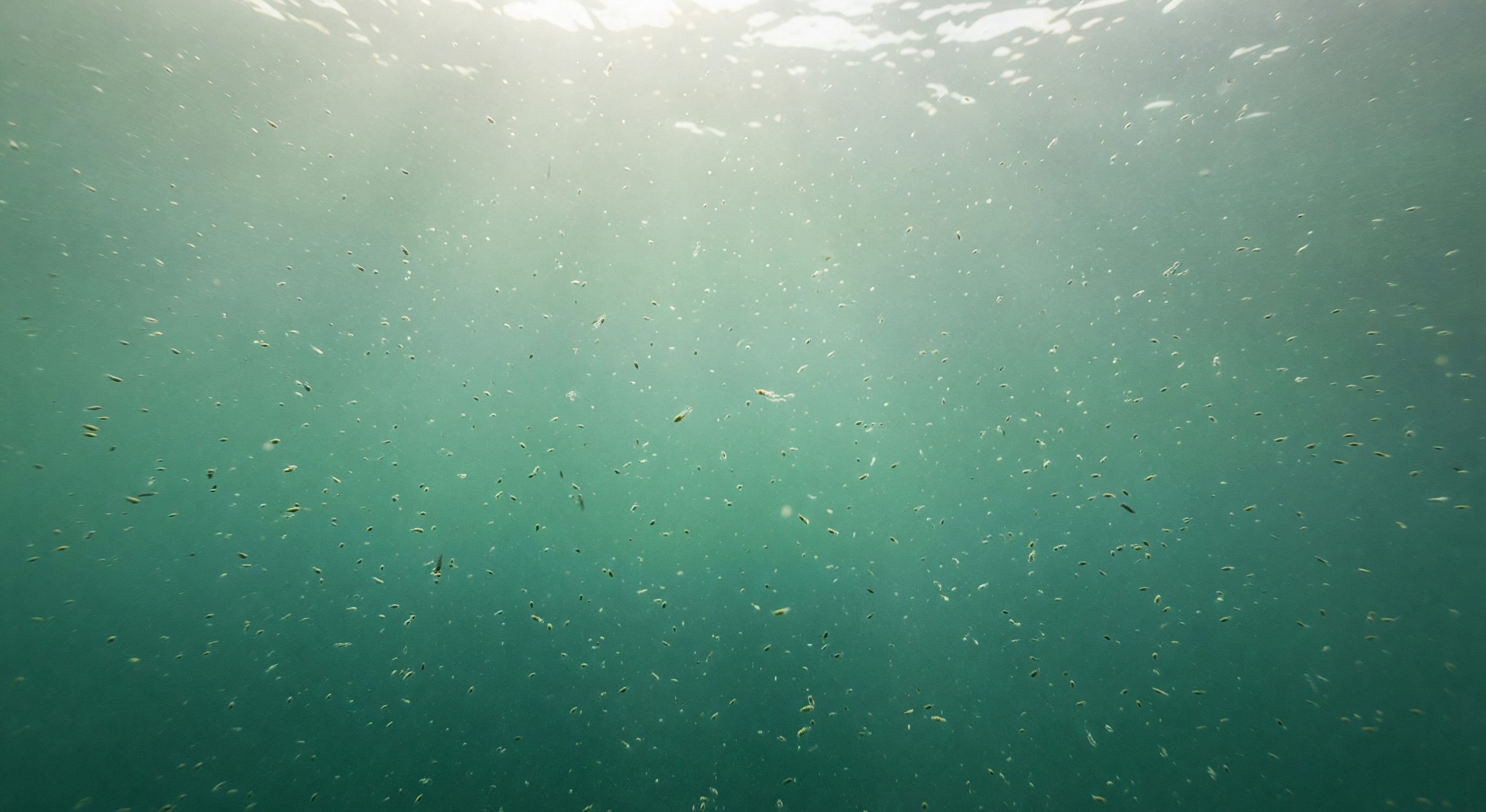
At the very surface of the sea, where ocean and atmosphere breathe together, a dense bloom of phytoplankton transforms sunlight into something diffuse and alive — the water itself becomes luminous, tinted jade and blue-green, as billions of microscopic algal cells scatter every photon passing through. This is the euphotic zone, the ocean's solar engine, where net photosynthesis drives one of Earth's great biogeochemical cycles: phytoplankton fix dissolved carbon dioxide, release oxygen, and form the base of a food web that cascades through countless trophic levels. Pressure here remains close to that of the atmosphere above — just a few atmospheres even at depth — and the water column churns gently with thermal mixing and wind-driven turbulence, suspending copepods, transparent nauplii larvae, organic aggregates, and drifting marine snow in a living particulate soup that filters and softens the light as it descends. In productive coastal seas like this, the euphotic layer compresses to as little as twenty or thirty meters before turbidity swallows the last usable photons, concentrating all photosynthetic activity into a bright, fertile, crowded upper stratum. This world of green water and drifting life exists in perpetual, unseen motion — a system older than any witness, sustaining the ocean from the very first centimeters below its surface.
Other languages
- Français: Floraison Verte Plancton
- Español: Florecimiento Verde Plancton
- Português: Florescimento Verde Plâncton
- Deutsch: Grüne Planktonblüte
- العربية: ازدهار العوالق الخضراء
- हिन्दी: हरित प्लवक प्रस्फुटन
- 日本語: 緑のプランクトン繁殖
- 한국어: 녹색 플랑크톤 번성
- Italiano: Fioritura Verde Plancton
- Nederlands: Groene Planktonbloei