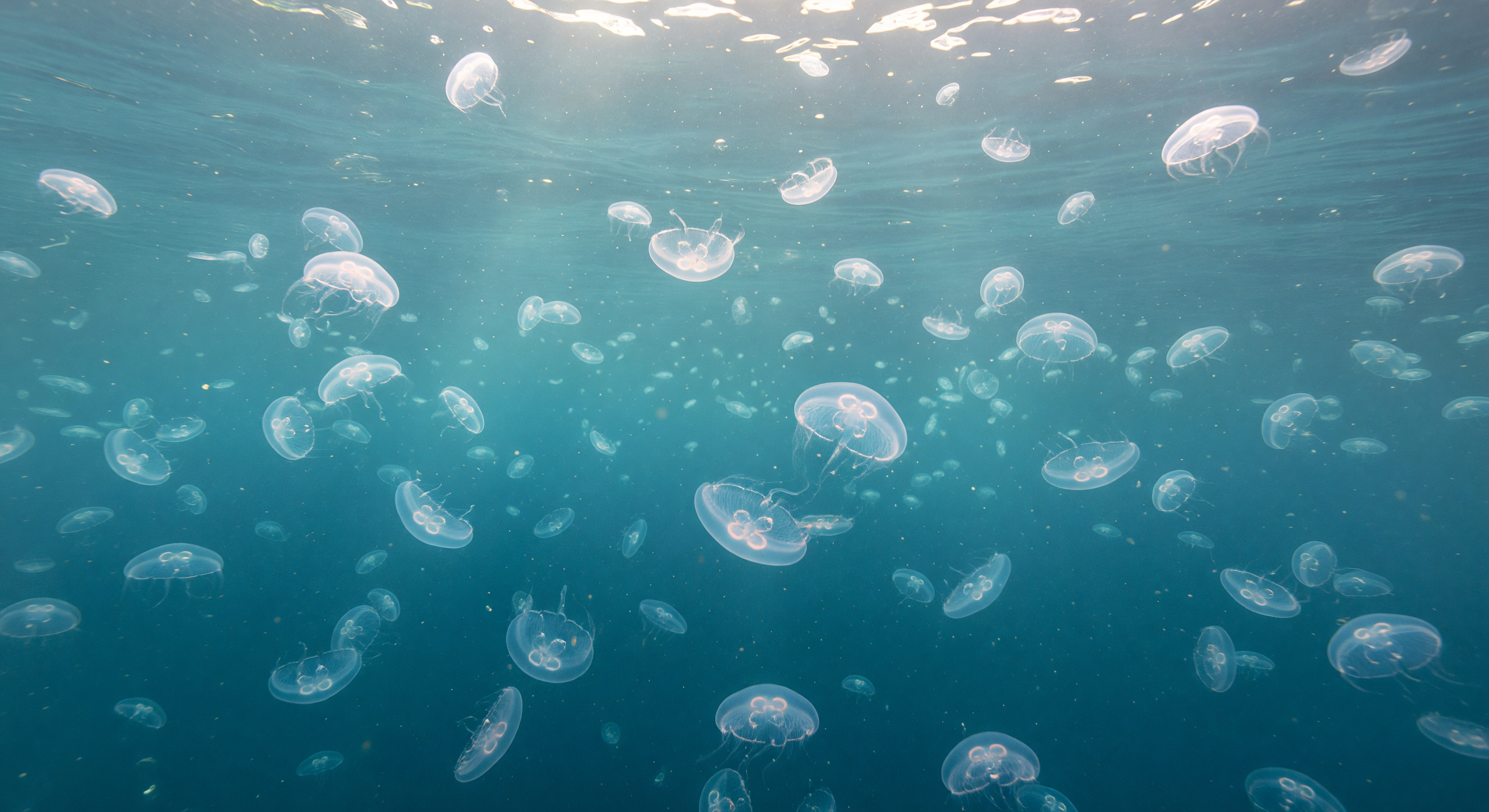
In the sunlit epipelagic, where pressure barely doubles from surface to depth and light still drives the engine of life, a bloom of ctenophores transforms the open water into a living chandelier of glass. These are not jellyfish but an ancient and wholly distinct phylum — Ctenophora — whose eight longitudinal rows of fused cilia, the combs that give them their name, scatter sunlight into fleeting spectral ribbons, a purely physical iridescence produced by diffraction rather than pigment or bioluminescence. Each body is composed of more than ninety-five percent seawater, virtually transparent, held together by a gelatinous mesoglea threaded with muscle and canal systems that pulse almost imperceptibly as the animals drift through water warmed by solar radiation and stirred by wind-driven mixing in the upper mixed layer. A bloom like this can arise within days when prey — copepods, fish larvae, other gelatinous plankton — reaches sufficient density, and a single square meter of productive sea may harbor hundreds of individuals, making ctenophores among the most numerically dominant predators in the world ocean despite their apparent fragility. Above, the surface ripples scatter sunlight into shifting caustic patterns that travel down through the water column, illuminating this quiet, weightless wilderness that has existed, utterly indifferent to observation, for hundreds of millions of years.
Other languages
- Français: Verre de Floraison Cténophore
- Español: Cristal de Floración Ctenófora
- Português: Vidro de Floração Ctenófora
- Deutsch: Rippenquallen Blüte Glas
- العربية: زجاج ازدهار المشطيات
- हिन्दी: कंघी जेली प्रस्फुटन काँच
- 日本語: クシクラゲ大発生の輝き
- 한국어: 빗해파리 번성 유리
- Italiano: Vetro di Fioritura Ctenofora
- Nederlands: Ribkwal Bloei Glas