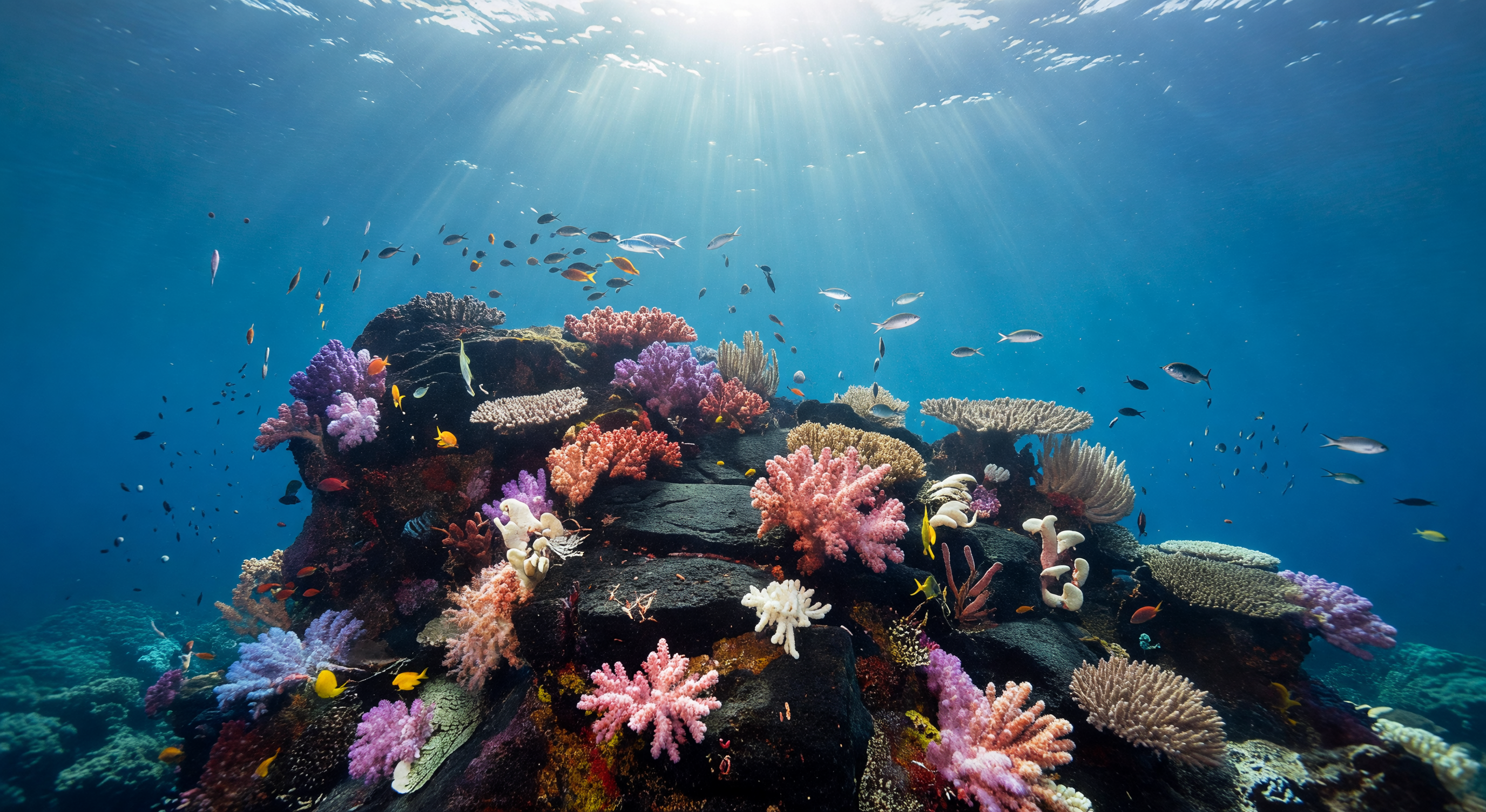
Where the volcanic pinnacle's flank rises into open water, broad shafts of sunlight descend from the surface in long, shifting columns, scattering across dark basalt and setting the water column alive with rippling caustics and the golden glint of suspended plankton. At twenty to thirty meters, pressure already reaches three to four atmospheres, yet this remains the ocean's most productive layer — the euphotic zone where solar energy drives photosynthesis and fuels the entire food web above and far below. Gorgonian fans and soft corals anchor themselves to every ledge and crevice along the upcurrent face, their polyps fully extended in the persistent flow, capturing zooplankton carried upward as the seamount deflects the passing current — a phenomenon known as topographic upwelling that concentrates nutrients and prey into a narrow, richly inhabited column of water. Above the reef structure, dense aggregations of anthias and chromis hold station facing the current, their scales catching brief solar flares, while deeper in the blue distance the pinnacle dissolves into open pelagic space, vast and unlit. Here the ocean exists entirely on its own terms — governed by light, flow, and the slow arithmetic of predator and prey — indifferent, continuous, and complete.
Other languages
- Français: Face du Courant Ascendant
- Español: Cara del Pináculo Corriente
- Português: Face do Pináculo Correnteza
- Deutsch: Strömungsseitige Pinnaclewand
- العربية: واجهة القمة المائية
- हिन्दी: शिखर धारा मुख
- 日本語: 海山の流れる岩面
- 한국어: 해산 조류 암벽
- Italiano: Parete del Pinnacolo Corrente
- Nederlands: Stroomopwaartse Pinnaclewand