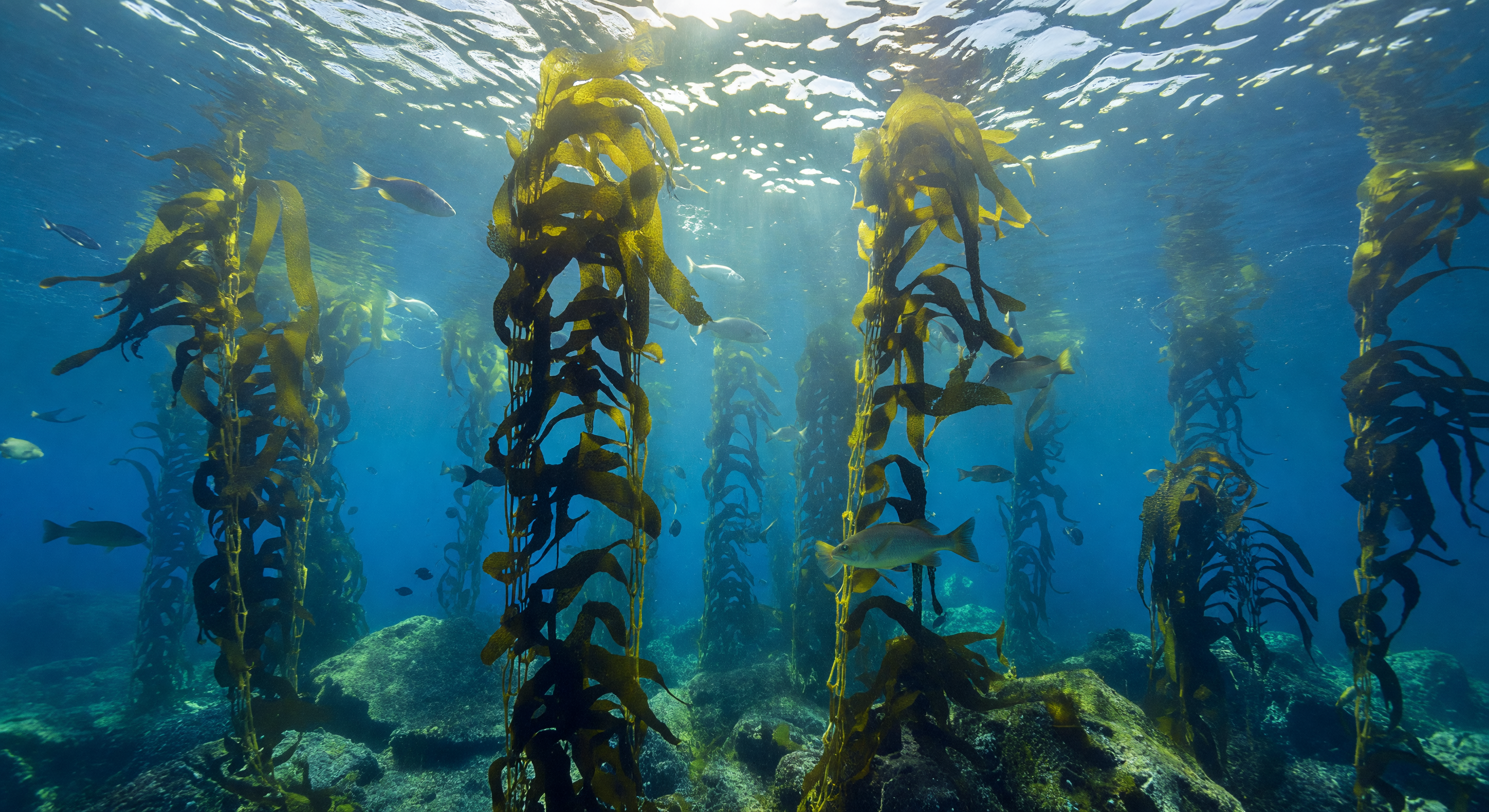
Sunlight here is not decoration but engine — it drives photosynthesis through every meter of the water column, sustaining a living architecture of giant kelp (*Macrocystis pyrifera*) whose stipes ascend twenty to thirty meters from anchoring holdfasts on the rocky substrate below, each one buoyed upward by gas-filled pneumatocysts that keep the fronds spread wide to harvest every available photon. The water itself is a working fluid: exchanging oxygen and carbon dioxide with the atmosphere above, suspending countless particles of phytoplankton, zooplankton, and marine snow that drift in slow gravitational fall, intercepting shafts of sunlight and scattering them into the blue-green luminosity that suffuses the entire column. Kelp bass (*Paralabrax clathratus*) move through the stipe corridors with the unhurried confidence of animals native to this structure, their scales catching caustic patterns refracted through the rippling surface a few body-lengths above; pressure here barely exceeds two atmospheres, and temperature, light, and dissolved gas are all close to atmospheric equilibrium. This forest produces its own microclimate — the dense canopy moderates surge, shades the understory, and sheds a continuous slow rain of organic detritus downward — making the kelp bed simultaneously a primary producer, a nursery, a hunting ground, and a conveyor belt of carbon toward darker water. It exists in perpetual, unremarkable abundance, indifferent to observation, exactly as it has for millions of years.
Other languages
- Français: Colonnes de la cathédrale d'algues
- Español: Columnas de catedral de kelp
- Português: Colunas da catedral de algas
- Deutsch: Kelp-Kathedralensäulen
- العربية: أعمدة كاتدرائية العشب البحري
- हिन्दी: केल्प कैथेड्रल स्तंभ
- 日本語: ケルプ大聖堂の柱
- 한국어: 켈프 대성당 기둥
- Italiano: Colonne della cattedrale di kelp
- Nederlands: Kelp kathedraal zuilen