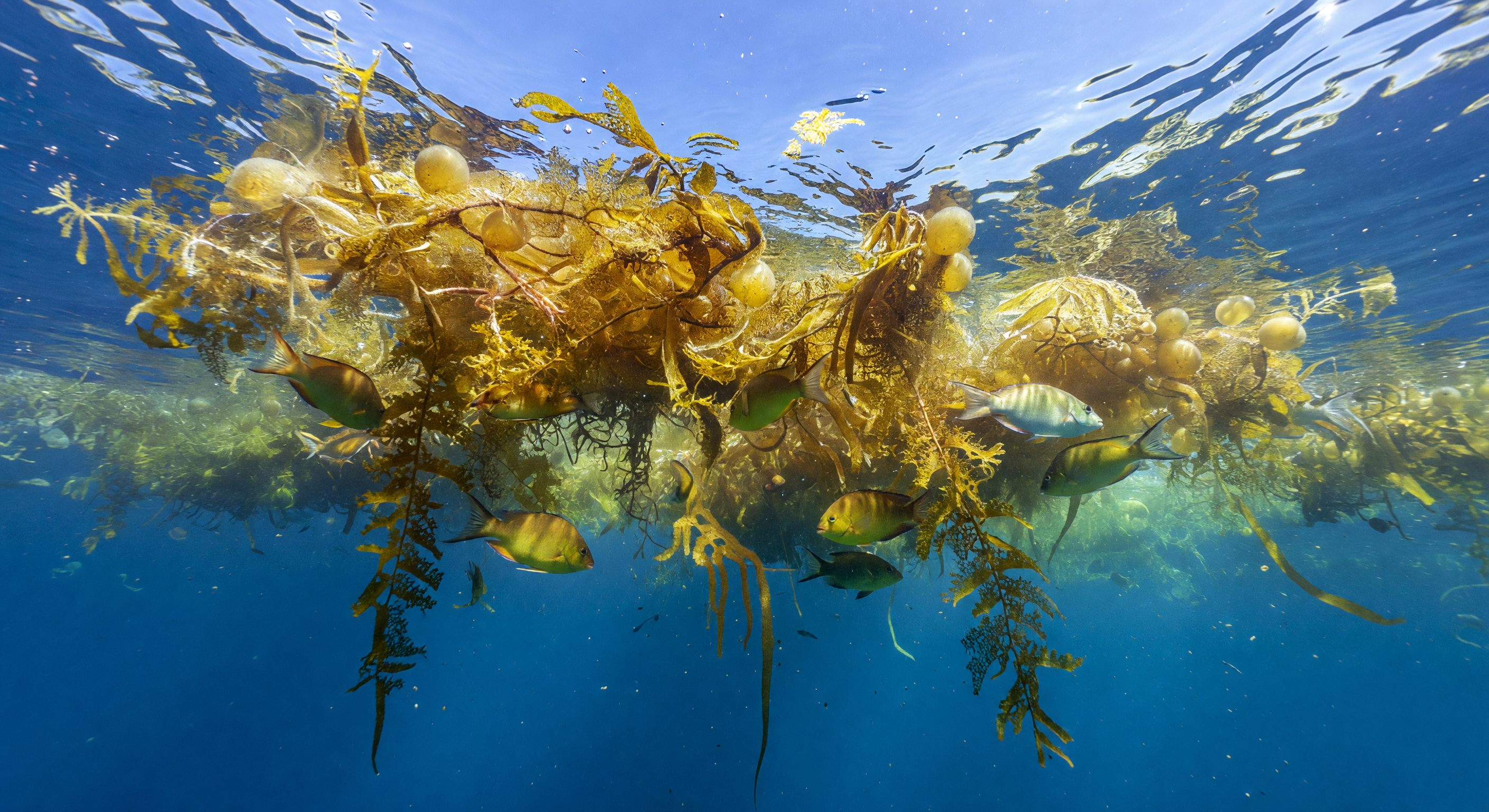
Beneath the drifting sargassum raft, natural sunlight fractures into shifting lacework — caustic patterns that ripple across amber fronds, rounded air bladders, and the open water column below, where the blue deepens from cobalt to a soft, velvety ultramarine. This is the epipelagic ocean at its most luminous: a layer of 0–200 metres where solar energy still penetrates with enough intensity to drive photosynthesis, warm the surface mixed layer, and sustain one of the most productive ecosystems on the planet. The sargassum itself is a floating biome, a pelagic habitat unanchored to any seafloor, carried by gyres and trade winds across thousands of kilometres of open Atlantic, its tangled fronds offering shade, structure, and concealment in an otherwise featureless expanse. Juvenile triggerfish and filefish — their bodies patterned in olive, honey, and translucent silver — hover among the hanging vegetation, finely camouflaged against predators rising from the blue depths below or scanning from above, exploiting a refuge that will drift with them through the first critical months of their lives. Fine particles of marine snow, plankton, and organic detritus drift slowly downward through the sunlit column, each fleck a node in the ocean's biological pump, carrying surface-fixed carbon toward the abyss in a process that quietly shapes the chemistry of the entire ocean.
Sunlit surface waters