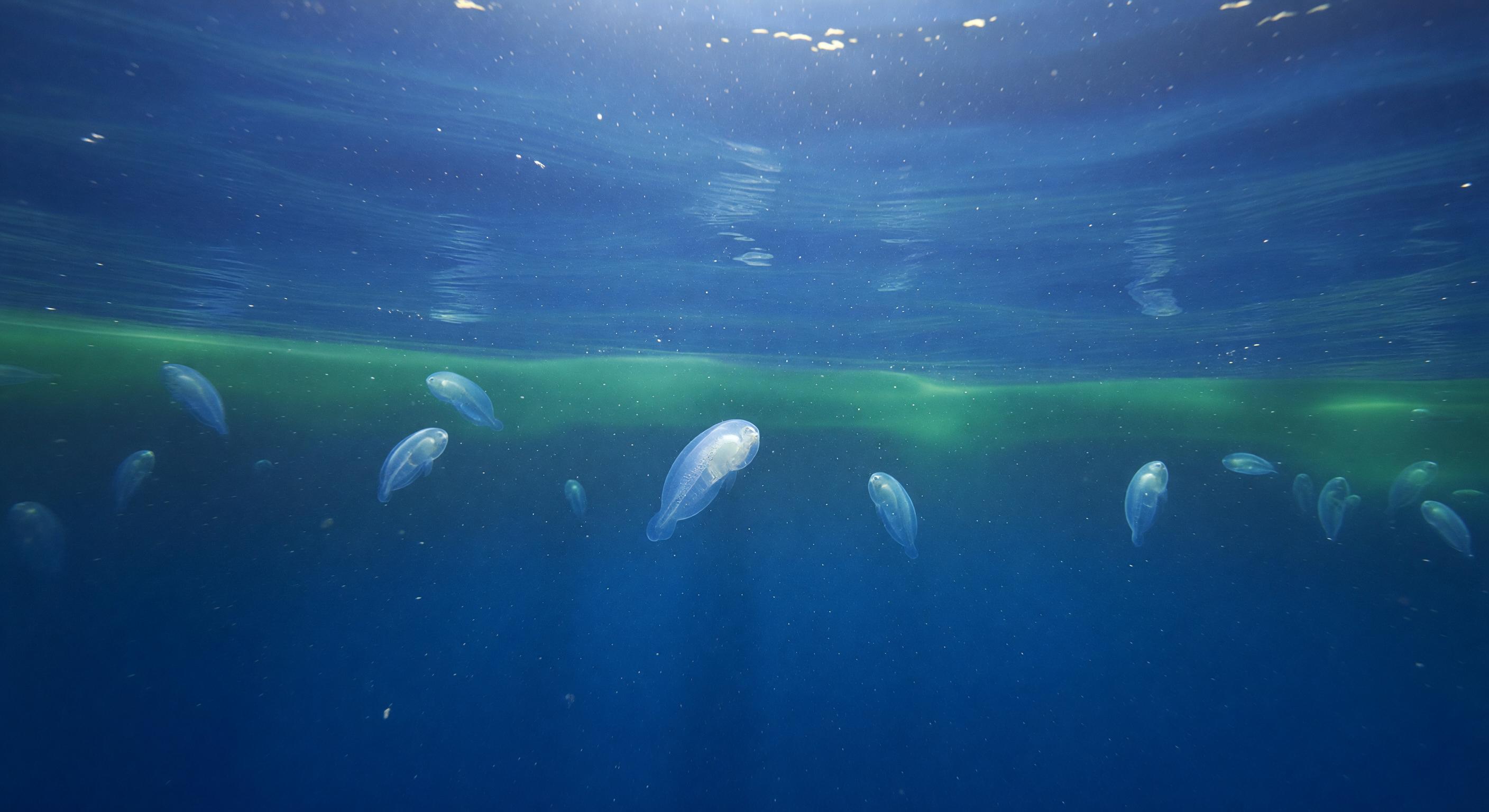
At roughly 120 to 150 meters depth in the open ocean, sunlight arrives as a pale, diffuse radiance — its reds and yellows long since absorbed — leaving only a cold sapphire glow that deepens to indigo below and still faintly illuminates the water column above. Here, at the base of the euphotic zone, phytoplankton gather in a phenomenon oceanographers call the deep chlorophyll maximum: a thin, horizontal band where microscopic photosynthetic cells — diatoms, coccolithophores, cyanobacteria — concentrate at the precise depth where remaining light and upward-diffusing nutrients briefly balance, forming a living emerald veil suspended in open water. Pressure here already exceeds eleven atmospheres, and the temperature has fallen through the thermocline into the quieter, colder water beneath, marking the boundary where the sun's biological influence essentially ends. Through this fragile green layer drift salps — solitary or colonial tunicate animals, barrel-shaped and wholly transparent, their circular muscle bands faintly visible through glass-clear tissue as they pulse slowly, filtering phytoplankton directly from the water with remarkable efficiency. Below the veil, the ocean grows darker and more immense, indifferent and self-contained, shaped entirely by physics, chemistry, and millions of years of biological negotiation with the fading light.
Other languages
- Français: Voile de Chlorophylle Maximum
- Español: Velo de Clorofila Máxima
- Português: Véu de Clorofila Máximo
- Deutsch: Chlorophyll-Maximum-Schleier
- العربية: حجاب الكلوروفيل الأقصى
- हिन्दी: क्लोरोफिल अधिकतम आवरण
- 日本語: クロロフィル極大の帳
- 한국어: 엽록소 최대층 베일
- Italiano: Velo di Clorofilla Massima
- Nederlands: Chlorofyl Maximum Sluier