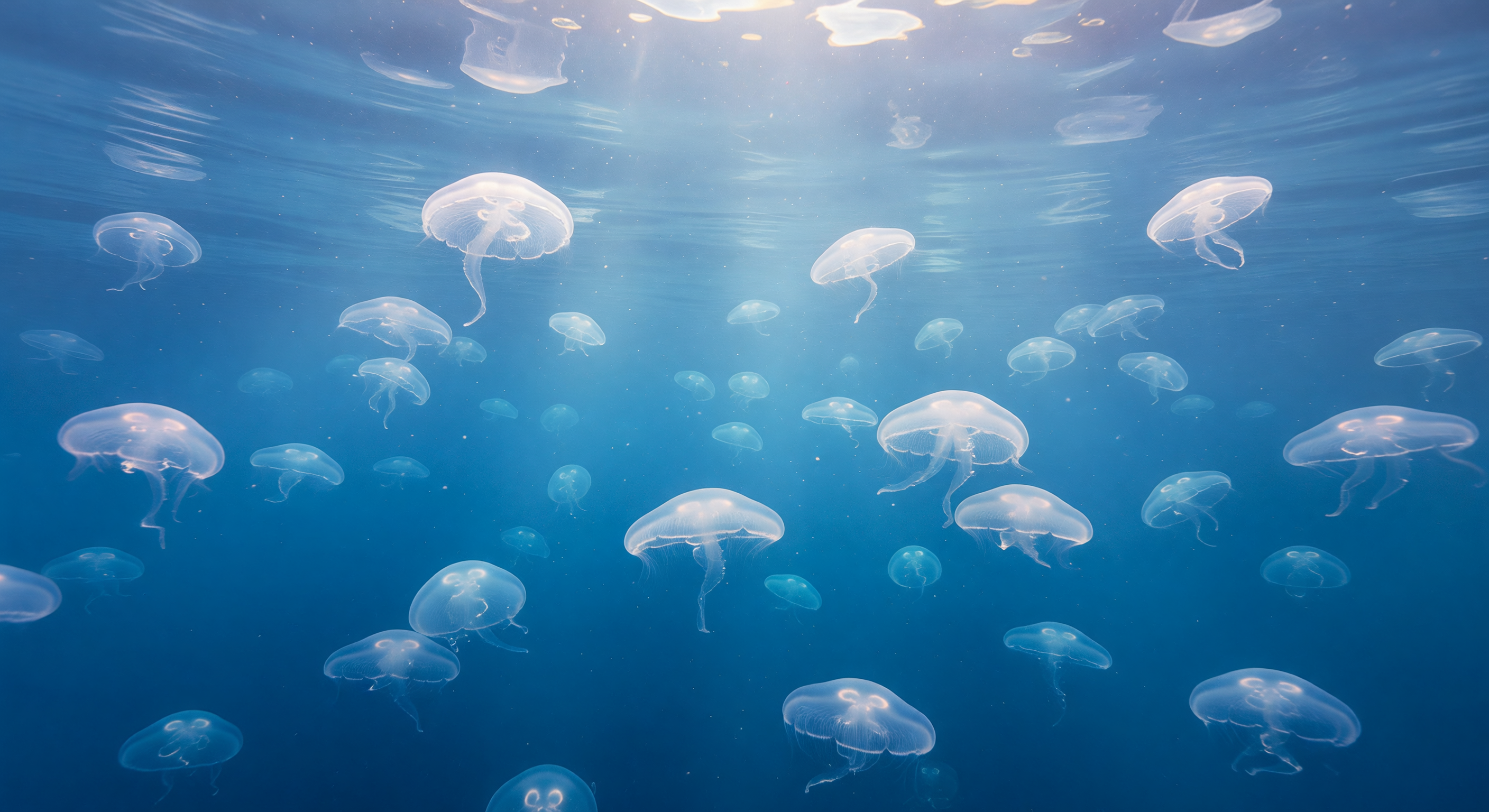
Beneath a mirror-bright surface that scatters sunlight into shifting veils of sapphire and turquoise, dozens of moon jellies — *Aurelia aurita* — pulse slowly through the upper water column, their translucent bells no thicker than wet silk, each one refracting the solar gradient into faint halos of milky white and pale violet. At these shallow depths, pressure barely exceeds a few atmospheres, oxygen is abundant, and the water teems with the microscopic phytoplankton and zooplankton that form the foundation of nearly all ocean life, drifting as invisible constellations through the luminous blue. The jellies are passive predators, trailing their fine oral arms and marginal tentacles through these particle-rich waters to capture copepods and fish larvae, their four-lobed gonads — rose-tinted rings at the bell's center — the only solid color in an otherwise ghostly anatomy. This is the epipelagic realm at its most serene: a living meadow sustained entirely by sunlight, shaped by gentle circular currents, and populated by creatures whose bodies are more than ninety percent water, evolved to exist in perfect suspension between surface and abyss. No seafloor anchors this world, no darkness defines it — only the endless blue column above and below, and the slow, rhythmic contraction of gelatinous bells that have pulsed through these waters for more than five hundred million years.
Sunlit surface waters